Muslim Law
Dr. Tanmoy Mukherji
[Advocate]
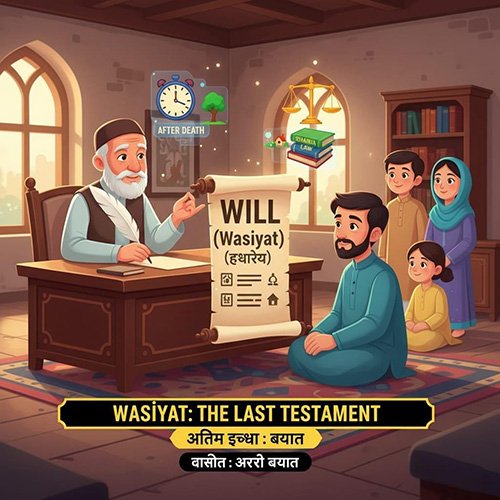
WILL (WASIYAT)-
Tanmoy Mukherji
[Advocate]
-Will is the Anglo-Mohammedan term for its Arabic equivalent wasiyat. Generally wasiyat means 'will' but it has also other meanings.
-A document embodying the will is called wasiyatnama.
Definitions-
A will is an instrument by which a person makes disposition of his property to take effect after his death, and which is in its own nature, ambulatory and revocable during his life.
Tyabji-
According to Tyabji, Will is "Conferment of right of property in a specific thing or in a profit or advantage or in a gratuity to take effect on the death of the testator".
Indian Succession Act, 1925-
According to section 2(h) of the Indian Succession Act, 1925, "Will is the legal declaration of the intention of a testator with respect to his property which he desires to be carried into effect after his death."
Hedaya-
According to Hedaya, will is the endowment with the property of anything after death.
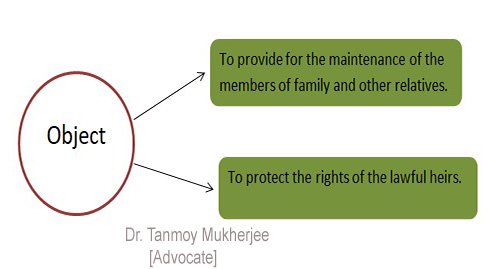
Object-
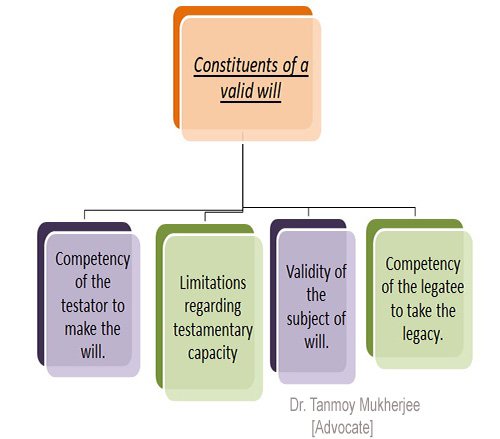
Constituents of a valid will-
Who is competent to make will-
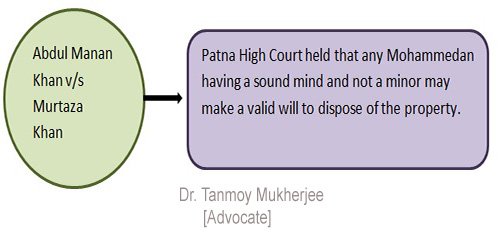
Every adult Muslim of sound mind can make a will.
Will of a Minor-
A minor is incompetent to make a will but when a will is made by a minor it may subsequently be validated by his ratification on attaining majority.
Who is a minor-
According to Muslim Law, the age of majority is 15 years and minority of a person terminates at that age.
-But this rule is not applicable to wills in India since the age of majority, in case of will is governed by the Indian Majority Act and not by personal law.
-According to the Indian Majority Act, 1875, the minority terminates at the age of 18 years.
Will of a person of unsound mind-
-A will made by a person of unsound mind cannot be deemed valid, if he becomes of sound mind subsequently.
-Conversely, a will made by a person of sound mind becomes invalid, if the testator subsequently becomes disable by unsoundness of mind.
Will of a person committing Suicide-
Under Sunni Law, the will of a person committing suicide is valid.
Under Shia Law, a will made by a person who has done any act towards the commission of suicide is not valid, but if the will is made before the doing of any act towards the commission of suicide, it is valid.
Reference Case-
Who is competent to take legacy -
Any person irrespective of sex, age, creed or religion, who is capable of holding property, may be the legatee under a will.
The assents of the legatee whether express or implied is required for the completion of the title to the subject of Bequest.
Validity of Certain Bequests-
|
1. Bequest to an institution-
|
A Bequest for the benefit of an institution or for religious or charitable object which is not opposed to Islam is valid.
|
|
2. Bequest to a non-Muslim-
|
A bequest in favor of a non-Muslim is valid.
|
|
3. Bequest to testator's murderer-
|
-According to Sunni law, a bequest to a person who has caused the death of the testator whether intentionally or unintentionally is invalid. -According to Shia Law, it is invalid if it is caused intentionally and not if accidentally or unintentionally.
|
|
4. Bequest to an unborn person-
|
-A child who is born within six months of the date of making the will is treated as a legatee in existence and is competent to take the legacy. - According to Shia Law, a bequest to a child in the womb is valid, even if it is born in the longest period of gestation, i.e., ten lunar months.
|
|
5. Bequest for a charitable object-
|
A bequest for the benefit of a religious or charitable object is valid.
|
Subject of a valid wil-
Requisites-
The requisites of a valid will are-
i) The property must be capable of being transferred;
ii) The property must be in existence at the time of testator's death. It is not necessary that it should be in existence at the time of the making of the will;
iii) The testator must be the owner of the property to be disposed by the will.
Validity of Certain Bequest-
|
1.Bequest in future → |
A bequest cannot be made of anything to be performed or produced in future.
|
|
2.Alternative bequest → |
An alternative bequest of property, i.e., to one or failing him to the other person is valid.
|
|
3.Contingent Bequest → |
Bequest of a property which is conditional to take effect on the happening or not happening of an uncertain event is Void.
|
|
4.Conditional bequest → |
A bequest with a condition which derogates from its completeness will take effect as if no condition was attached to it, i.e., the bequest will be valid while the condition will be void.
|
Limitations to the Testamentary power of a Muslim-
The testamentary capacity of a Muslim is not unlimited. There are two-fold restrictions on the power of a Muslim to dispose of his property by will.
Limitation regarding the persons-
Ghulam Mohammed v/s Ghulam Hussain-
It was held that a bequest in favour of an heir is not valid unless the other heirs consent to the bequest after the death of the testator.
Abdul Manan Khan v/s Murtaza Khan-
The Court held that a bequest in favor of an heir is invalid unless the other heirs consent to it after the death of the testator.
- According to Shia Law a testator may give a legacy to an heir without the consent of other heirs so long as it does not exceed one-third of his estate. But if the legacy exceeds one-third it is not valid unless the other heirs consent thereto.
Limitation regarding the property-
The general rule is that no Muslim can make a bequest of more than one-third of his net assets after payment of funeral charges and debts.
Illustration-
A, a Muslim, dies leaving behind him property of Rs. 4,000. His funeral charges are Rs. 100 and his debts Rs. 900. The rest money is Rs. 3,000 and 1/3 of it is Rs. 1,000. Thus 1/3, i.e., Rs. 1,000 may be the subject of will.
Exception-
There are two exceptions to the general rule-
1. Under Hanafi law, a bequest of more than one-third of the net assets may be valid, if the heirs, whose rights are infringed thereby, give their consent to the bequest after the death of the testator.
In Shia law such consent validates the will whether given before or after the testator's death.
2. The rule of bequeathable one-third will not apply to a case where the testator has no heir.
Revocation of will-
Under Mohammedan law a testator has unfettered right to revoke his will at any time.
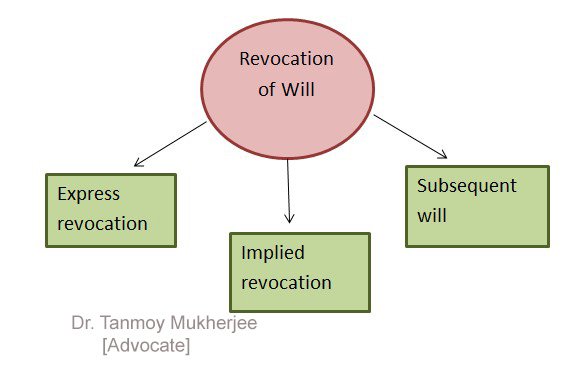
Express revocation-
An express revocation may be either written or oral.
Example-
A makes a testamentary disposition of land in favor of B. At any time after making the disposition, he says "the land that I gave to B is for x." These words will amount to express revocation of the bequest.
Implied revocation-
Revocation of bequest may be implied.
Example-
Where A bequeaths a land to B and subsequently builds a house over it, the bequest stands revoked.
Subsequent will-
Where a testator makes a will, and by a subsequent will gives the same property to someone else, the prior bequest is revoked.

we believe in a holistic approach to legal education building not just lawyers, but socially conscious leaders of tomorrow.