TRIPS Agreement
Dr. Tanmoy Mukherji
Advocate
TRIPS Agreement
Tanmoy Mukherji
[Advocate]
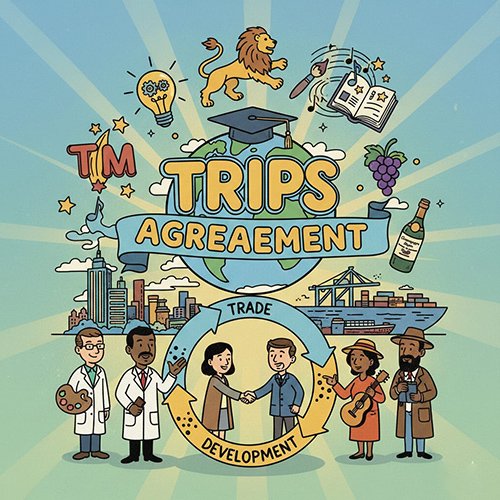
Before TRIPS, International Intellectual various Property Protection was governed by fragmented Treaties (Like the Paris convention, Berne Convention), which lack uniform enforcement mechanism. This caused:-
• Trade Distortions
• Dispute between Countries
• Inadequate Intellectual Property Protection in developing Countries.
To address these issues, TRIPS was introduced of GATT as part of the Uruguay Round, and it became a negotiations, mandatory Agreement for all WTO Members,
TRIPS →Trade Related Aspects of Intellectual Property Rights.
Came into effect 1st January, 1995
Administered by → World Trade Organization (WTO).
Objective (Article 7) -
(i) Create a Uniform standard of Intellectual Property Protection worldwide;
(ii) Promote innovation and technology transfers between Countries;
(iii) Ensure that Intellectual Property enforcement does not hinder trade;
(iv) Balance Intellectual Property Rights with public interest;
(v) Balance public health and development.
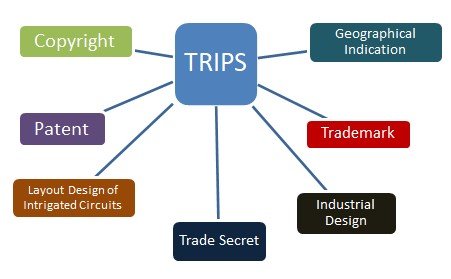
TRIPS sets minimum standards for protection in the following IP Areas-
|
IP Type
|
Coverage
|
Duration
|
|
Copyright
|
Literary, Artistic works, Software.
|
Life of author + 50 years
|
|
Trade mark
|
Logos, signs, names for goods/services.
|
7 years renewable indefinitely.
|
|
Geographical Indication
|
Goods links to region (e.g. Darjeeling Tea).
|
As long as conditions apply.
|
|
Industrial Design
|
Aesthetic aspect of products.
|
Minimum 10 years
|
|
Patent
|
Inventions, (products/process)
|
20 years from filling.
|
|
Layout Designs
|
Designs of Semi-conductor layouts |
10 years
|
|
Trade Secret
|
Undisclosed business information.
|
No fixed term, depends on secrecy
|
Principles-
No discrimination between domestic and foreign IP holders.
Any advantage to one country must be extended to all WTO members.
Sets a global baseline of IP Protection.
Flexibility of TRIPS -
|
Flexibility
|
Meaning
|
|
Compulsory licensing
|
Govt. allows use of Patents without owners consent in emergencies (e.g., health crisis).
|
|
Parallel importing
|
Importing a patented product sold cheaply in another country.
|
|
Exceptions to Patentability
|
Members may exclude inventions that harm public order, morality or health.
|
|
Bolar Provisions
|
Permits research on generics before patent expires.
|
TRIPS and India-
India had to amend several IP (Intellectual Property) laws to comply with TRIPS -
Patents Act, 1970 -
1999 - Introduced Mailbox Provision.
2002 - Extended term to 20 years.
2005 - Introduced Product Patent (e.g., Pharmaceuticals).
Copyright Act, 1957 -
Amended in 1999 and 2012.
Trademark Act, 1999.
Geographical Indication of Goods Act, 1999.
Designs Act, 2000.
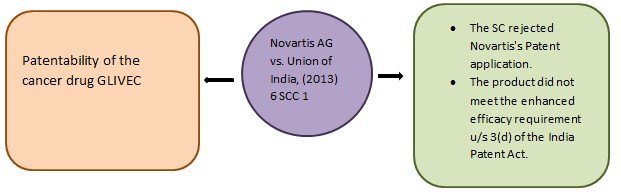
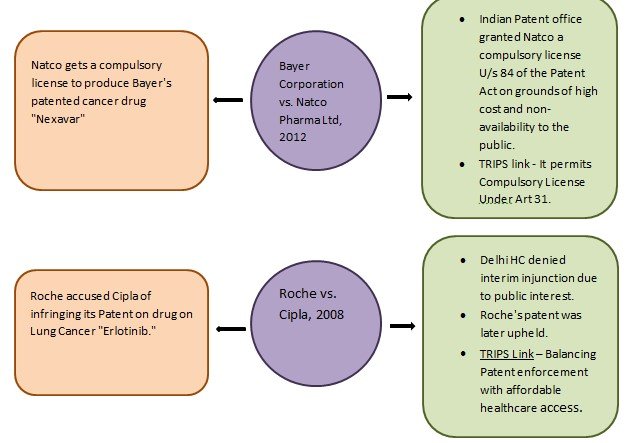
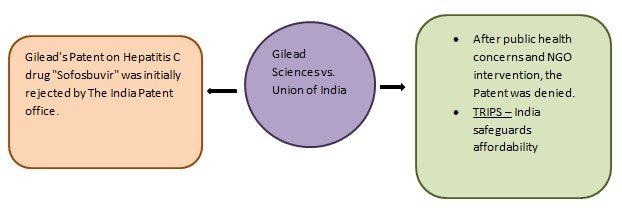
Reference Cases-

we believe in a holistic approach to legal education building not just lawyers, but socially conscious leaders of tomorrow.
