SHORT QUESTIONS ANSWER- LEGISLATIVE DRAFTING
Dr. Tanmoy Mukherji
Advocate
SHORT QUESTIONS ANSWER
LEGISLATIVE DRAFTING-
Tanmoy Mukherji
Advocate
1. Define Legislation
→Legislation is the process of making law by a competent authority such as Parliament or State Legislature. It is an important source of law in modern times. Legislation lays down general rules of conduct which are binding on all persons within its jurisdiction. Laws made through legislation are expressed in the form of Acts, statutes, rules, regulations, and orders. In India, legislative power is derived from the Constitution, and legislation must be in conformity with constitutional provisions.
2. Mention two advantages of Legislative Drafting
→Legislative drafting has several advantages.
Firstly, it ensures clarity and precision in law by expressing legislative intent in clear language.
Secondly, it reduces ambiguity and misinterpretation, thereby minimizing unnecessary litigation.
Proper drafting also ensures uniform application of law and helps courts in effective interpretation of statutes.
3.Use of Marginal Notes in Legislation
→Marginal notes are brief notes written on the margin of sections in a statute. They indicate the subject matter of the provision and help readers understand the scheme of the Act. Though marginal notes do not form part of the enactment, courts may use them as an aid to interpretation when the language of the section is ambiguous. They make legislation easier to read and comprehend.
4.Four Basic Techniques used in Legislative Drafting
→The basic techniques used in legislative drafting include:
Use of clear, simple, and precise language
Logical arrangement of sections and provisions
Avoidance of ambiguity, repetition, and unnecessary words
Consistency in terminology throughout the statute
These techniques help in making legislation effective and enforceable.
5.Preparatory Process in Legislative Drafting
→The preparatory process in legislative drafting refers to the preliminary steps taken before actual drafting begins. It includes understanding the legislative policy, studying existing laws, identifying defects in current law, and collecting necessary data. The draftsman also considers constitutional limitations and practical requirements. This process ensures that the final draft is clear, workable, and legally sound.
6.Define Order
→An Order is a form of delegated or subordinate legislation issued by an executive authority under powers conferred by a statute. Orders are generally made to implement, administer, or give effect to the provisions of an Act. They have binding legal force but must remain within the limits of the parent statute. An order cannot override or amend the Act under which it is made.
7.Meaning of ‘Bill’
→A Bill is a draft of a proposed law presented before the legislature for consideration and approval. It contains proposed legal provisions which, after debate and passing by the legislature and receiving assent, become an Act. A Bill represents the legislative intent and policy of the government. Until it becomes law, it has no legal force.
8.Significance of the Phrase “Any Other Sufficient Cause”
→The phrase “any other sufficient cause” is used in legislative drafting to provide flexibility and discretion. It allows authorities or courts to consider valid reasons not expressly mentioned in the statute. This phrase prevents rigidity and ensures justice in unforeseen situations. However, such discretion must be exercised reasonably and not arbitrarily.
9.Delegated Legislation
→Delegated legislation refers to laws made by an authority other than the legislature under powers delegated by a statute. Since the legislature cannot handle all details, it delegates rule-making power to the executive. Rules, regulations, orders, and by-laws are examples of delegated legislation. Such legislation must conform to the parent Act and the Constitution.
10.Significance of Schedule in a Legislation
→A Schedule is an appendix attached to a statute containing detailed provisions such as forms, tables, lists, or procedures. It forms an integral part of the Act and has the same legal force as the main sections. Schedules help in avoiding overcrowding of sections and make the Act systematic and easy to understand.
11.Define Proviso
→A proviso is a clause added to a section to qualify, restrict, or create an exception to the general rule laid down in that section. Its purpose is to limit the operation of the main provision in certain cases. A proviso cannot enlarge the scope of the section. It is generally interpreted strictly by courts.
12.Punctuations in a Legislation
→Punctuation refers to the use of symbols such as commas, semicolons, and full stops in legislative drafting. Proper punctuation helps in clarifying meaning and avoiding ambiguity in statutory provisions. Though punctuation is not decisive, courts may consider it as an aid to interpretation when the language of the statute is unclear.
13.Principles of Legislation
→The principles of legislation are the fundamental guidelines that govern the making of laws by the legislature. These principles ensure that legislation is rational, just, and effective. A good legislation must be clear, precise, certain, reasonable, and consistent with constitutional provisions. It should promote public welfare and uphold the rule of law. Legislation should also be practical, enforceable, and free from arbitrariness. These principles help in preventing misuse of legislative power and ensure fairness, equality, and justice in society.
14.Importance of Legislative Drafting
→Legislative drafting is of great importance because it translates legislative intent and policy into legally enforceable language. Proper drafting ensures clarity and avoids ambiguity in statutes. It helps courts in interpretation and ensures uniform application of law. Good drafting reduces unnecessary litigation and administrative difficulties. Poor drafting may defeat the very purpose of legislation and lead to injustice. Thus, effective legislative drafting is essential for a sound legal system.
15.Meaning of ‘Order’ under Legislative Drafting
→An Order is a form of delegated or subordinate legislation issued by an authority empowered under a statute. It is generally used to implement or give effect to the provisions of an Act. Orders have binding legal force but must remain within the limits of the parent statute. They cannot override or amend the main Act. Orders are commonly issued by the executive to regulate procedures, administration, or enforcement of law.
16.Words which should not be used in Legislative Drafting?
→In legislative drafting, words that are vague, ambiguous, emotional, or colloquial should be avoided. Expressions having uncertain meaning such as “reasonable”, “as soon as possible”, or “adequate” should not be used unless clearly defined. Slang, ornamental language, and unnecessary technical jargon must also be avoided. The language should be simple, precise, and unambiguous so that the law can be easily understood and enforced.
17.Responsibilities of a Legislative Draftsman
→A legislative draftsman plays a crucial role in law-making. His primary responsibility is to convert policy decisions into clear and precise legal provisions. He must ensure consistency with the Constitution and existing laws. The draftsman should avoid ambiguity, repetition, and contradictions. He must ensure that the law is workable, enforceable, and easy to interpret. Accuracy, clarity, and simplicity are essential duties of a draftsman.
18.Steps in Legislative Drafting
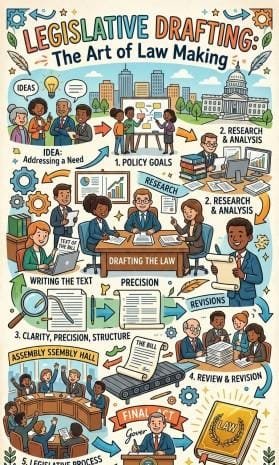
→Legislative drafting involves several steps. First, the draftsman must understand the legislative policy and objectives. Second, relevant existing laws are studied. Third, the structure and scheme of the Bill are prepared. Fourth, provisions are drafted using clear and precise language. Fifth, the draft is revised to remove errors, ambiguity, and inconsistencies. Finally, the draft is scrutinised before introduction in the legislature.
19.Schedule
→A Schedule is a part of a statute attached at the end, containing details such as forms, tables, lists, or procedures. It forms an integral part of the Act and has the same legal effect as the main sections. Schedules help in avoiding unnecessary length and complexity in the main body of the Act. They make the legislation more systematic and readable.
20.Non-Obstante Clause
→A non-obstante clause is a legislative device used to give overriding effect to a particular provision. It is generally introduced by the words “Notwithstanding anything contained in…”. The purpose of this clause is to ensure that the provision prevails over conflicting laws or provisions. Courts interpret such clauses strictly and limit their application to the extent clearly intended by the legislature.
21.Legislative Process
→The legislative process is the procedure by which a Bill becomes law. It begins with drafting and introduction of a Bill in the legislature. This is followed by readings, debates, and committee scrutiny. After discussion and voting, the Bill is passed by the legislature. It is then sent for the assent of the President or Governor. Upon receiving assent, the Bill becomes an Act.
22.Scrutiny of Legislative Drafting
→Legislative drafting is scrutinised to ensure legal validity and effectiveness. Scrutiny is done by legal experts, drafting committees, and law departments. It checks constitutional compliance, clarity, consistency, and absence of ambiguity. Courts also scrutinise drafting during interpretation of statutes. Scrutiny helps in improving the quality of legislation and preventing future disputes.
23.Marginal Notes
→Marginal notes are short descriptions written on the margin of sections in a statute. They indicate the subject matter of the provision and help readers understand the scheme of the Act. Although marginal notes are not a part of the statute, courts may use them as an aid to interpretation when the language of the section is ambiguous.
24.Syntax
→Syntax refers to the grammatical structure and arrangement of words and sentences in legislative drafting. Proper syntax ensures clarity, logical flow, and correct meaning of legal provisions. Faulty syntax may lead to confusion and misinterpretation of law. Therefore, careful construction of sentences is essential to achieve precision and certainty in legislation.
25.What is Legislation?
→Legislation is the process of making law by a competent authority such as Parliament or State Legislature. It is an important source of law in modern legal systems. Legislation lays down general rules of conduct which are binding on the people. Laws made through legislation are expressed in the form of Acts, statutes, rules, regulations, and orders. It reflects the will of the State and is enforceable by courts. In India, legislative power is derived from the Constitution and exercised by Parliament and State Legislatures within their respective jurisdictions.
26.What is Legislative Drafting?
→Legislative drafting is the art and science of preparing legal texts of statutes in clear, precise, and unambiguous language. It involves translating legislative policy and intent into legal provisions that can be effectively implemented and interpreted by courts. A legislative draftsman must ensure clarity, simplicity, consistency, and certainty in the language used. Good legislative drafting avoids vagueness and confusion and ensures that the law achieves its intended purpose without unnecessary litigation.
27.Importance of Legislative Drafting
→Legislative drafting plays a crucial role in the effective functioning of the legal system. Proper drafting ensures that laws are clear, precise, and easily understandable by the public and authorities. Poor drafting may lead to ambiguity, misinterpretation, and misuse of law. Clear drafting reduces litigation and helps courts in proper interpretation. It also ensures uniform application of law and helps in achieving legislative objectives efficiently.
28.Meaning of Heading
→A heading is a descriptive title placed above a section or group of sections in a statute. It indicates the subject matter covered under that particular provision. Headings help in understanding the scheme and structure of an Act and guide the reader in interpretation. Though headings do not control the clear meaning of the section, they can be used as an aid to interpretation when ambiguity exists.
29.Proviso – Definition and Purpose
→A proviso is a clause added to a section to qualify, limit, or create an exception to the general rule stated in that section. The main purpose of a proviso is to carve out special cases or conditions from the main provision. A proviso cannot expand the scope of the main section but only restricts or explains it. Courts generally interpret provisos strictly in relation to the main provision.
30. Supreme Legislation
→Supreme legislation refers to laws made by the sovereign authority of the State, such as Parliament. It derives its authority directly from the Constitution and is superior to all other forms of legislation. In India, Acts passed by Parliament are supreme, subject only to constitutional limitations. Delegated or subordinate legislation must conform to supreme legislation and cannot override it.
31.Punctuation in Legislative Drafting
→Punctuation refers to the use of symbols such as commas, semicolons, and full stops in legislative drafting. Proper punctuation helps in clarifying meaning and avoiding ambiguity in statutory provisions. Although punctuation is a minor element, it plays an important role in interpretation when the meaning of a provision is doubtful. Courts may consider punctuation as an aid but not as a decisive factor.
32.Legal Drafting
→Legal drafting is the skill of preparing legal documents such as contracts, pleadings, deeds, notices, and affidavits in precise and formal language. The objective of legal drafting is to clearly express rights, duties, and obligations of parties. It requires knowledge of law, logical arrangement, and use of appropriate legal terminology. Good legal drafting prevents disputes and ensures enforceability of documents.
33.Legislative Process
→The legislative process is the procedure through which a Bill becomes a law. It begins with the introduction of a Bill in the legislature, followed by readings, debate, and voting. After being passed by both Houses, the Bill is sent for the assent of the President or Governor. Upon assent, it becomes an Act and comes into force as per its provisions.
34. Preamble
→The preamble is the introductory part of a statute which explains the object, purpose, and reasons for enacting the law. It reflects the intention of the legislature and helps in understanding the spirit of the Act. Although it is not enforceable, courts use the preamble as an aid in interpretation when the language of the statute is ambiguous.
35.Title of an Act
→The title of an Act gives its official name and identity. The long title explains the purpose and scope of the Act, while the short title provides a convenient reference. The title helps in understanding the subject matter of the legislation and is useful for interpretation in case of doubt.
36.Words to be Avoided in Legislative Drafting
→In legislative drafting, vague, ambiguous, emotional, and colloquial words should be avoided. Unnecessary technical jargon without proper definition should not be used. The language must be simple, precise, and certain so that the law can be easily understood and uniformly applied.

we believe in a holistic approach to legal education building not just lawyers, but socially conscious leaders of tomorrow.
