Section 9, BSA 2023 - - When Facts Not Otherwise Relevant Become Relevant
TANMOY MUKHERJI INSTITUTE OF JURIDICAL SCIENCE
Dr. Tanmoy Mukherji
Advocate
Section 9, BSA 2023 - - When Facts Not Otherwise Relevant Become Relevant-
Tanmoy Mukherji
Advocate
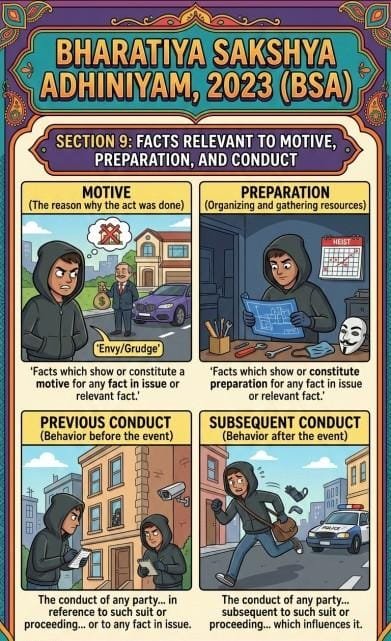
Section 11, Indian Evidence Act– When Facts Not Otherwise Relevant Become Relevant
Facts that are not otherwise relevant become relevant if:
→They are inconsistent with any fact in issue or a relevant fact; or
→By themselves, or in connection with other facts, they make the existence or non-existence of a fact in issue or relevant fact highly probable or highly improbable.
Section 11, IEA, expands what evidence can be admitted in a trial beyond the strictly “in issue” or otherwise relevant facts under Sections 5–10,IEA.
→It allows the court to consider facts that contradict a party’s claim or make a fact more probable/improbable, even if those facts are normally irrelevant.
→The aim is to ensure truth and justice, by letting in evidence that significantly affects the probability of core issues.
Principles-
1. Inconsistency with Facts in Issue
Any fact that directly contradicts or undermines an asserted fact in issue or a relevant fact becomes admissible.
Example: In a murder charge, evidence that the accused was in another city at the time of the crime contradicts the prosecution’s claim that he was at the scene.
2. Probability & Improbability
A fact that helps show a fact in issue is highly probable or highly improbable is admissible.
Example: Evidence that the accused was far from the crime scene at the relevant time makes it highly improbable that they committed the offen
Major Applications-
Alibi
→The most frequent application of Section 11 is the plea of alibi, where the accused claims to have been elsewhere when the crime was committed.
→Alibi isn’t an exception under the Penal Code; it is treated as a rule of evidence under Section 11 — a fact inconsistent with the charge.
Judicial Interpretations & Case Law-
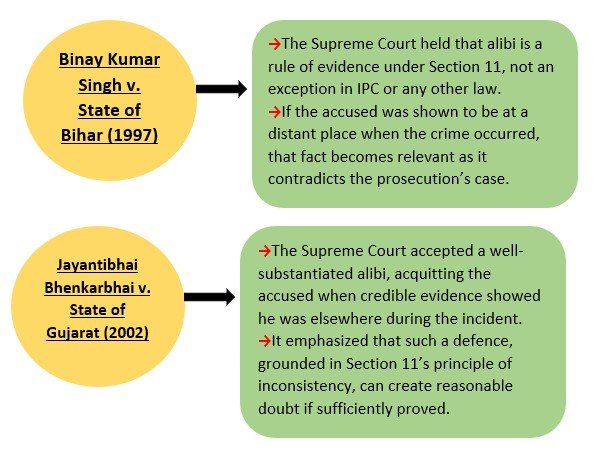
Burden of Proof in Alibi
→While Section 11 makes the alibi relevant, the burden to prove an alibi lies on the accused under Section 103 of the Evidence Act.
→The accused must present credible evidence to support the alibi; mere assertions without proof won’t succeed.
High Court Orders on Alibi Evidence-
High courts often reiterate that alibi is a rule of evidence under Section 11, and courts must weigh its credibility in context with other evidence presented.
Other Types of Facts Relevant Under Section 11, IEA
Apart from alibi, the courts have held that the following may also be relevant if they make a fact in issue/probability more or less likely:
→Non-access of a husband to show child’s illegitimacy – if the husband had no access during the conception period, the fact becomes relevant.
→Survival of an alleged deceased – if evidence shows a person was alive after the alleged date of murder, it contradicts the prosecution’s claim.
→Crime by a third person – evidence that a third person committed the offence makes the accused’s involvement highly improbable.
→Suicide - if evidence shows that the deceased committed suicide, the fact becomes relevant.

we believe in a holistic approach to legal education building not just lawyers, but socially conscious leaders of tomorrow.
