SALE: MEANING, DEFINITION AND ELEMENTS
Transfer of Property Act,1882
TANMOY MUKHERJI INSTITUTE OF JURIDICAL SCIENCE
Dr. Tanmoy Mukherji
[Advocate]
SALE: MEANING, DEFINITION AND ELEMENTS-
Tanmoy Mukherji
[Advocate]
Meaning-
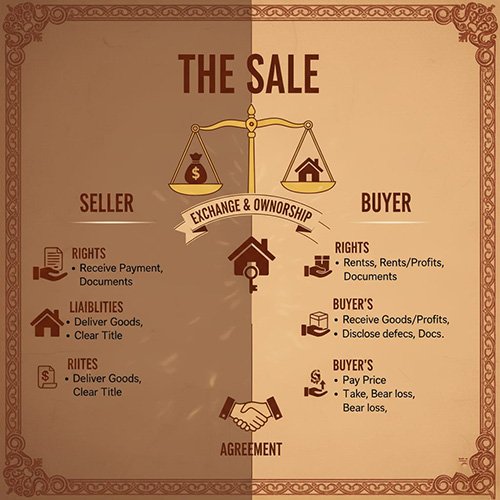
-The word 'Sale' literally means "voluntary transfer of property from one person to another for a price."
-Sale is a transfer of absolute interest in property, movable or immovable property from one person to another in consideration for price, paid or promised; or partly paid and partly promised. Sale under Section 54 of the T.P.Act refers to sale of immovable property only.
-Section 54 of the T.P.Act, 1882 defines - "Sale is a transfer of ownership in exchange for a price paid or promised or part paid and part promised".
It runs as follows-
Sale how made-
- Such transfer, in the case of tangible immovable property of the value of one hundred rupees and upwards, or in the case of a reversion or other intangible thing, can be made only by a registered instrument.
-In the case of tangible immovable property of a value less than one hundred rupees, such transfer may be made either by a registered instrument or by delivery of the property.
-Delivery of tangible immovable property takes place when the seller places the buyer or such person as he directs, in possession of the property.
Contract for-sale-
-A contract for the sale of immovable property is a contract that a sale of such property shall take place on terms settled between the parties.
-It does not, of itself, create any interest in or charge on such property.
-In sale, the person who conveys the property for a price or consideration is known as the seller or vendor and the person, who acquires it, is known as the buyer or purchaser. In other words, the person transferring (transferor) the property is called 'Seller' or 'Vendor' and the person to whom it is transferred (transferee) is called 'Buyer' or 'Purchaser'. The contract between the Seller and Buyer is called 'Contract of Sale'.
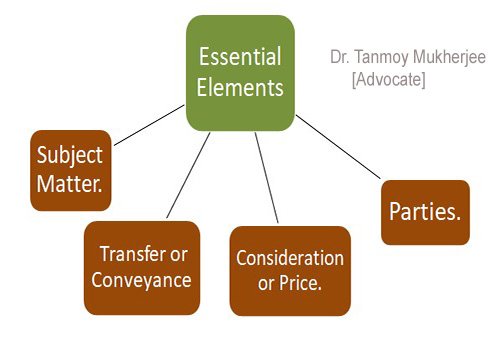
Essential Elements-
To constitute sale, the following conditions are to be satisfied-
1. Parties-
-In a contract of Sale, there are two parties namely - Seller/Vendor and Buyer/Purchaser.
-Both the Seller and Buyer must be competent to contract under Section 11 of the Indian Contract Act, 1872. (Major, sound mind and not disqualified by the law in force). The Seller must be competent to transfer i.e. either he must have title or authority over the property to transfer (Section 7, T.P.Act). The buyer must be competent to be a transferee and should not be disqualified to be a transferee (Section - 6). A person is a judge, a legal practitioner or an officer connected with a court of law is forbidden from purchasing an actionable claim under Section 136 of the T.P.Act. Similarly, Order 21, Rule 73 prohibits any officer or person having any duty to perform in connection with any sale from acquiring an interest in the sale property. A minor is not incompetent to become a buyer. A sale of property in favor of a minor is valid.
2. Subject Matter-
The subject matter must be a transferable immovable property (Section 7). It may be tangible (E.g.: Land, buildings, etc.) or intangible such as right of ferries, fisheries, a mortgage debt, a patta right etc.
3. Transfer or Conveyance-
There must exist transfer or conveyance of ownership i.e. transportation of absolute interest in the property by the seller in favor of the purchaser in a manner prescribed by law. The transfer must be in exchange for a price. The price may be paid or promised, or partly paid or partly promised.
4. Consideration or Price-
The transfer of ownership in exchange for a price is the essence of a sale. The word price is used in its ordinary sense as money only.
Mode of Sale-
According to Section 54, there are two modes of Transfer for sale as follows:
(i) By Registered Instrument; and
(ii) By Delivery of Possession.
-Whether it is a tangible immovable property or intangible immovable property, if the value is Rs.100 or above, the transfer must be effected through a registered instrument.
- If the value is below Rs.100/- the transfer may be effected either by registered instrument or by delivery of possession of property.
CONTRACT FOR SALE OR AGREEMENT TO SELL-
Contract for Sale (Section 54)-
A contract for the sale of immovable property is a contract that the sale of such property shall take place on the terms settled between the parties. It does not, of itself, create any interest in or charge on such property.
Essentials of. Contract for Sale-
To constitute contract for sale the following conditions are to be satisfied:
(i) There is an agreement between the parties.
(ii) The agreement as to future sale.
(iii) It does not create any interest in the property.
(iv) It does not create any charge on the property.
(v) There must be a consideration in the form of price to be paid.
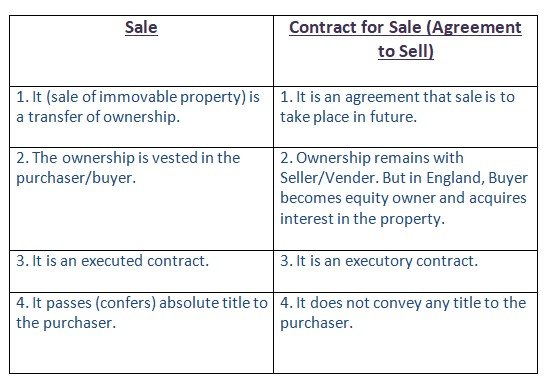
Distinction between Sale and Agreement for Sale-
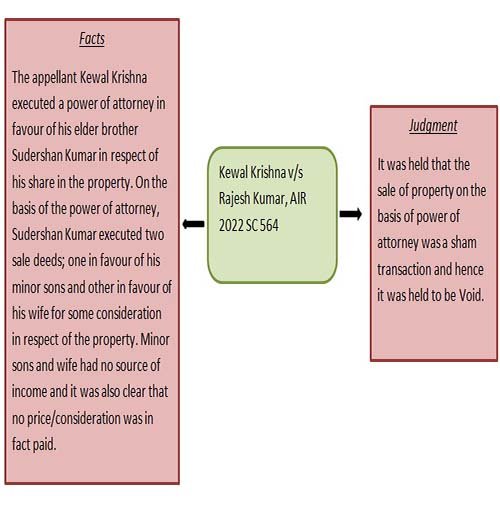
Recent Judicial Developments-

we believe in a holistic approach to legal education building not just lawyers, but socially conscious leaders of tomorrow.