RULES OF CONSTRUCTION OF TAXING STATUTES- Tax Can Be Levied Only by Authority of Law
TANMOY MUKHERJI INSTITUTE OF JURIDICAL SCIENCE
Dr. Tanmoy Mukherji
Advocate
RULES OF CONSTRUCTION OF TAXING STATUTES- Tax Can Be Levied Only by Authority of Law
Tanmoy Mukherji
Advocate
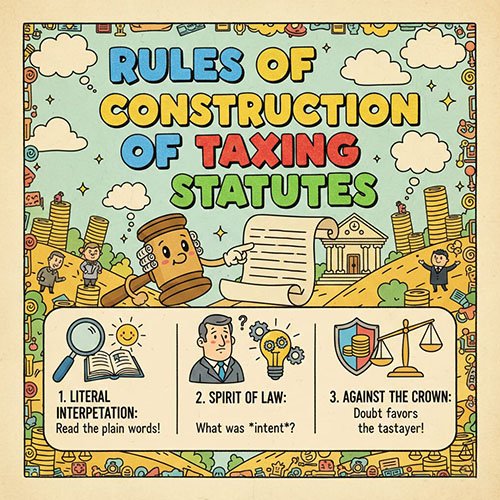
Article 265 of the Indian Constitution mandates:
“No tax shall be levied or collected except by authority of law.”
This constitutional mandate governs interpretation of taxing statutes.
Reference Cases-
A.V. Fernandez v. State of Kerala (1957) – Taxing statute must strictly comply with constitutional requirements.
Bennett Coleman & Co. v. Union of India (1972) – Taxing power must be exercised strictly within statutory limits.
Rule of Strict Construction-
Taxing statutes must be construed strictly, especially charging provisions.
Aspects:
→Nothing can be added by inference.
→No tax by implication.
→Legislative intent must be clear from words used.
Reference. cases:
Cape Brandy Syndicate v. IRC (1921) – “No room for intendment.”
Partington v. Attorney General (1869) – Subject not to be taxed unless statute clearly says so.
CIT v. Kasturi & Sons Ltd. (1999) – Courts cannot enlarge scope of charging section.
No Equity, No Presumption, No Intendment in Taxation-
Equitable or moral considerations are irrelevant.
Reference Cases:
CIT v. Ajax Products Ltd. (1965) – Equity has no place in tax law.
Mathuram Agrawal v. State of M.P. (1999) – No presumption as to tax.
Federation of A.P. Chambers of Commerce v. State of A.P. (2000) – Court cannot fill legislative gaps.
Charging Section – Backbone of Tax Liability
Tax liability arises only from charging provision.
Essential elements must be clear:
→Taxable event
→Person liable
→Rate of tax
→Measure of tax
Reference. Cases:
Govind Saran Ganga Saran v. CST (1985) – All components must be present.
CIT v. B.C. Srinivasa Setty (1981) – Failure of computation provision nullifies charge.
CIT v. Eli Lilly & Co. (2009) – Charging section must be strictly interpreted.
Machinery Provisions – Liberal Interpretation-
Machinery provisions are construed liberally to give effect to charging section.
Reference Cases:
CIT v. Mahaliram Ramjidas (1940) – Machinery provisions are aids to charge.
CIT v. National Taj Traders (1980) – Procedural provisions should advance object of statute.
Indian Aluminium Co. v. Thane Municipal Corporation (1991) – Machinery sections cannot override charging provisions.
Ambiguity – Benefit to the Assessee (Charging Provisions)-
If two interpretations are possible, the one favourable to the assessee must be adopted.
Reference Cases:
CIT v. Vegetable Products Ltd. (1973) – Benefit of doubt to assessee.
CIT v. Naga Hills Tea Co. Ltd. (1973) – Ambiguity resolved in favour of taxpayer.
State of Jharkhand v. Ambay Cements (2005) – Taxing provisions must be clear and certain.
Exemption, Deduction & Concession Provisions – Strict Interpretation-
Exemptions are exceptions to the general rule of taxation.
Rules:
→Burden of proof on assessee.
→Ambiguity benefits revenue.
Reference. Cases:
Novopan India Ltd. v. CCE (1994) – Strict interpretation of exemptions.
Dilip Kumar & Co. v. Commissioner of Customs (2018) (Constitution Bench) – Ambiguity in exemption → revenue wins.
Union of India v. Wood Papers Ltd. (1990) – Once eligibility is established, exemption should be liberally applied.
Literal Rule – Primary Rule in Taxation
Words must be given ordinary grammatical meaning.
Reference. Cases:
IRC v. Duke of Westminster (1936) – Literal interpretation is mandatory.
A.V. Fernandez v. State of Kerala (1957) – Nothing can be implied.
State of Tamil Nadu v. Kodaikanal Motor Union (1986) – Commercial terms to be understood in trade sense.
Trade, Commercial & Technical Meaning
Where words have trade meaning, that meaning must prevail.
Reference. Cases:
Ramavatar Budhaiprasad v. Assistant STO (1961) – Common parlance test.
Commissioner of Sales Tax v. Jaswant Singh Charan Singh (1967) – Popular meaning preferred over technical meaning.
Penal Provisions in Tax Statutes – Strictest Interpretation
Penalty provisions must be construed more strictly than charging provisions.
Reference Cases:
Hindustan Steel Ltd. v. State of Orissa (1970) – Penalty not automatic.
CIT v. Anwar Ali (1970) – Burden on revenue to prove mens rea (earlier law).
Union of India v. Dharmendra Textile Processors (2008) – Civil penalties do not require mens rea (post-amendment).
Substance over Form & Tax Avoidance
Courts discourage colourable devices.
Reference. Cases:
McDowell & Co. v. CTO (1985) – Tax evasion through colourable devices is impermissible.
Vodafone International Holdings v. UOI (2012) – Legitimate tax planning allowed.
Azadi Bachao Andolan v. Union of India (2003) – Treaty shopping permissible if legal.
Retrospective Operation of Taxing Statutes
Tax statutes are presumed prospective.
Refeference Cases:
CIT v. Vatika Township Pvt. Ltd. (2014) – No retrospective tax burden unless expressly stated.
Jawaharlal v. State of Rajasthan (1966) – Retrospective tax must be explicit.
Rai Ramkrishna v. State of Bihar (1963) – Retrospective taxation constitutionally valid if reasonable.
Casus Omissus – No Supply by Courts
Courts cannot supply omissions.
Reference. Cases:
Padmasundara Rao v. State of T.N. (2002) – Casus omissus cannot be supplied.
Union of India v. Deoki Nandan Aggarwal (1992) – Court cannot rewrite tax law.
Harmonious Construction in Tax Statutes
Provisions must be read together.
Reference Cases:
CIT v. Hindustan Bulk Carriers (2003) – Harmonious construction applicable.
Rajasthan State Electricity Board v. Mohan Lal (1967) – Avoid conflict between provisions.
Doctrine of Strict Interpretation vs Purpose
Purpose cannot override clear language.
Reference Cases:
CIT v. Calcutta Knitwears (2014) – Procedural compliance essential.
Sundaram Pillai v. Pattabiraman (1985) – Purpose relevant only where ambiguity exists.
The construction of taxing statutes is governed by certainty, clarity, and strict legality. Courts consistently hold that:
→Tax liability must be clearly imposed,
→No equity or intendment applies, and
→Ambiguity in charging provisions benefits the assessee, while
→Ambiguity in exemption provisions benefits the revenue.
These principles ensure balance between sovereign taxing power and taxpayer protection, forming the backbone of Indian tax jurisprudence.

we believe in a holistic approach to legal education building not just lawyers, but socially conscious leaders of tomorrow.
