ROLE OF CIVIL SOCIETY IN POLICY MAKING-
Dr. Tanmoy Mukherji
Advocate
ROLE OF CIVIL SOCIETY IN POLICY MAKING-
Tanmoy Mukherji
Advocate
INTRODUCTION-
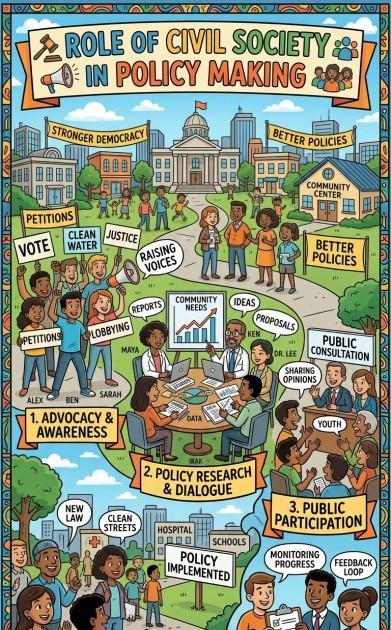
Civil society refers to voluntary organizations, NGOs, social movements, pressure groups, trade unions, media, academic institutions, and citizen groups that work independently from the government. In a democratic country like India, civil society plays a vital role in influencing public policy and ensuring accountability.
MEANING OF CIVIL SOCIETY-
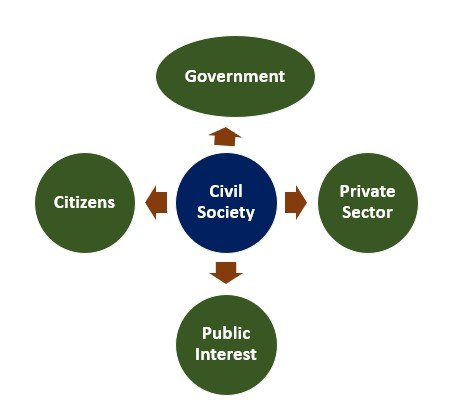
Civil society acts as a bridge between Government, Citizens and Private sector.
EXAMPLES-
→NGOs
→Human Rights Organizations
→Consumer Forums
→Environmental Groups
→Women’s Organizations
→Trade Unions
→Student Associations
→Media Houses
ROLE IN POLICY MAKING-
POLICY FORMULATION:
Provides expert opinions, research reports, public suggestions and ground-level data. Helps in framing practical and people-oriented policies.
CREATING PUBLIC AWARENESS:
Spreads awareness about health, education, environment, human rights and government schemes. Helps citizens participate actively in governance.
REPRESENTING MARGINALIZED GROUPS:
Gives voice to poor people, women, children, tribals, minorities and disabled persons. Ensures inclusive policy making.
MONITORING GOVERNMENT POLICIES:
Monitors corruption, misuse of power, policy implementation and public expenditure. Increases transparency and accountability.
ACTING AS PRESSURE GROUPS:
Influences governments through campaigns, protests, petitions, public debates and social media movements.
PROMOTING DEMOCRATIC PARTICIPATION:
Encourages public consultations, community participation and participatory governance. Makes policy making more democratic.
IMPORTANT AREAS WHERE CIVIL SOCIETY INFLUENCED POLICIES-
ENVIRONMENT: Forest protection, anti-pollution movements
HEALTH: Vaccination awareness, HIV/AIDS campaigns
EDUCATION: Right to Education awareness
HUMAN RIGHTS: Protection against discrimination and injustice
TRANSPARENCY: RTI movement led to Right to Information Act, 2005
WOMEN EMPOWERMENT: Influenced laws against domestic violence, dowry, sexual harassment.
MAJOR CIVIL SOCIETY MOVEMENTS IN INDIA-
CHIPKO MOVEMENT:
→1970s, Uttarakhand
→Forest conservation movement
→Focused on environmental protection
RTI MOVEMENT:
→Led by grassroots organizations
→Resulted in Right to Information Act, 2005
ANNA HAZARE MOVEMENT:
→Anti-corruption movement
→Influenced Lokpal and Lokayukta legislation
NARMADA BACHAO ANDOLAN:
→Protest against displacement due to big dams
→Focus on rehabilitation and environmental concerns.
ADVANTAGES OF CIVIL SOCIETY PARTICIPATION-
→Increases transparency
→Encourages accountability
→Improves policy effectiveness
→Strengthens democracy
→Protects public interest
→Encourages social justice.
CHALLENGES FACED BY CIVIL SOCIETY-
→Political pressure
→Lack of funds
→Government restrictions
→Limited rural reach
→Misinformation
→Coordination problems.
CONCLUSION-
Civil society is an essential pillar of democracy in India. It helps in policy formulation, implementation, monitoring and public participation. Effective cooperation between government and civil society leads to inclusive and people-centric public policies.

we believe in a holistic approach to legal education building not just lawyers, but socially conscious leaders of tomorrow.
