RIGHTS AND LIABILITIES OF THE SELLER AND THE BUYER
The T.P.Act, 1882
TANMOY MUKHERJI INSTITUTE OF JURIDICAL SCIENCE
Dr. Tanmoy Mukherji
[Advocate]
RIGHTS AND LIABILITIES OF THE SELLER AND THE BUYER [Section – 55 of the Transfer of Property Act]-
Tanmoy Mukherji
[Advocate]
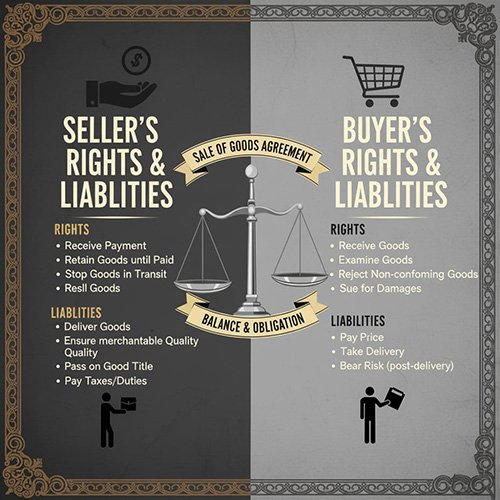
Section 55 of the T.P.Act, 1882 deals with the rights and liabilities (duties) of the Seller and the Buyer. Generally these rights and liabilities are correlative i.e. the rights of the seller are the duties of the purchaser. Similarly the rights of purchaser are the duties of the seller. The rights and liabilities of the-seller-and-buyer may be explained with reference to-
(A) Before completion of Sale; and
(B) After completion of Sale.
-The former are contractual, while the latter are regulated by the rule that property having been passed to the buyer, the transaction cannot be avoided.
(A) BEFORE COMPLETION OF SALE-
|
Seller's Liabilities (Section 55(1))
|
Buyer's Liabilities (Section 55(5))
|
|
1. He has to disclose material defects of the property.
|
1. He has to reveal (disclose) the facts that materially increase the value of the property.
|
|
2. He should produce title deeds.
|
2. He should pay price.
|
|
3. He has a duty to answer questions as to the title of the property.
|
|
|
Seller's Rights (Section 55(4))
|
Buyer's Rights (Section 55(6))
|
|
1. He has a right to take all rents and profits.
|
1. He has a right of lien over the property for the price paid.
|
(B) AFTER COMPLETION OF SALE-
|
Seller's Liabilities (Section 55)
|
Buyer's Liabilities (Section 55(5))
|
|
1. He has to give possession and to deliver title deeds on receipt of price (Section 55(1) (F) and Section 55(3).
|
1. He has to bear losses and to pay outgoings.
|
|
Seller's Rights (Section 55(4))
|
Buyer's Rights (Section 55(6))
|
|
1. He has a lien over the property if price is not paid (Vendor's lien).
|
1. He has a right to get increase (increment) in value, rent and profits.
|
The above points may be explained in detail as follows:
Seller's Liabilities before completion of Sale-
Seller has a duty to disclose known material defects of the property to the Buyer. Omission to disclose such defects amounts to fraud. The rule of Caveat Emptor is applicable here.
Rule of Caveat Emptor:
-It is a fundamental rule relating to sale in English Common Law. It means 'let the buyer beware'. Once sale is completed, the buyer has no outstanding liability towards the buyer. In T.P.Act, certain qualifications are prescribed for this maxim and hence, it is applicable to certain extent only.
-In sale of Immovable Property, the maxim has a limited application and it extends to patent defects (i.e. defects, which can be easily observable/visible; whereas latent defects are those which cannot be observed easily without special skills).
Latent defects are of two types, namely-
(1) Defects in the property; and
(2) Defects in the title.
(1) Defects in the Property- Existence of underground culvert or drainage is latent defect in the property.
(2) Defects in the Title- It includes encumbrances, liability of property-to-the-compulsory acquisition, easement rights etc.
Reference Cases-
Shaik Buddan Sab vs. Nagamma, 1977, A.P. 90 –
It was held in this case that the doctrine of Caveat Emptor is not applicable to the latent defects of the property.
Facts- Plaintiff purchased 12 acres of land from the Defendant. The plaintiff was disposed of 6 acres since the defendant had no title (defective title). In an action, the defendant pleaded the defence of the doctrine. But the Court rejected and held the defendant liable.
It is to be noted that the doctrine of Caveat Emptor is applicable to patent defects and not to the latent defects.
According to Section 55(1) Seller has a duty to disclose in the following circumstances-
(1) The defect must be material;
(2) It must be latent (not patent);
(3) The seller is aware of it and buyer is not aware of it.
2. To produce title deeds-
The seller has to produce the title deed of the property so as to enable the buyer to satisfy himself as to the title.
3. To answer questions as to title-
The Seller has a duty to answer the questions put by the Buyer as to title.
Seller's Liability - After Completion of Sale-
4. To give possession and to deliver title deeds-
After the Sale, the Seller has to give possession of the property and to hand over title deeds to the buyer, on receipt of the price. (Nonpayment of purchase money is not a constraint for passing ownership from Seller to the Buyer).
Buyer's Liability - Before Completion of Sale-
1. To disclose facts-
The buyer has a duty to disclose facts, which materially increase the value of the property.
2. To pay the price-
He has a duty to pay the price (against the execution of sale by seller).
Buyer's Liability - After Completion of Sale-
After completion of Sale, incidental loss, accidental destruction if any has to be borne by the buyer.
Rights of the Seller - Before Sale-
1. To claim Rents and Profits-
Seller has a right to claim rents, and profits accrued till the completion of sale).
Rights of the Seller - After Sale-
1. Vendor’s Lien –
Lien means right to retain/detain till the dues are cleared. If the purchase money has not been paid completely, seller has a charge over the property though it is in the possession of the Buyer. The charge is not possessory in character. Therefore the seller cannot retain the possession of the property.
Conditions-
Vendor's Lien arises provided the following two conditions are satisfied-
1. The buyer has become the owner of the property.
2. Non-payment of purchase money in whole or in part.
-The charge may be executed if there is any agreement to that effect.
-If the above two conditions are satisfied, the Seller (Vendor) can retain (keep) the property with him till the purchase money is fully paid. This right of vendor is popularly known as 'unpaid vendor's lien'.
It was laid down in the leading case of-
Webb vs. Mac Pherson (1904) ILR 32 Cal. 57, 72 –
One by name Lloyd sold a tea estate to Mac Pherson for Rs.80000/- Mac Pherson paid Rs.30000/- in cash and agreed to pay the balance in annual installments. The property was conveyed, but the installments were not paid. After the death of Lloyd, his legal executor, Webb sued Mac Pherson for unpaid vendor's charge/lien on the tea estate. The Privy Council held in favor of Webb.
-In case of Vendor's lien, the period of limitation to enforce the charge is 12 years and to enforce personal remedy is 3 years from the date of approval of the cause of action.
Rights of the Buyer – before completion of sale-
Right of Lien over the property-
Buyer has a right of lien over the property, if the seller fails to complete sale after receiving purchase money. He is entitled to get back the amount and interest.
Rights of Buyer – after completion of sale-
Right to get increase in value-
The Buyer has a right to get increase in value of the property and also rents and profits.

we believe in a holistic approach to legal education building not just lawyers, but socially conscious leaders of tomorrow.
