RIGHT OF SUBROGATION
Section 92 of the T.P.Act, 1882
TANMOY MUKHERJI INSTITUTE OF JURIDICAL SCIENCE
Dr. Tanmoy Mukherji
[Advocate]
RIGHT OF SUBROGATION [Section 92 of the Transfer of Property Act, 1882]
Tanmoy Mukherji
[Advocate]
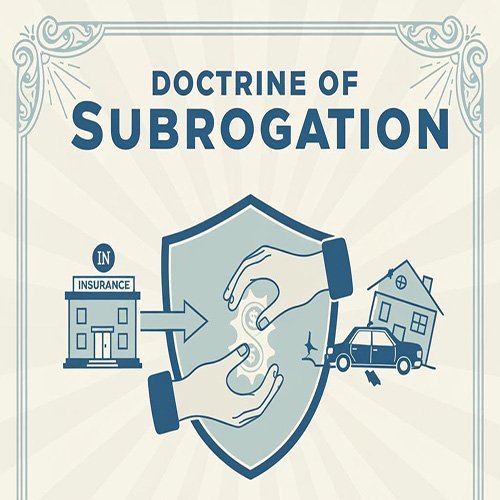
Section 92 of the Transfer of Property Act, 1882 makes provision for the right of subrogation. It runs as follows-
Any of the persons referred to in Section 91 (other than the mortgagor) and any co-mortgagor shall, on redeeming property subject to the mortgage have, so far as regards redemption, foreclosure of sale of such property, the same rights as the mortgagee whose mortgage he redeems may have against the mortgagor or any other mortgagee.
-The right conferred by this section is called the right of subrogation and a person acquiring the same is said to be subrogated to the rights of the mortgagee whose mortgage he redeems.
-A person who has advanced to a mortgagor money with which the mortgage has been redeemed shall be subrogated to the rights of the mortgagee whose mortgage has been redeemed, if the mortgagor has, by a registered instrument, agreed that such person shall be so subrogated.
-Nothing in this section shall be deemed to confer a right of subrogation on any person unless the mortgage in respect of which the right is claimed has been redeemed in full.
-The expression 'Subrogation' literally means 'transfer of right from one person to another'. It means that one person is substituted for another in regard to the latter's rights and liabilities in a certain matter. In mortgage, it refers to transfer of mortgagee's right against the mortgagor to a person, who met the liability. The right of such person is called the right of 'Subrogation'.
-In Mortgage, Mortgager has a right of redemption against the mortgagee on repayment. Sometimes, any person other than the mortgagor may repay the entire amount to the mortgagee. Such other person is entitled to all rights of the mortgagee. In other words, he enters into the shoes of the mortgagee. He is called 'Subrogee' and his right is called 'Right of Subrogation'.
-The term 'Subrogation' is derived from Roman Law, which means 'Substitution', Subrogation means 'Substitution for person redeeming is substituted for the incumberancer whom he has paid off. For instance, if a surety of a mortgage releases mortgagor by paying off to the mortgagee, he (surety) is substituted in the place of mortgagee.
Prior to the amendment in 1929, the right of subrogation was available only to the subsequent mortgagee. Now, it is made available to all those who have interest in the property mortgaged (Section 91).
Kinds of Subrogation-
Subrogation is of two kinds as follows:
(1) Legal Subrogation; and
(2) Conventional Subrogation.
(1) Legal Subrogation:
Legal Subrogation arises by operation of law. Paragraph one of Section 91 deals with Legal Subrogation and the persons acquire the right of subrogation. Legal Subrogation arises, when a person having interest in the property, to protect his own interest discharges a prior encumbrance. Following are the persons having the right of legal subrogation-
(i) Puisne Mortgage;
(ii) Surety;
(iii) Co-mortgagor; and
(iv) Purchaser of the Equity of Redemption.
i.Puisne Mortgage:
He is one, who redeems a prior mortgage. He has a right of subrogation to occupy in the place of prior mortgage.
E.g- 'A' mortgages 'X' to 'B' for Rs.20, 000/-
E.g- 'A' mortgages 'X' to 'C' for Rs.15, 000/-
In the illustration, 'C' being the assignee of equitable right of redemption can be substituted in the place of 'B' by paying the entire debt to him.
ii.Surety:
Surety is also entitled to redeem the mortgaged property and has a right to be subrogated in the place of the creditor.
iii.Co-Mortgagor:
A Co-Mortgagor also will have the right of subrogation.
E.g- 'A' and 'B' having same interest (share) in property 'X'. They jointly mortgaged 'X' to 'C' for Rs.20, 000/- and shared the amount equally. Later, 'A' alone paid off the entire amount i.e. Rs.20,000/- Now, 'A' is entitled to the right of subrogation by standing in Mortgagee's (C's) position to the extent of excess amount paid.
iv.Purchaser of the Equity of Redemption:
He is entitled to the right of subrogation.
E.g- 'X' mortgaged his property first to 'A', and later to 'B'. 'X' has a right of redemption. If 'C' pays off the first mortgagee (i.e. 'A'), 'C' takes up the position of 'A' under the right of subrogation.
2.Conventional Subrogation-
Conventional Subrogation takes place, where the mortgage debt is paid off by a person who has no interest in the security. He may be even a stranger. It must be in writing and signed by the mortgagor, and it requires registration.

we believe in a holistic approach to legal education building not just lawyers, but socially conscious leaders of tomorrow.
