REHABILITATION VS RETRIBUTION-
Dr. Tanmoy Mukherji
Advocate
REHABILITATION VS RETRIBUTION-
Tanmoy Mukherji
Advocate

Detailed Comparison-
|
Basis |
Rehabilitation |
Retribution
|
|
Meaning |
Reforming the offender |
Punishing the offender for wrongdoing
|
|
Primary focus |
Offender's improvement |
Offence and culpability |
|
Orientation |
Future-oriented |
Past-oriented |
|
Central question |
How can the offender be changed? |
What punishment does the offender deserve?
|
|
Purpose |
Reformation and reintegration |
Just deserts and accountability
|
|
View of offender |
Capable of behavioural change |
Morally responsible for wrongdoing
|
|
Punishment |
Instrument for correction |
Proportionate response to wrongdoing
|
|
Methods |
Education, counselling, treatment, vocational training, probation |
Imprisonment, fine and other legally prescribed penalties |
|
Individualisation |
Strong emphasis on individual needs and circumstances |
Strong emphasis on gravity and culpability
|
|
Recidivism |
Directly seeks to reduce reoffending |
Reduction of recidivism is not its defining rationale
|
|
Social reintegration |
Major objective |
Secondary rather than central objective
|
|
Underlying idea |
"Reform the offender." |
"Give proportionate punishment for the wrong."
|
REHABILITATION-
The rehabilitative theory considers criminal behaviour capable, in suitable cases, of being modified through appropriate intervention.
Flowchart:
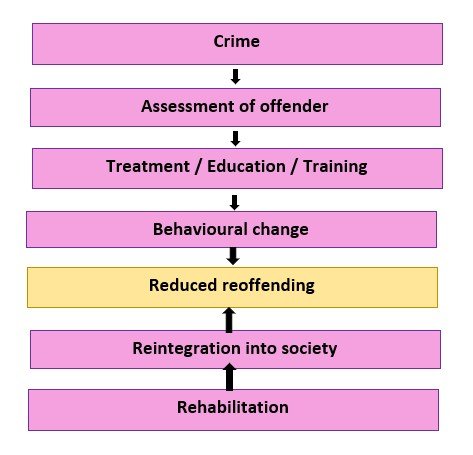
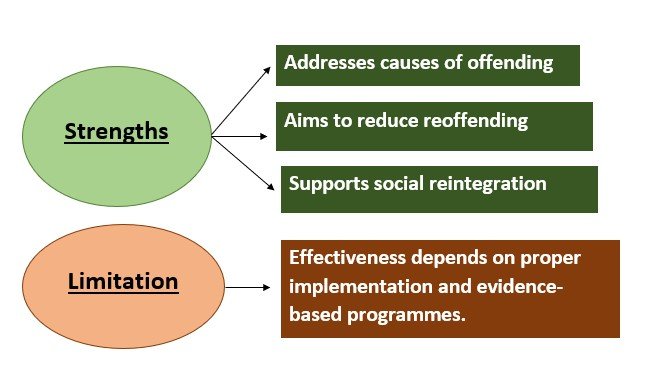
→Seeks to address factors contributing to offending.
→Facilitates the offender's return to society.
→Effectiveness depends on proper assessment and evidence-based programmes.
RETRIBUTION-
Retributive theory is founded on the principle that a person who culpably commits a wrong may deserve punishment because of that wrongdoing. Modern retributive approaches ordinarily stress proportionality rather than revenge.
Flowchart:
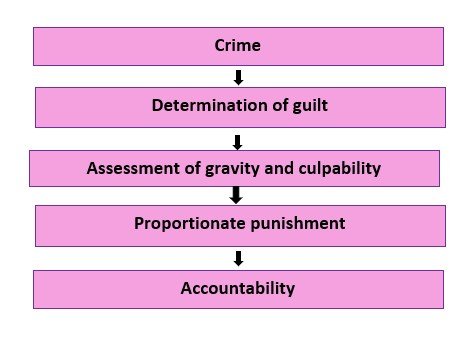
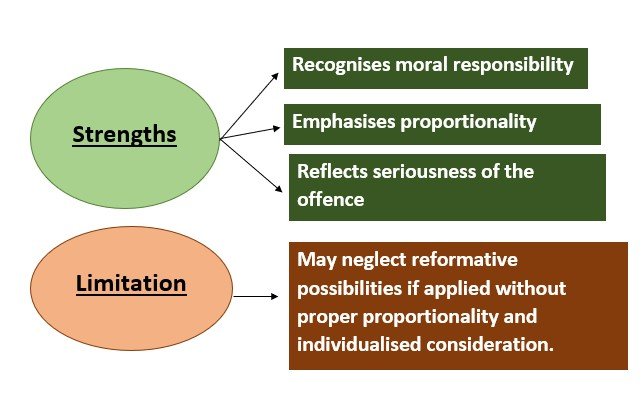
→Recognises responsibility and proportionality.
→Reflects the seriousness of the victim's wrong.
→If applied without adequate proportionality or individualised consideration, a purely punitive approach can neglect possibilities of reform.
Relationship between the Two-
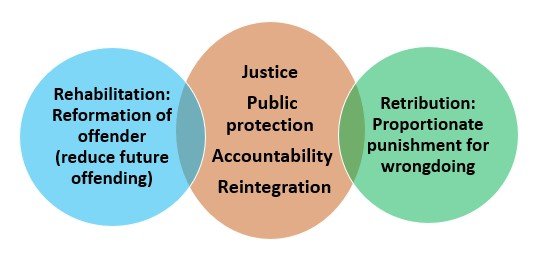
They need not always be mutually exclusive. A criminal sentence may contain both elements.
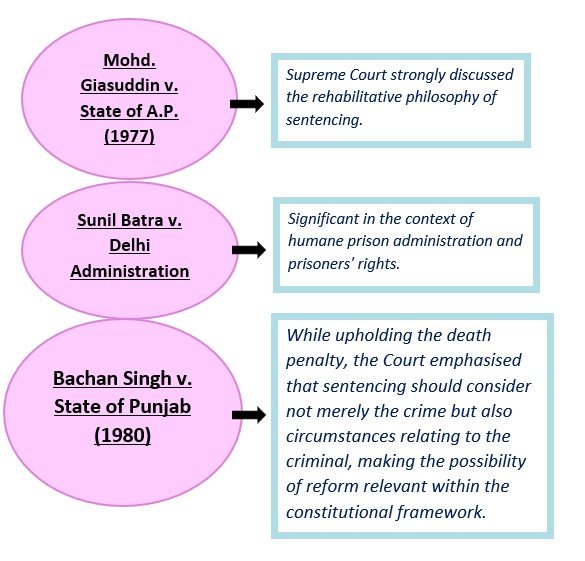
Indian Judicial Perspective-
Strengths and Limitations-
Rehabilitation-
Retribution-
Retribution → "Punishment proportionate to culpable wrongdoing."
Rehabilitation → "Transformation of the offender for successful return to society."
Conclusion-
Neither theory alone explains every legitimate objective of modern punishment. Retribution emphasises proportionality and accountability, while rehabilitation emphasises reformation and prevention of future offending.

we believe in a holistic approach to legal education building not just lawyers, but socially conscious leaders of tomorrow.
