Provisions under the Factories Act, 1948 for Protection against Fire and for Safety of Building and Machinery
Dr. Tanmoy Mukherji
Advocate
Provisions under the Factories Act, 1948 for Protection against Fire and for Safety of Building and Machinery-
Tanmoy Mukherji
Advocate
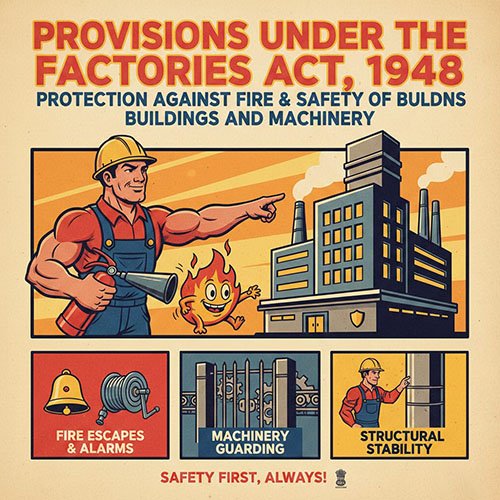
→The Factories Act, 1948 is a welfare legislation enacted to ensure the health, safety and welfare of factory workers. Chapter IV (Sections 21–41) specifically provides for safety measures, including fire protection and safety of factory buildings and machinery.
Protection against Fire-
Precautions in Case of Fire – Section 38-
Section 38 mandates that every factory must take effective measures to prevent fire and to protect workers in case of fire, which include:
→Provision of adequate means of escape for all workers.
→Properly maintained exits, clearly marked and free from obstruction.
→Installation of fire-fighting equipment such as extinguishers, hydrants, sand buckets etc.
→Arrangement for training of workers in fire-fighting and evacuation.
→Periodic mock drills to ensure preparedness.
→The responsibility for compliance lies on the occupier and manager of the factory.
Emergency Preparedness in Hazardous Factories – Sections 41B & 41C-
Factories involving hazardous processes must:
→Prepare an on-site emergency plan.
→Inform workers and local authorities about possible hazards.
→Install alarm systems, emergency exits, and protective devices.
→Maintain coordination with fire services and disaster management authorities.
Judicial View on Fire Safety-
In Indian Chemical Council v. Union of India (1998), the Supreme Court stressed that fire safety and emergency planning are integral to the right to life under Article 21, especially in hazardous industries.
Safety of Factory Buildings-
Safety and Stability of Buildings – Section 40-
Factory buildings must be structurally sounded, well-constructed and properly maintained.
If the Inspector believes that any building or part thereof is dangerous, he may:
→Order necessary repairs
→Prohibit its use
→Direct immediate evacuation of workers
This section ensures prevention of building collapse and structural accidents.
Overcrowding – Section 16-
Overcrowding is prohibited.
Minimum space per worker must be provided to reduce risk during emergencies like fire or panic.
Floors, Stairs and Access – Sections 32 & 33-
Floors, stairs and means of access must be:
→Soundly constructed
→Non-slippery
→Properly maintained
→Safe access is crucial during emergency evacuation.
Safety of Machinery-
Fencing of Machinery – Section 21-
Dangerous parts of machinery such as:
→Moving gears
→Flywheels
→Belts
→Pulleys and shafts
→must be securely fenced to prevent accidental contact.
Work on or Near Machinery in Motion – Section 22-
Only trained adult male workers (as prescribed) are allowed to work on moving machinery.
Workers must wear tight-fitting protective clothing.
Adequate supervision is mandatory.
Employment of Young Persons on Dangerous Machines – Section 23-
Young persons shall not work on dangerous machines unless:
→They have been fully instructed
→Proper supervision is provided
Striking Gear and Power Cut-off Devices – Section 24-
Every machine must be fitted with:
→Striking gear
→Emergency stop devices to instantly cut off power in case of danger.
Self-Acting Machines – Section 25-
A safe distance must be maintained from self-acting machines to prevent workers from being struck or trapped.
Casing of New Machinery – Section 26-
Newly installed machinery must have protective casings to avoid exposure to dangerous moving parts.
Pressure Plants – Section 31-
Pressure vessels and plants must be:
→Properly constructed
→Periodically tested
→Maintained to prevent explosions
Reference Cases-
State of Gujarat v. Jethalal Mohanlal (1964)-
The court held that safety provisions under the Factories Act are mandatory in nature, and non-compliance attracts strict liability.
A.C.C. v. Inspector of Factories (1957)
It was held that failure to fence machinery amounts to a violation even if no accident occurs.
The Factories Act, 1948 lays down comprehensive statutory safeguards to protect workers against:
→Fire hazards
→Structural dangers
→Mechanical accidents
The Act imposes a strict and non-delegable duty on occupiers and managers to ensure a safe working environment, thereby fulfilling the constitutional mandate of right to life and dignity of labour.

we believe in a holistic approach to legal education building not just lawyers, but socially conscious leaders of tomorrow.
