The provisions of the Factories Act, 1948 regarding the health of factory workers
Dr. Tanmoy Mukherji
Advocate
The provisions of the Factories Act, 1948 regarding the health of factory workers
Tanmoy Mukherji
Advocate
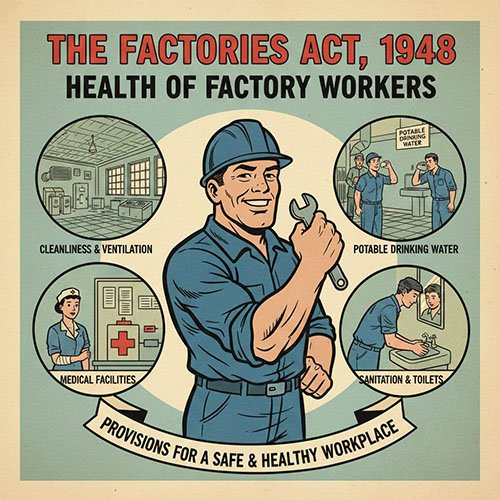
The Factories Act, 1948 is a beneficial social-welfare legislation enacted to protect workers from health hazards arising out of industrial employment. Chapter III (Sections 11–20) of the Act specifically deals with health provisions, which aim to secure hygienic working conditions, prevent occupational diseases, and promote the physical well-being of factory workers.
→The Supreme Court has repeatedly emphasized that the Act must be interpreted liberally in favour of workers.
Health Provisions under the Factories Act, 1948-
Cleanliness – Section 11
Provision
→Every factory must be kept clean and free from effluvia.
→Daily removal of dirt and refuse.
→Weekly cleaning of floors.
→Periodic painting, varnishing or white-washing of walls and ceilings.
Object
To prevent the spread of diseases and ensure a hygienic workplace.
Ref. Case-
State of Gujarat v. J.K. Industries Ltd., AIR 1992 SC 117
The Supreme Court held that cleanliness is a mandatory obligation, and failure to maintain hygienic conditions attracts penal liability.
Disposal of Wastes and Effluents – Section 12
Provision
→Effective arrangements must be made for disposal and treatment of industrial wastes.
→Effluents must not cause health hazards to workers or the public.
→Compliance with State Government standards is compulsory.
Ref. Case-
Subhash Kumar v. State of Bihar, AIR 1991 SC 420
The Court recognized the right to a pollution-free environment as part of Article 21 and emphasized proper disposal of industrial waste to protect workers’ health.
Ventilation and Temperature – Section 13
Provision
→Adequate ventilation for fresh air circulation.
→Reasonable temperature must be maintained.
→Excessive heat to be controlled by insulation, ventilation, exhaust fans, etc.
Ref. Case-
Indian Oil Corporation v. Factory Inspector (Madras HC)
It was held that failure to maintain proper ventilation and temperature amounts to a violation of health provisions under the Act.
Dust and Fume – Section 14
Provision
→Prevent inhalation of dust, fumes or gases.
→Exhaust appliances must be installed near the source of origin.
→Applies particularly to chemical and mining-related factories.
Ref. Case-
M.C. Mehta v. Union of India (Oleum Gas Leak Case), AIR 1987 SC 1086
The Supreme Court stressed the employer’s absolute liability for harm caused due to hazardous industrial operations affecting workers’ health.
Artificial Humidification – Section 15
Provision
→Applies where humidity is artificially increased.
→Water used must be clean and properly purified.
→Hygrometers must be installed.
Ref. Case-
Chandrakant Tukaram Nikam v. Municipal Corporation (Bombay HC)
The court emphasized strict adherence to standards of artificial humidification to prevent respiratory ailments.
Overcrowding – Section 16-
Provision
Overcrowding is prohibited.
Minimum space:
→14.2 cubic meters per worker (new factories)
→9.9 cubic meters per worker (existing factories)
Object-
Ensures free movement and reduces health risks.
Ref. Case
Associated Cement Companies Ltd. v. Labour Inspector (Rajasthan HC)
The court held that overcrowding seriously affects workers’ health and violates Section 16.
Lighting – Section 17-
Provision
→Adequate natural or artificial lighting.
→Prevention of glare and sharp shadows.
→Even distribution of light.
Ref. Case
Crompton Greaves Ltd. v. State of Maharashtra
The court held that improper lighting causing eye strain amounts to non-compliance with health standards.
Drinking Water – Section 18
Provision
→Supply of wholesome drinking water.
→Water points marked “Drinking Water”.
→For factories employing more than 250 workers, cooling arrangements are mandatory.
Ref. Case
People’s Union for Democratic Rights v. Union of India, AIR 1982 SC 1473
The Supreme Court linked provision of clean drinking water to the right to life under Article 21.
Latrines and Urinals – Section 19
Provision
→Separate latrines and urinals for male and female workers.
→Proper lighting, ventilation and cleanliness.
→Adequate drainage arrangements.
Ref. Case
Municipal Council, Ratlam v. Vardhichand, AIR 1980 SC 1622
The Supreme Court held that lack of sanitary facilities violates basic human dignity and public health obligations.
Spittoons – Section 20
Provision
→Spittoons must be provided at convenient places.
→Must be kept clean and hygienic.
→Spitting elsewhere is a punishable offence.
Ref. Case
State v. Kartar Singh (Punjab HC)
The court held that failure to provide spittoons amounts to a breach of statutory duty under the Factories Act.
Constitutional Perspective-
Health provisions under the Factories Act are closely connected with:
Article 21 – Right to life and health
Article 42 – Just and humane conditions of work
The health provisions under the Factories Act, 1948 constitute a comprehensive legal framework to ensure safe, clean and humane working conditions. Judicial interpretation has strengthened these provisions by linking them with fundamental rights, making employer compliance not only a statutory duty but also a constitutional obligation.

we believe in a holistic approach to legal education building not just lawyers, but socially conscious leaders of tomorrow.
