Presumptions in Interpretation of Statutes-
TANMOY MUKHERJI INSTITUTE OF JURIDICAL SCIENCE
Dr. Tanmoy Mukherji
Advocate
Presumptions in Interpretation of Statutes-
Tanmoy Mukherji
Advocate
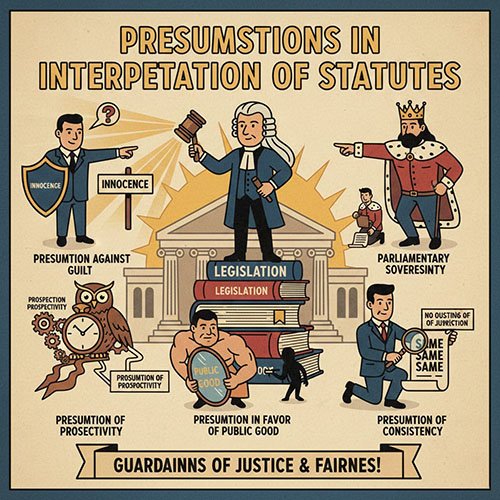
In the interpretation of statutes, courts aim to discover and give effect to the intention of the legislature. Since legislative intent is not always expressly stated, courts have evolved certain presumptions which act as guiding principles. These presumptions are rebuttable and operate unless the statute clearly indicates a contrary intention. They promote certainty, consistency, and fairness in statutory interpretation.
Presumption of Constitutionality
Every statute enacted by a competent legislature is presumed to be constitutional. Courts assume that the legislature understands and respects constitutional limitations and does not intend to transgress them.
The burden of proving unconstitutionality lies on the person challenging the statute.
Reference Cases-
Charanjit Lal Chowdhury v. Union of India (1951)
The Supreme Court held that there is a strong presumption in favour of the constitutionality of a statute.
State of Bihar v. Bihar Distillery Ltd. (1997)
The Court reiterated that if two interpretations are possible, the one which upholds constitutionality should be preferred.
Rationale-
This presumption ensures judicial restraint and respect for legislative wisdom.
Presumption Against Retrospective Operation
A statute is presumed to be prospective in operation, especially when it affects substantive rights, obligations, or liabilities. Retrospective operation must be expressly stated or clearly implied.
Reference Cases-
Govinddas v. Income Tax Officer (1976)
The Supreme Court held that laws imposing new liabilities are presumed to be prospective unless expressly made retrospective.
Hitendra Vishnu Thakur v. State of Maharashtra (1994)
The Court clarified that procedural laws may apply retrospectively, but substantive laws do not.
Exception:
Procedural and declaratory statutes may have retrospective effect.
Presumption Against Taking Away Vested Rights
Legislature is presumed not to interfere with vested rights unless the intention to do so is clearly expressed or necessarily implied.
Reference Cases-
Keshavan Madhava Menon v. State of Bombay (1951)
The Supreme Court observed that existing rights cannot be taken away by implication.
Gurbachan Singh v. Satpal Singh (1990)
The Court held that vested rights cannot be disturbed except by express legislative provision.
Importance:
This presumption protects stability and predictability in law.
Presumption Against Ouster of Jurisdiction of Courts
It is presumed that the legislature does not intend to exclude the jurisdiction of civil courts. Exclusion must be expressly stated or clearly implied.
Reference Cases-
Dhulabhai v. State of M.P. (1968)
The Supreme Court laid down principles to determine when civil court jurisdiction is excluded.
Secretary of State v. Mask & Co. (1940)
Exclusion of jurisdiction is not to be readily inferred.
Rationale:
Access to justice is a basic principle of the legal system.
Presumption of Mens Rea in Penal Statutes-
There is a presumption that mens rea (guilty intention) is an essential ingredient of a criminal offence unless the statute expressly or by necessary implication excludes it.
Reference Cases-
State of Maharashtra v. Mohd. Yakub (1980)
The Supreme Court reaffirmed the importance of mens rea in criminal liability.
Nathulal v. State of M.P. (1966)
Absence of dishonest intention negatived criminal liability.
Exception-
In socio-economic offences, mens rea may be excluded.
Presumption Against Penal Consequences Without Clear Words-
Courts presume that the legislature does not intend to impose penal consequences without clear and unambiguous language.
Reference Case-
Tolaram Relumal v. State of Bombay (1954)
-If two interpretations are possible, the one favourable to the accused must be adopted.
-This presumption protects individual liberty and prevents arbitrary punishment.
Presumption That Legislature Does Not Make Mistakes-
Courts presume that the legislature does not commit mistakes or use redundant words. Every word and provision is presumed to have a purpose.
Reference Case-
Quebec Railway v. Vandry (1920)
No word in a statute should be treated as surplusage.
Principle-
Courts should avoid interpretations that render provisions meaningless.
Presumption of Consistency and Harmonious Construction
Legislature is presumed not to contradict itself. Therefore, statutes and provisions should be interpreted to harmonise rather than conflict.
Reference Cases-
Venkataramana Devaru v. State of Mysore (1958)
The Supreme Court applied harmonious construction to reconcile conflicting provisions.
Presumption Against Implied Repeal
Repeal by implication is not favoured. Courts presume that the legislature does not intend to repeal an existing law unless the inconsistency is irreconcilable.
Reference Cases-
Municipal Council, Palai v. T.J. Joseph (1963)
Repeal by implication is not to be lightly inferred.
State of Rajasthan v. Gopi Kishan Sen (1992)
Presumption That Law Promotes Public Good
Courts presume that legislation is enacted for public welfare and social good, not to cause injustice or hardship.
Reference Cases-
Workmen v. American Express International Banking Corp. (1985)
Beneficial legislation must receive liberal interpretation.
→Presumptions in interpretation of statutes are vital judicial tools that assist courts in uncovering legislative intent. These presumptions uphold constitutional supremacy, protect individual rights, ensure fairness, and promote legal certainty. Though rebuttable, they play a crucial role in maintaining balance between legislative authority and judicial review, thereby strengthening the rule of law.

we believe in a holistic approach to legal education building not just lawyers, but socially conscious leaders of tomorrow.
