Pre-emption (Shufa)
Muslim Law
TANMOY MUKHERJI INSTITUTE OF JURIDICAL SCIENCE
Tanmoy Mukherji
[Advocate]
Pre-emption (Shufa)-
Tanmoy Mukherji
[Advocate]
The Arabic term for its Anglo-Mohammedan equivalent 'pre-emption' is Shufa which literally means adding.
Definition-
Mulla-
According to Mulla, the right of Shufa or pre-emption is a right which the owner of an immovable property possess to acquire by purchase another immovable property which has been sold to another person.
Justice Mahmood-
In Govind Dayal v/s Inayatullah, Justice Mahmood stated that pre-emption is a right which the owner of certain immovable property possesses, as such, for the quiet enjoyment of that immovable property, to obtain in substitution for the buyer, proprietary possession of certain other immovable property, not his own, on such terms as those on which such later immovable property is sold to another person.
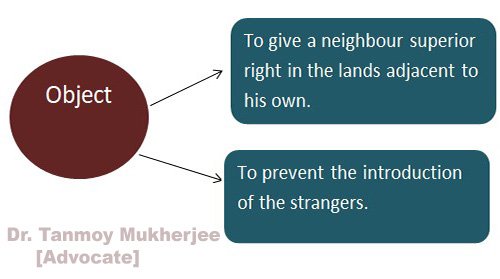
Object-
Nature of the right of pre-emption-
A right of preference-
The right of pre-emption is a kind of preference given to the owner of a property to purchase another property adjoining to his land or of which he is the co-owner.
A right of substitution-
In Bishan Singh v/s Khazan Singh, the Supreme Court observed that the right of pre-emption is a right of substitution but not repurchase, the pre-emptor takes the entire bargain and steps into the shoes of the original vendee.
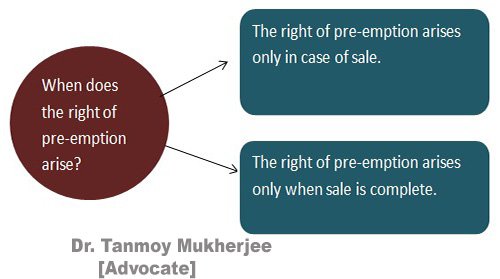
Cases in which the right of Pre-emption arises-
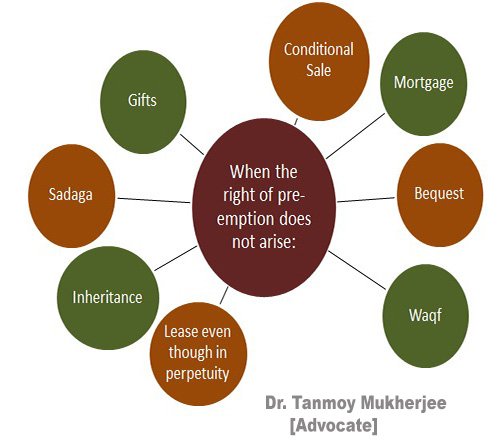
Cases in which the right of Pre-emption does not arise-
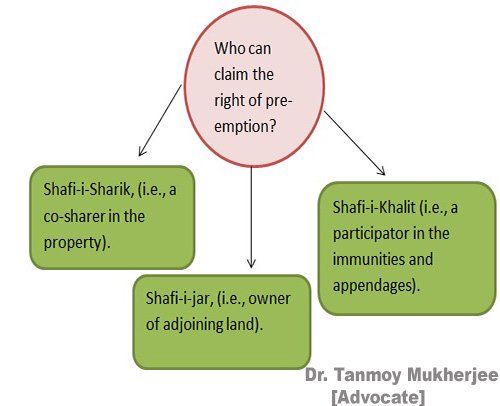
Who are entitled to the right of pre-emption-
Shafi-i-Sharik-
A co-sharer in the property is also known as Shafi-i-Sharik. A co-sharer (sharik) is an owner of an undivided share in the property.
Shafi-i-Khalit-
A participator in the immunities and appendages is known as a Shafi-i-Khalit.
Shafi-i-jar-
An owner of adjoining or contiguous immovable property is known as Shafi-i-jar.
-Although the neighbour is himself entitled to pre-empt, the tenant or persons in possession without any title does not have any right of pre-emption.
-The right of pre-emption on the ground of vicinage does not extend to large estates, i.e., villages or Zamindaris, but is confined to houses, gardens and small pieces of land.
Conditions regarding pre-emption-
|
An immovable property- |
The subject of pre-emption must be an immovable property.
|
|
The property must be pre-empted as a whole- |
The subject of pre-emption must be pre-empted as a whole. exception- Where several distinct properties are sold by same contract, in that case the pre-emptor may claim the one and leave the other.
|
Talabs (Demands) regarding the right of pre-emption-
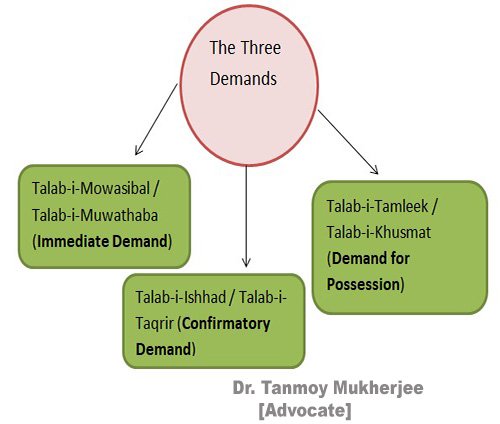
Talab-i-Mowasibat / Talab-i-Muwathaba /Immediate Demand-
In Arabic it is known as talab-i-mowasibat which literally means a demand by jumping.
-For the application of this demand, the person should make an immediate demand in that moment when the news comes to him that the property has been sold.
Talab-i-ishaad/Talab-i-taqrir/ Confirmatory Demand-
In Arabic it is known as talab-i-tagrir on talab-i-ishaad.
-For giving effect to the first demand/Immediate demand it is to be followed by a formal claim i.e., talab-i-ishaad.
The essentials for making the confirmatory demand are-
i) The pre-emptor must affirm his intention to assert his right, referring expressly to his having made the immediate demand or talab-i-mowasibat;
ii) The pre-emptor must make a formal demand-
a) either in the presence of the buyer or the seller or on the subject of the sale.
b) in the presence of at least two witnesses specially called for that purpose.
Talab-i-tamleek/Talab-i-Khusmat/ Demand for possession-
It is the final enforcement of claim by instituting a regular suit within the period prescribed by the Indian Limitation Act, if it is not conceded after the second demand.
Essentials-
i) The talab-i-mowasibat must be made after the sale is complete and not prior to the completion.
ii) It may be made either in person or by an authorized agent or even by a letter.
iii) No formula for making the demand is necessary but the claim must be equivocally asserted.
iv) The demand must be made immediately and affirmed without delay.
v) Where there are two or more buyers, the names of all the purchasers need not be mentioned in making the demand.
vi) Tendering the price is not essential. It is sufficient that the pre-emptor should then declare his readiness to pay the price.
Constitutional validity of the law of pre-emption-
Before the 44th Amendment of the Indian Constitution-
Before the 44th Amendment of the Constitution there existed Art 19 (1)(f) which gave the citizens of India, "the right to acquire, hold and dispose of property" but under Art 19(5) it was also permitted to put reasonable restrictions on exercise of this right.
Article-13-
According to Art. 13(1), all laws in force in the territory of India immediately before the commencement of the Constitution and inconsistent with the provisions of the constitution relating to fundamental rights of the people shall to the extent of such inconsistency be void.
Article 13(2) –
forbids the state from making any law which takes away or abridges the fundamental rights and declares that any law made in contravention of this clause shall to the extent to the contravention, be void.
Reference Cases-
Bhau Ram v/s Baej Nath, AIR 1962 SC 1476-
The Supreme Court held that pre-emption on the ground of vicinage is unconstitutional.
Sant Ram v/s Labh Singh AIR 1965 SC 314-
It was held that the customary law of pre-emption on the ground of vicinage imposed unreasonable restrictions on the right to hold, acquire and to dispose of property guaranteed by Art. 19(1) (f) of the Constitution and was void.
After the 44th Amendment of the Indian Constitution-
-By the 44th Amendment of the Constitution Art. 19(1) (f) has been abrogated and the right to property was recognized as a Constitutional right under Art. 300A.
-After this amendment right of pre-emption on the ground of vicinage has been revived and the right of pre-emption still continues to be a legal right and its reasonableness still can be recognized under article 14 and 15 of the Constitution.
Reference Cases-
Atma Prakash v/s State of Haryana (1986)2 sec 249, 257-
The Supreme Court held that claim of pre-emption on the ground of consanguinity, i.e., on the ground that pre-emptor is co-sharer of the vendor, is ultra vires the Constitution.
Razzaque Sajan Saheb Bagwan and others v/s Ibrahim Hazi Mohd Hussain, AIR 199950 2043-
The Supreme Court of India has held the right of pre-emption on the ground of neighbour (shafi-i-jar) is unconstitutional and therefore cannot be recognized.
When the right of pre-emption is lost-
The right is lost on following grounds-
i) Under Sunni law, the right is extinguished if the pre-emptor dies during the pendency of the suit. But under Shia law, the right to sue may be carried on by the pre-emptor's heirs.
ii) If the pre-emptor waves his right in favor of the vendee.
iii) By his acquiescence in the sale.
iv) When he fails in the observance of the formalities.
v) When the pre-emptor releases the right for consideration.
vi) When the pre-emptor transfers the subject of pre-emption to a stranger.
vii) When a pre-emptor joins with himself as co-plaintiff a person who has no right of Shufa.

we believe in a holistic approach to legal education building not just lawyers, but socially conscious leaders of tomorrow.