POLITICAL SCIENCE
Dr. Tanmoy Mukherji
Advocate
POLITICAL SCIENCE-
Tanmoy Mukherji
Advocate
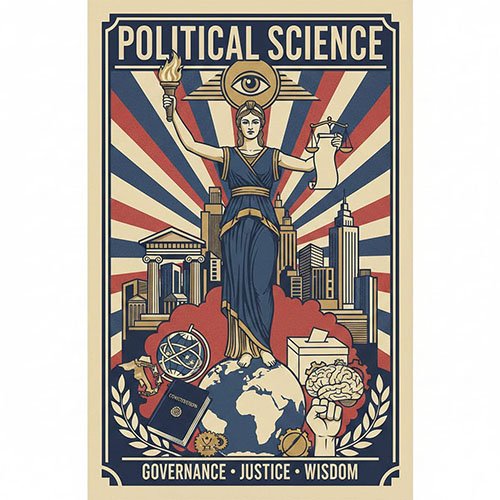
Political Science is a branch of social science that deals with the study of the state, government, politics, power, authority, and political institutions. It examines how political systems function, how laws and policies are made, and how power is exercised and controlled in society.
Definitions
Aristotle: Political Science is the study of the state.
Paul Janet: Political Science is that part of social science which treats the foundations of the state and the principles of government.
Garner: Political Science begins and ends with the state.
Why Political Science is called a Science
Political Science is called a science because it studies political phenomena in a systematic, logical, and objective manner, similar to other sciences.
Reasons Why Political Science is a Science
1. Systematic Study
Political Science studies political facts—such as the state, government, laws, elections, and political behavior—in an organized and methodical way.
2. Use of Scientific Methods
Modern Political Science uses scientific tools and methods like:
→Observation
→Comparison
→Statistical analysis
→Surveys and case studies
→This makes its conclusions more reliable.
3. Cause-and-Effect Relationship
Political Science explains cause-and-effect relationships, for example:
→Why revolutions occur
→How laws affect society
→How political instability impacts governance
4. Formulation of General Principles
It develops general concepts and principles such as:
→Sovereignty
→Rule of law
→Separation of powers
→Democracy
→These principles are applicable across political systems.
5. Objective and Empirical Approach
Political Science aims to be objective by studying facts based on evidence rather than personal opinions or moral judgments.
6. Predictive Value
Though not exact like natural sciences, Political Science can predict political trends, such as voting behavior or policy outcomes.
Criticism-
Some scholars argue that Political Science is not a science because:
→Human behavior is unpredictable
→Experiments cannot be conducted like in physics or chemistry
→However, most modern scholars agree that it is a social science, not a natural science.
Political Science is called a science because it applies scientific methods to the study of political life, even though its subject matter involves human behavior. Hence, it is rightly described as a social science.
Nature and Scope of Political Science-
Nature of Political Science
The nature of Political Science explains its basic characteristics and the way it studies political life.
A Social Science
Political Science is a branch of social science because it studies human behavior in relation to the state, government, and society.
Study of the State and Government
Traditionally, Political Science deals with the origin, nature, functions, and forms of the state and government.
Both Normative and Empirical
Normative: It discusses ideals like justice, liberty, equality, and rights.
Empirical: It studies political facts, institutions, and behavior through observation and analysis.
Dynamic in Nature
Political Science is not static; it changes with social, economic, and political developments.
Interdisciplinary Subject
It is closely related to sociology, law, history, economics, and philosophy.
Concerned with Power and Authority
Modern Political Science studies power relations, authority, influence, and decision-making processes.
Scope of Political Science
The scope refers to the subject matter covered by Political Science.
Study of the State
Includes the origin, nature, elements, sovereignty, and functions of the state.
Study of Government
Covers forms of government (democracy, monarchy, dictatorship), organs of government—legislature, executive, and judiciary.
Political Institutions
Includes constitutions, political parties, pressure groups, and electoral systems.
Political Theory and Thought
Study of ideas and philosophies of thinkers like Plato, Aristotle, Machiavelli, Hobbes, Locke, Rousseau, Marx, and Gandhi.
Public Administration
Deals with the organization, functions, and working of government administration.
Comparative Politics
Comparative study of political systems of different countries.
International Relations
Study of relations among states, international law, diplomacy, war, peace, and international organizations like the UN.
Political Behavior
Study of political participation, voting behavior, leadership, and public opinion.
Political Science is a comprehensive and dynamic discipline that studies both the theory and practice of politics. Its nature is broad and scientific, and its scope has expanded from the study of the state to include political behavior and international relations.

we believe in a holistic approach to legal education building not just lawyers, but socially conscious leaders of tomorrow.
