PASSING OFF
Dr. Tanmoy Mukherji
Advocate
PASSING OFF-
Tanmoy Mukherji
Advocate
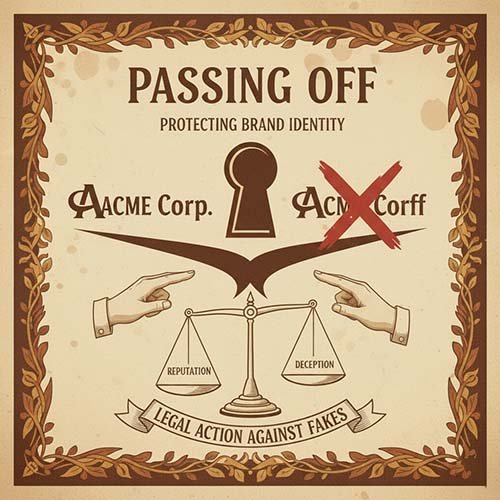
1. Meaning of Passing Off-
Passing off is a common law remedy that protects the goodwill of a business against misrepresentation.
It prevents one person from misleading the public by passing off their goods/services as those of another.
Definition-
"A misrepresentation made by a trader which causes or is likely to cause damage to the goodwill of another trader."
It protects unregistered trademarks.
2. Nature of Passing Off-
→A tort (civil wrong).
→Based on honesty in trade.
→Consumer protection concept.
→Recognized under Section 27(2) of the Trade Marks Act, 1999.
3. Essentials/Classical Trinity (Reckitt & Colman v. Borden- Jif Lemon Case)-
A. Goodwill - Plaintiff must have reputation in the market.
B. Misrepresentation - Defendant must mislead public.
C. Damage - Actual or probable damage to plaintiff's goodwill.
4. Types of Passing Off-
→Classical Passing Off
→Extended Passing Off
→Reverse Passing Off
5. Key Case Laws-
i) Perry v. Truefitt (1842) - "A man is not to sell his goods as those of another."
ii) Reckitt & Colman v. Borden (1990) - Classical Trinity established.
iii) Cadbury Schweppes v. Pub Squash (1981)
iv) Hindustan Pencils v. India Stationery Products (1990)
v) S. Syed Mohideen v. P. Sulochana Bai (2016)
vi) Bikanervala v. New Bikanerwala (2005)
Vii) Mahendra & Mahendra v. Mahindra & Mahindra (2002)
6. Passing Off vs Trademark Infringement-
Passing Off-
→Protects unregistered marks.
→Common law.
→Must prove goodwill + misrepresentation + damage.
Trademark Infringement-
→Protects registered marks.
→Statutory remedy.
→Only similarity of mark needs proof.
7. Defences in Passing Off-
→Honest and concurrent use
→Descriptive use
→No goodwill
→No misrepresentation
→Delay/acquiescence
8. Remedies-
→Injunction
→Damages
→Account of profits
→Delivery/destruction of infringing goods.
9. Indian Legal Position
→Mentioned under Section 27(2) & 135 of the Trade Marks Act, 1999.

we believe in a holistic approach to legal education building not just lawyers, but socially conscious leaders of tomorrow.
