NUISANCE
Law of Torts
Dr. Tanmoy Mukherji
Advocate
NUISANCE -
Tanmoy Mukherji
Advocate
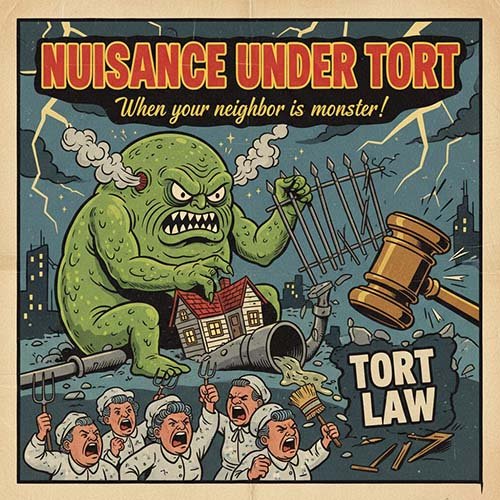
Nuisance is a tort that protects a person’s interest in land. It refers to unlawful, unreasonable or unwarranted interference with the plaintiff’s use or enjoyment of land, or with some right over or in connection with land (e.g., easement, water rights).
The principle stems from the maxim-
“Sic utere tuo ut alienum non laedas” (Use your own property in such a manner as not to injure your neighbour’s.)
Winfield
According to Winfield-“Nuisance is an unlawful interference with a person’s use or enjoyment of land, or of some right over or in connection with it.”
Salmond
According to Salmond- “The wrong of nuisance consists in causing or allowing without lawful justification, the escape of any deleterious thing from one’s land to another’s.” Salmond emphasizes escape of something harmful — smoke, noise, fumes, smell, water etc.
Clerk & Lindsell
According to Clerk & Lindsell -“A nuisance is a condition or activity which unduly interferes with the use or enjoyment of land.”
Pollock
According to Pollock- “Nuisance is anything done to the hurt or annoyance of the lands, tenements or hereditaments of another, and not amounting to trespass.” Pollock distinguishes nuisance from trespass.
Stephen’s Commentaries
According to Stephen’s Commentaries-“Nuisance is any act or omission which interferes with the comfortable enjoyment of life or property.”
Black’s Law Dictionary
According to Black’s Law Dictionary- “Nuisance is anything that unlawfully annoys or does damage to another person’s property or violates his rights.”
Dr.Mukherjee
According to Dr.Mukherjee- “Nuisance means a non-trespassory, continuous or recurring interference, caused by human conduct or controllable conditions, that materially affects the comfort, convenience, health, or property of a person in the lawful occupation of land.”
BY COURTS-
St. Helen’s Smelting Co. v. Tipping (1865)
The Court defined nuisance as-“Material injury to property or material interference with the ordinary comfort of human existence.”
Attorney-General v. PYA Quarries (1957)
Public nuisance defined as-“A nuisance which materially affects the reasonable comfort and convenience of a class of Her Majesty’s subjects.”
Private Nuisance-
To establish private nuisance, courts look at:-
1. Unreasonable Interference-
Unreasonableness is central.
It depends on-
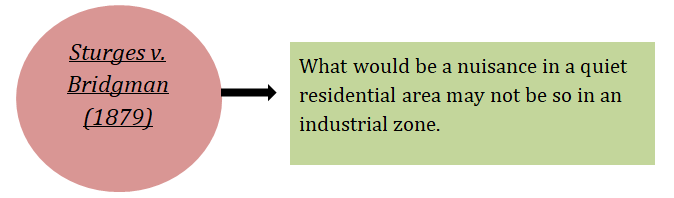
a. Locality Principle-
b. Duration and Frequency-
Continuous, repetitive, or long-term interference constitutes nuisance.
c. Intensity / Gravity-
Measured by-
→extent of harm,
→frequency,
→time of day,
→effect on health/sleep,
→safety risks.
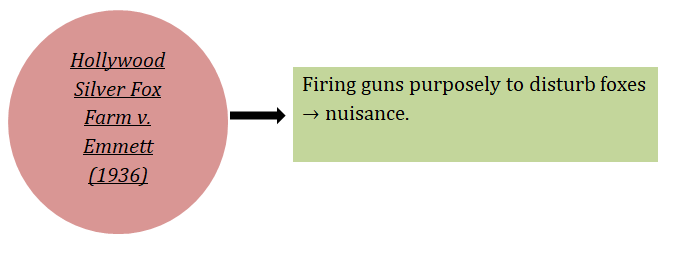
d. Malice-
Malicious acts automatically become unreasonable.
2. Interference Must Be with Use or Enjoyment of Land-
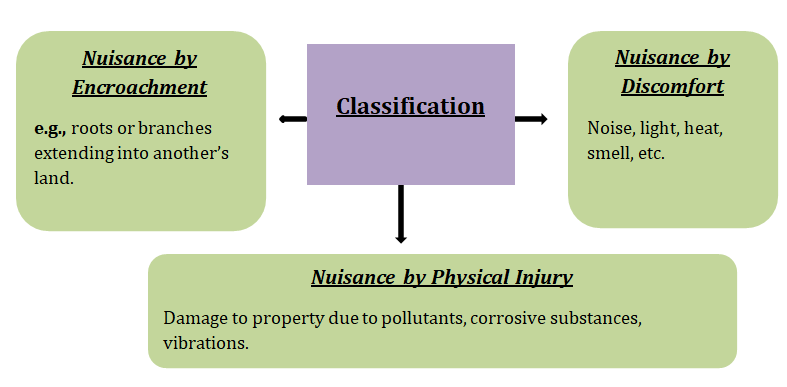
Interference may be-
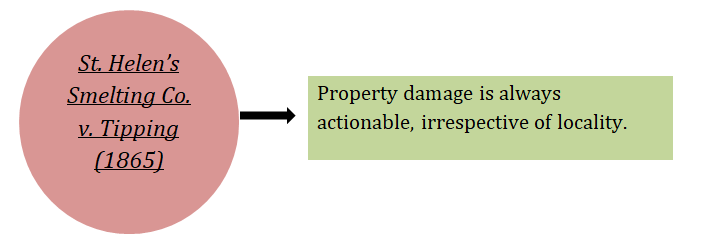
a. Physical damage to land/property-
e.g., smoke depositing particles, vibrations, sewage leakage.
b. Material discomfort-
e.g., noise, heat, smell, dust, glare.
-Courts balance interests using the Reasonable Neighbour Test.
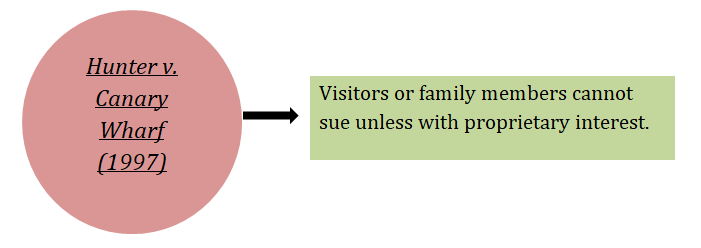
3. Plaintiff Must Have Possessory Interest-
-Owner, tenant, lessee, or occupier may sue.
Public Nuisance –
Defined as an interference affecting the public, or a considerable number of persons.
It originates both as-
Common law crime
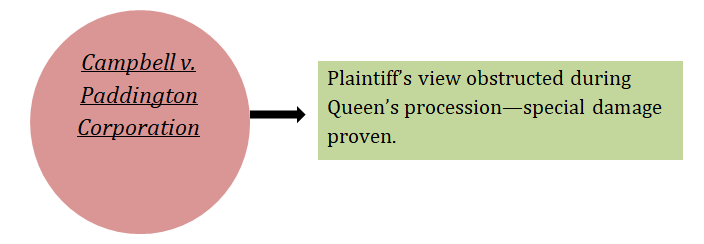
Civil wrong (only if special damage is proved)
Essentials-
1. Interference with public right (health, safety, morals, comfort).
2. Must affect a class of people.
-Civil Action Requires “Special Damage”
-Individual must show damage beyond what the public suffered.
Classification of Nuisance-
DEFENCES -
1. Prescription (20 years rule)-
If interference continues openly for 20 years, a prescriptive right is acquired.
Conditions-
→Identity of nuisance must be the same.
→Time counted from when nuisance began affecting plaintiff.
→Must be peaceful, open, and continuous.
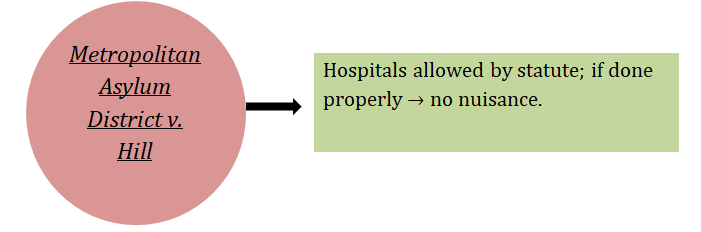
2. Statutory Authority-
If an act is authorized by statute, it is a complete defence.
3. Act of God-
Natural events beyond human control.
4. Inevitable Accident-
An Inevitable Accident is an event that causes damage or injury but could not have been prevented by the exercise of ordinary care, caution, and skill on the part of the defendant.
5. Plaintiff’s Default-
If interference arises because of plaintiff’s own actions.
NOT DEFENCES-
1. Coming to the nuisance-
– Not valid.
Sturges v. Bridgman
2. Public benefit / utility-
– Not an absolute defence, only a factor in reasonableness test.
REMEDIES -
1. Damages-
→Compensatory
→Special damages (public nuisance)
→Loss of amenity.
2. Injunction-
Granted if-
→Nuisance is continuing or recurrent
→Monetary compensation inadequate.
Types-
→Interim / Temporary
→Perpetual
→Mandatory injunction (removal of structure, noise barrier etc.)
3. Abatement-
Plaintiff may remove nuisance himself after giving notice.
e.g., cutting branches overhanging one’s land.
Reference Cases-
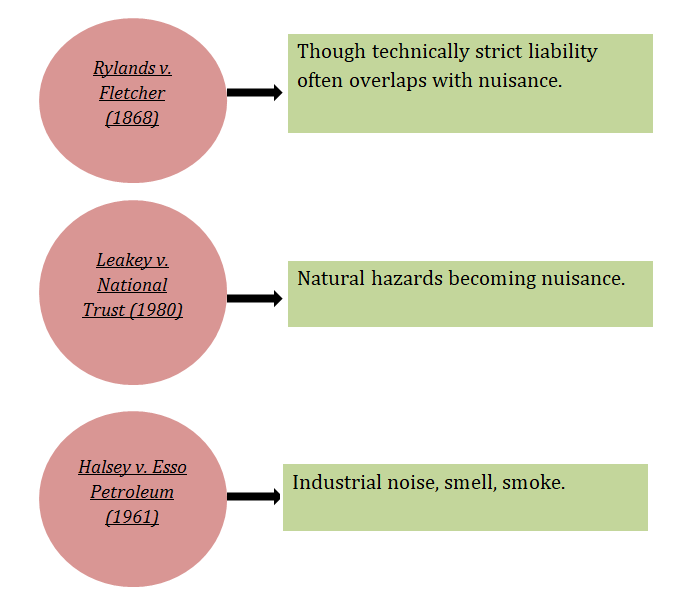
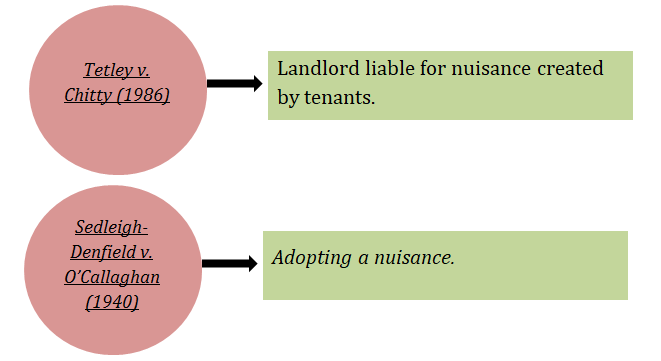
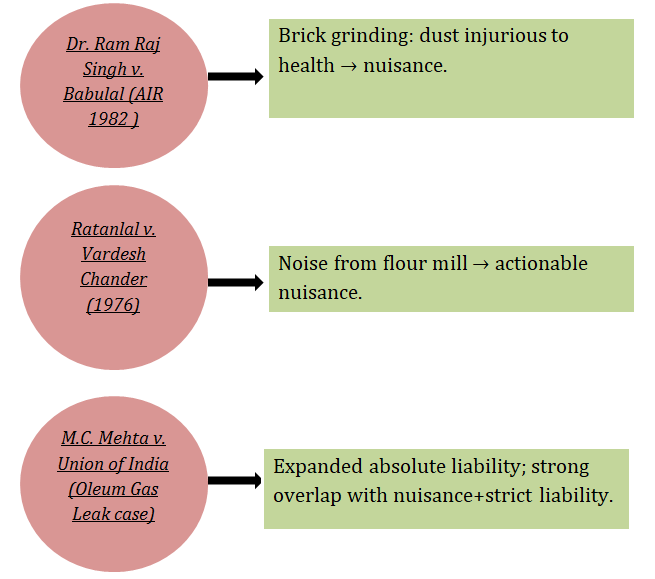
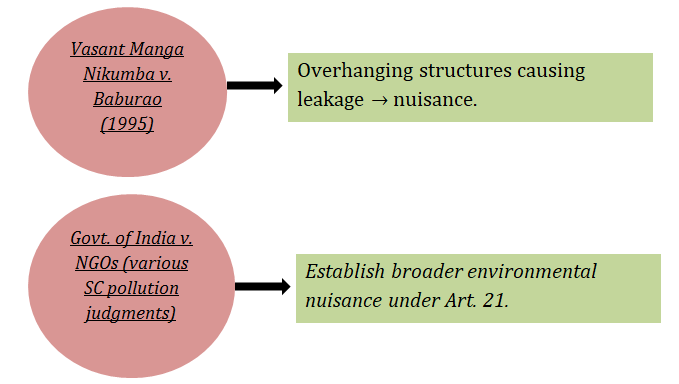
MODERN DEVELOPMENT-
1. Expansion of Environmental Nuisance
Courts increasingly treat pollution and ecological degradation as nuisance.
2. Noise Pollution as Nuisance
Recognized explicitly under-
→Article 21 (Right to life)
→Environment (Protection) Act, 1986
→Noise Pollution Rules, 2000
3. Nuisance & Fundamental Rights
Supreme Court links nuisance with-
→Right to clean environment
→Right to silence
→Right to health
Church of God v. KKR Majestic Colony (2000)

we believe in a holistic approach to legal education building not just lawyers, but socially conscious leaders of tomorrow.
