Nikah (Marriage)
Dr. Tanmoy Mukherji
Advocate
Nikah (Marriage)
TANMOY MUKHERJI
[ADVOCATE]
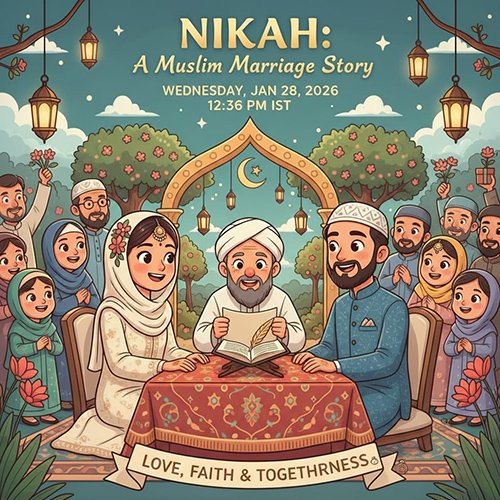
Marriage, i.e., nikah in pre-Islamic Arabia, meant different forms of sexual relationship between a man and a woman established on certain terms. In pre-Islamic days, women were treated as chattels and were not given any right of inheritance and were absolutely dependent. It was Prophet Mohammad who brought about a complete change in the position of women. The improvement was striking and their position is now unique as regards their legal status.
Under Muslim Law, marriage is considered as a civil contract. After marriage, a woman does not lose her individuality. She can alienate or transfer her property in any way she pleases without her husband. She can enter into binding contracts with her husband and proceed against him in law courts, if necessary. The woman enjoys this position through the injunctions of the Quran.
Definition:
The Arabic word Nikah literally means the union of the sexes, and in law, this term means marriage.
In Baillie’s Digest, marriage has been defined to be a contract for the purpose of legalizing sexual intercourse and procreation of children.
In Hedaya, it is defined as: “Nikah, in its primitive sense, means carnal conjunction. Some have said that it signifies conjunction generally. In the language of law, it implies a contract used for the purpose of legalizing generation.”
Ashabah says: “Marriage is a contract underlying a permanent relationship based on mutual consent on the part of a man and woman.”
Nikah under Muslim Law is not a religious ceremony. There is a consensus among Muslim jurists that marriage is Sunnat Mumakkida. A person who complies with it is rewarded in the next world, and he who does not, commits a sin.
According to Tyabji, marriage brings about a relation based on and arising from a permanent contract for the procreation of children, between a man and a woman, who are referred to as parties to the marriage, and who after being married, become husband and wife.
a) The rights and duties between the parties themselves, and
b) Between each of them and the children born from the union.
The essentials or formal requirements of Nikah are as follows:
1.Proposal (Ijab): This is the formal offer of marriage. It is typically made by the bride's guardian (Wali), such as her father, on her behalf and with her explicit consent. The groom then accepts the proposal. Alternatively, the groom can make the proposal, and the bride or her guardian accepts.
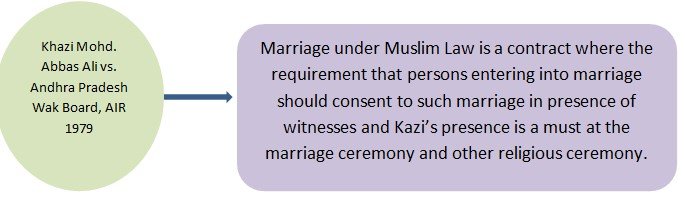
2.Acceptance (Qubul): This is the clear and unequivocal acceptance of the proposal. Both the proposal and acceptance must occur in the same session, in front of witnesses.
3.Presence:
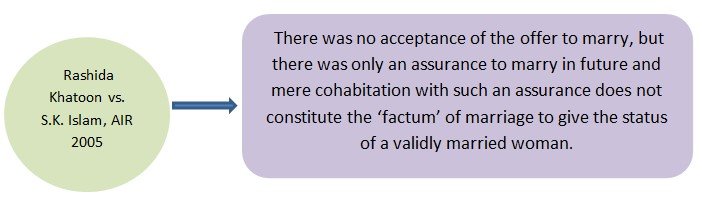
The words conveying proposal and acceptance must be uttered in each other’s presence or in the presence of their agents, who are called Vakils. In case the words are uttered in each other’s presence, the parties should hear the words. Kazi’s presence is must at marriage ceremony and other religious ceremony.
4.One meeting:
The other requirement of a valid marriage is that the transaction must be completed at one meeting. A proposal made at one meeting and an acceptance at another meeting does not constitute a valid marriage.
5.Reciprocity:
There must be reciprocity between offers and acceptance. The acceptance must not be conditional. Where A offers to marry B on Rs. 2000/- as dower and B accepts on condition that Rs. 4000/- should be paid to her as dower, there is no reciprocity between offer and acceptance and therefore there is no marriage.
6. Witnesses:
Under Sunni Law, the proposal and acceptance must be made in the presence of two males or one male and two female witnesses who are sane, adult, and Muslims. Absence of witnesses does not render marriage void but irregular. In Shia law, witnesses are not necessary at the time of marriage. They are required at the time of dissolution of marriage.
7.Free will and consent:
The parties contracting a marriage must be acting under their free will and consent. The consent should be without fear or undue influence or fraud.
8.Competent parties:
The parties to a marriage must have the capacity of entering into a contract. In other words, they must be competent to marry. A Muslim who is of sound mind, and who has attained puberty, may enter into a contract of marriage. The parties must be able to understand the nature of their Act. A marriage contracted by a ‘majnoon’ (lunatic) is void except when it is contracted in lucid intervals. However, lunatics can be contracted in marriage by their respective guardians
9.Puberty:
Puberty means the age at which a person becomes capable of performing sexual intercourse and procreating children. Puberty and majority are in Muslim law one and the same.
10.No Legal disability:
Legal disability means the existence of certain circumstances under which marriage is not permitted. These prohibitions have been classified into four classes as follows:
A)Absolute Incapacity:
Absolute incapacity arises from:
Consanguinity means blood relationship. A man is prohibited from marrying:
* his mother or grandmother how highsoever.
* his daughter or granddaughter how lowsoever.
* his sister whether full, consanguine or uterine.
* his niece or great niece how lowsoever.
* his paternal aunt (father’s sister, mother’s sister) or great aunt, how highsoever, whether paternal or maternal.
A marriage with a woman prohibited by reason of consanguinity is void. Issues from such marriage are void.
A man is prohibited from marrying:
* his wife’s mother or grandmother how highsoever.
* his wife’s daughter or granddaughter how lowsoever.
* wife of his father or paternal grandfather how highsoever.
* wife of his son or son’s son or daughter’s son; how lowsoever.
A marriage with a woman prohibited by reason of affinity is void. In case, marriage with wife’s daughter or granddaughter is prohibited only if the marriage with his wife was consummated.
When a child under the age of two years has been sucked by a woman other than its own mother, the woman becomes the foster mother of the child. A man may not, for instance, marry his foster mother or her daughter, or his foster sister.
Under Sunni Law, there are few exceptions to the general rule of prohibition on the ground of fosterage and a valid marriage may be contracted with:
* Sister’s foster mother
* Foster sister’s mother
* Foster son’s sister
* Foster brother’s sister
(Void in Shia Law, Valid in Sunni Law)
B) Relative Incapacity:
Relative incapacity springs from cases which render the marriage invalid or irregular only so long as the cause which creates the bar exists. The moment it is removed, the incapacity ends and the marriage become valid and binding.
The following are the cases of relative incapacity:
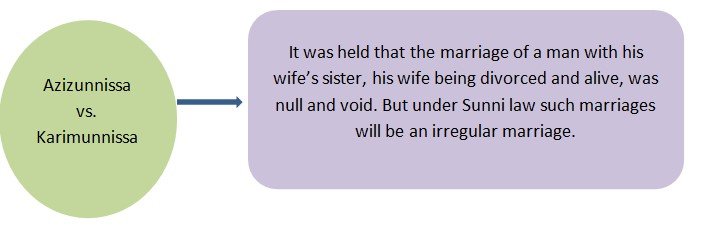
It means contemporaneously marrying two women so related by consanguinity, affinity, or fosterage that they could not have lawfully intermarried with each other if they had been of different sexes. This bar may, however, be removed by divorcing his first wife or when she is dead. The bar of unlawful conjunction renders a marriage irregular, not void.
It means plurality of wives, i.e., marrying a fifth wife. It is unlawful for a Mohammedan to have more wives than four. Marriage with a fifth wife is irregular under Sunni law but this irregularity may be removed by divorcing one of them. Under Shia law, marriage with the fifth wife is not merely irregular, it is void.
It is essential under the Sunni law that at least two male witnesses or one male and two female witnesses must be present to testify that the contract of a marriage was properly entered into between the parties.
In Shia law, a marriage contracted by the spouses themselves or their guardians in private are held valid. Presence of witnesses is not necessary.
The witnesses must be of sound mind, adult, and Muslim.
Under Sunni law, marriage with a woman undergoing iddat is irregular and not void. But under Shia law, marriage with a woman undergoing iddat is void.
c) Prohibitive Incapacity:
It arises in the following cases:
Polyandry means the fact of having more than one husband. Polyandry is forbidden in the Muslim system and a married woman cannot marry a second time so long as the first marriage subsists.
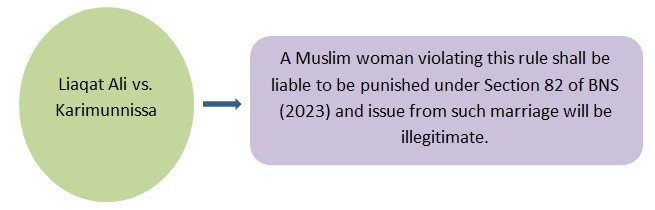
Marriage of a Muslim female with a non-Muslim male whether he be a Christian, or a Jew or an Idolater or a fire worshipper is irregular under Sunni law and void under Shia law.
d) Directory Incapacity:
This may arise from:

we believe in a holistic approach to legal education building not just lawyers, but socially conscious leaders of tomorrow.
