Nature of Comparative Politics
Dr. Tanmoy Mukherji
Advocate
Nature of Comparative Politics
Tanmoy Mukherji
Advocate
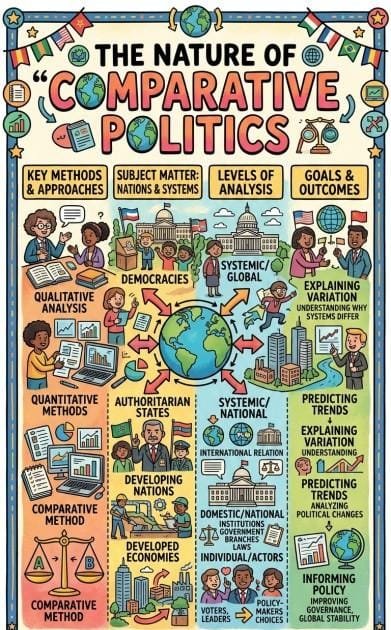
(a) Nature of Comparative Politics
→Comparative politics is a major branch of political science concerned with the systematic comparison of political systems, institutions, and processes of different countries. Traditionally, comparative politics focused mainly on the study of constitutions, legal structures, and formal governmental institutions. This approach was largely descriptive and institutional. However, with the emergence of the modern behavioural approach, the scope of comparative politics widened significantly. It now includes the study of political culture, political socialisation, interest groups, political parties, pressure groups, voting behaviour, and decision-making processes.
→The nature of comparative politics is scientific and analytical. It aims to discover patterns, regularities, and general principles of political behaviour by using empirical data and comparative methods. It is also interdisciplinary, borrowing concepts and methods from sociology, economics, psychology, and anthropology. Modern comparative politics is problem-oriented rather than country-oriented and seeks to explain why political systems behave differently under similar or different conditions. Thus, its nature is dynamic, explanatory, and theory-building.
(b) System of Checks and Balances
→The system of checks and balances is a constitutional device closely associated with the doctrine of separation of powers. Its main objective is to prevent the concentration of power in any single organ of government and to ensure mutual control among the legislature, executive, and judiciary. While each organ has its own defined functions, it is also given certain powers to check the excesses of the others.
→In practice, this system operates most effectively in the United States. The President can veto laws passed by Congress, but Congress can override the veto by a special majority. The President appoints judges, but such appointments require Senate approval. The judiciary, through the power of judicial review, can declare laws and executive actions unconstitutional. This system promotes accountability, safeguards individual liberty, and maintains constitutional balance. It ensures that no branch becomes authoritarian and that governance remains limited and responsible.
(c) ‘Veto’ Powers of the U.S. President
→The veto power of the U.S. President is an important constitutional weapon that enables the executive to participate effectively in the legislative process. According to the U.S. Constitution, every bill passed by Congress must be presented to the President for approval. If the President agrees, he signs the bill and it becomes law. If he disagrees, he may veto the bill by returning it to Congress with his objections.
→The President also possesses the pocket veto, which occurs when Congress adjourns within ten days of presenting the bill and the President neither signs nor returns it. In such cases, the bill automatically lapses. However, Congress may override a regular veto by a two-thirds majority in both Houses. The veto power enables the President to check hasty or undesirable legislation and strengthens the principle of checks and balances within the constitutional framework.
(d) ‘Shadow Cabinet’ in the U.K.
→The Shadow Cabinet is a distinctive institution of the British parliamentary system and plays a crucial role in democratic opposition. It consists of senior leaders of the opposition party, each of whom is assigned to “shadow” a particular Cabinet minister of the ruling government. The leader of the opposition appoints the members of the Shadow Cabinet.
→The primary function of the Shadow Cabinet is to scrutinize government policies, expose weaknesses, and offer constructive criticism. It also prepares alternative policies and programmes and acts as a government-in-waiting. If the opposition party wins the general election, members of the Shadow Cabinet usually become Cabinet ministers. Thus, the Shadow Cabinet ensures effective parliamentary accountability, continuous policy debate, and political stability.

we believe in a holistic approach to legal education building not just lawyers, but socially conscious leaders of tomorrow.
