MASTER’S LIABILITY FOR ACTS DONE BY SERVANT
Law of Torts
Dr. Tanmoy Mukherji
Advocate
MASTER’S LIABILITY FOR ACTS DONE BY SERVANT –
Tanmoy Mukherji
Advocate
1. Meaning of Vicarious Liability-
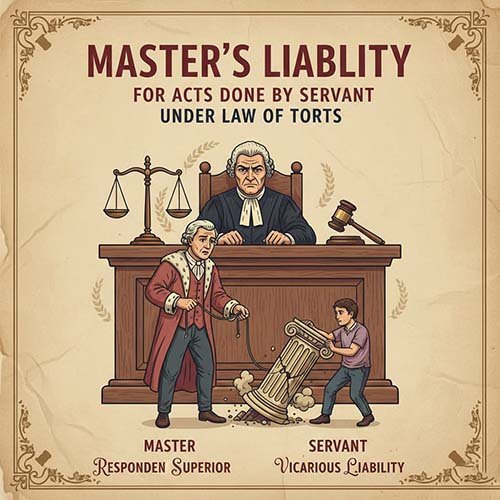
Vicarious liability means holding one person liable for the wrongful act (tort) committed by another person. In this context-
Master = employer
Servant = employee
If a servant commits a tort in the course of employment, the master is jointly and severally liable.
2. Rationale / Reasons-
1. Control – Master controls the work of servant.
2. Benefit – Servant’s acts benefit the master → so he must bear the burden.
3. Deep Pocket Theory – Master is financially stronger to compensate victims.
4. Social convenience & equity – Ensures compensation to the injured party.
3. Essentials for Master’s Liability-
To make the master liable, the following conditions must be satisfied:
(A) Existence of Master–Servant Relationship-
Contract of service must exist.
Tests used:
1. Control Test – Master controls how work is done.
2. Integration Test – Servant’s work is integral to employer’s business.
3. Multiple Test – Combination of control, wages, tools, supervision, etc.
Case Law:
Yewens v. Noakes (1880) – Laid down control test.
(B) Tort must be committed by the servant-
If the tort is committed by-
An independent contractor → Master is NOT liable.
A borrowed servant → Liability depends on who has effective control.
Case Law:
Mersey Docks v. Coggins (1947) – Who had control → liable.
(C) Act must be done in the “course of employment”-
This is the most important condition.
A servant acts in the course of employment when-
1. He is doing what he is authorized to do.
2. He is doing it in an authorized manner (even if done negligently).
3. Even if he acts against instructions but within the scope of employment.
Leading Case:
Limpus v. London General Omnibus Co. (1862)
Driver raced another bus against orders → still master liable.
4. Acts for which Master is Liable-
(i) Wrongful Acts Authorized by Master
If the master directly authorizes the tort → clear liability.
(ii) Unauthorized Mode of Doing an Authorized Act
If the servant commits the tort while doing master's work but in an improper manner:
Case Law:
Century Insurance Co. v. Northern Ireland Transport Board (1942) – Servant smoking while transferring petrol → explosion; master liable.
(iii) Negligence of Servant-
If a servant performs his duty negligently
Case Law:
State of Rajasthan v. Vidyawati (1962) – Driver negligently hit someone → State held vicariously liable.
(iv) Fraud or Willful Wrongdoing in the Course of Employment-
If the wrongful act is closely connected to employment:
Case Law:
Lloyd v. Grace Smith & Co. (1912) – Clerk committed fraud while doing employer’s business → Master liable.
(v) Act for Master’s Benefit-
Even if the servant acts beyond authority but to benefit the master.
Case Law:
Barwick v. English Joint Stock Bank (1867) – Fraud for employer’s benefit → bank liable.
5. Acts for which Master is NOT Liable-
(i) Acts done outside the course of employment-
Servant on a frolic of his own → Master not liable.
Case Law:
Joel v. Morrison (1834) – Detour for personal purpose → no liability.
(ii) Unauthorized Acts Not Connected to Duty-
If the act is completely independent of the employment:
→Theft
→Personal enmity
→Acts for personal pleasure
(iii) Independent Contractor-
Master is not liable unless:
→There is negligence in selecting contractor.
→Work is inherently dangerous.
→Non-delegable duty exists.
6. Special Situations-
(i) Borrowed Servant
Whoever has control at the time → liable.
(ii) Partners
Partners are each other’s principle → vicariously liable.
(iii) Government Servants-
State is liable for non-sovereign functions.
Case Law:
Kasturi Lal v. State of UP (1965) – Sovereign functions → no liability.
7. Modern Test – “Close Connection Test”-
Used to determine whether a tort is connected with employment.
Case Law:
Lister v. Hesley Hall Ltd. (2001) – Sexual abuse by warden; employer liable because of close connection.
8. Leading Case References-
1. Limpus v. London General Omnibus – Unauthorized mode.
2. Century Insurance Case – Negligent performance.
3. State of Rajasthan v. Vidyawati – State liability.
4. Lloyd v. Grace Smith – Fraud by servant.
5. Barwick v. English Joint Stock Bank – Fraud & benefit.
6. Joel v. Morrison – Frolic of his own.
7. Mersey Docks v. Coggins – Borrowed servant.
8. Kasturi Lal Case – Sovereign immunity.
9. Conclusion-
Master’s liability is based on:
→Control
→Responsibility
→Risk distribution
→Social justice
If a servant commits a tort within the course of employment, the master is liable, even if the servant acted against instructions, negligently, or fraudulently.

we believe in a holistic approach to legal education building not just lawyers, but socially conscious leaders of tomorrow.
