MAINTENANCE (NAFAQA)
Muslim Law
TANMOY MUKHERJI INSTITUTE OF JURIDICAL SCIENCE
Dr. Tanmoy Mukherji
[Advocate]
MAINTENANCE (NAFAQA)-
Tanmoy Mukherji
[Advocate]
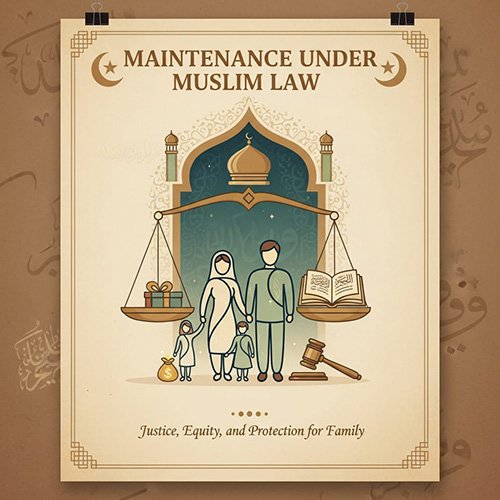
The Arabic equivalent of "maintenance" is Nafaqa, which literally means, "What a person spends over his family".
In legal sense, maintenance signifies and includes three things:
i) Food
ii) Clothing
iii) Lodging.
Definitions-
Hedaya-
According to Hedaya, maintenance is all those things which are necessary to the support of life, such as food, clothes and lodging.
Fatawa-i-Alamgiri-
According to Fatawa-i-Alamgiri, Maintenance comprehends food, clothing and lodging, though in common parlance it is limited to the first.
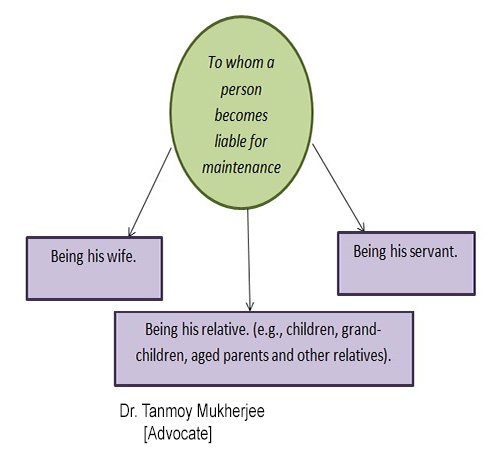
Liability of a person towards maintenance-
Essentials-
Only such person is entitled to maintenance-
i) Who has no property of his own;
ii) Who is related within prohibited degrees to the person;
iii) The person from whom he claims in "easy circumstances".
Exception-
The above mentioned essentials are not required in the case of the following persons-
i) When the claimant is wife of the person.
ii) When the claimants are minor sons or unmarried daughters, except when he has no means.
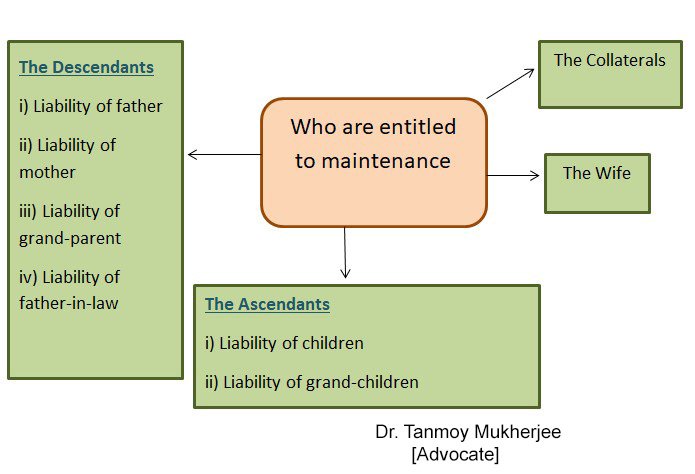
Persons entitled to maintenance-
The Descendants-
1. Liability of father-
The liability of a father to maintain his children is absolute in terms. He is bound to maintain them so long as he can earn and is in a position to do so or the children have no independent income of their own.
A father is liable to provide maintenance to the following:
-minor children of either sex.
-unmarried daughter.
-married daughter, if she is poor, and
-adult son, if he is necessitous (indigent).
Maintenance of children after the dissolution of marriage-
The liability of a father to maintain his children is not affected by the dissolution of the marriage. He is bound to maintain them, even if they are in their mother's custody.
Under Sec. 3(1) (B) of the Muslim Women (Protection of Rights on Divorce) Act, 1986, the divorced wife has a right to claim maintenance in respect of her children.
The right of children to claim maintenance is separate and independent to the right of a divorced wife to claim maintenance. Therefore, the right of the child is not affected by Section 3(1) (B) of the Act.
Reference Cases-
Noor Saba Khatoon v/s Mohd. Quasim-
-The court held that both under the Muslim Personal law and under sec. 125 of CrPC, the obligation of the father was absolute when the children were living with the divorced wife.
-The Court clarified that sec. 3(1) (B) of the Muslim Women Act, 1986 did not in any way affect the rights of the minor children of divorced Muslim parents to claim maintenance from their father under sec. 125 of the CrPC till they attain majority or were able to maintain themselves or in the case of a female children, till they were married.
Haji Farzand Ali v/s Noorjahan-
-The Court held that children's right was independent of the mother's. All the clauses (a), (b), (c) and (d) of section 125 have used the conjunction 'or' which is significant and shows each claimant's right is independent.
2. Liability of mother
-The mother is liable to maintain her children when the father has no means and is indigent.
-She is entitled to recover the expenses from the father when circumstances permit.
3. Liability of grandparent-
When both father and mother fail to maintain their children, it is the duty of the grandparents, maternal or paternal, to provide for their maintenance.
4. Liability of father-in-law-
There is no obligation on father-in-law to maintain the widow of his son.
The Ascendants-
1. Liability of children-
Every children, whether male or female, adult or minor, who has sufficient property, is responsible to supply maintenance to his parents.
Sunni Law-
-Under Sunni Law, whether the parents are capable of earning or not makes no difference, the children are under duty to maintain their parents if they are capable to maintain the parents.
-If a child is in a position to maintain only one of its parents, mother gets priority over the father.
Shia Law -
- Under Shia law, the children are relieved of their duty if the parents are capable of earning.
2. Liability of grandchildren-
The grandchildren are liable to provide maintenance of their grandparents if:
i) There are no children, or
ii) The children are indigent.
The Collaterals-
A Muslim is under an obligation to maintain his collateral relations within the prohibited degree only in the following cases:
i) When he himself is in "easy circumstances"; and
ii) The relation claiming to be maintained has no other means of maintenance.
The Wife-
Requisites-
The right of a Muslim wife to be maintained by her husband arises in the following two cases-
-on account of status arising out of a valid marriage.
-on account of a pre-nuptial agreement entered into between the parties to the marriage, or between the parents in the case the parties or one of them is minor.
1) Maintenance during subsistence of Marriage-
During subsistence of marriage the right of maintenance of the wife is absolute. The husband is bound to maintain the wife if she fulfills following conditions-
-She has attained puberty.
-She places and offers to place herself in power so as to allow free access to herself at all lawful times and obeys all his lawful commands.
ii) Maintenance of widow-
The wife's right of maintenance ceases on the death of her husband, for her right of inheritance supervenes. The widow is therefore not entitled to maintenance during the iddat of death.
iii) Maintenance of Divorced woman-
Before Shah Bano Case-
-The husband is liable to maintain his divorced wife till the period of iddat only and his liability to maintain the divorced wife terminates after this period.
-If the divorce is not communicated to the wife, she is entitled to maintenance even after the expiry of the period of iddat.
Under Section 144 BNSS-
Under Section 144 of the Bharatiya Nagarik Suraksha Sanhita, 2023, the term 'wife' includes a divorced wife or a wife who has obtained a divorced from the husband and has not remarried.
Under the Sanhita, a divorced wife is entitled to be maintained by her former husband beyond the period of iddat provided she remains unmarried.
Under Sec. 146(3) of the Sanhita, the order for the maintenance in favor of a divorced wife shall be cancelled if-
-she has remarried;
-she received the whole sum due to her under any customary on personal law;
-she has voluntarily surrender her rights to maintenance after her divorce.
Reference Case-
Zohra Khatoon v/s Mohd. Ibrahim-
The SC has held that the word wife in sec. 125(1) explanation (B) of CrPC, 1973 includes a woman who has obtained a decree for dissolution of her marriage under any of the provisions of the Dissolution of Muslim Marriages Act, 1939.
After, Shah Bano Case-
Shah Bano Begum v/s Mohammad Ahmed Khan, AIR 1985 SC 945 –
- The SC held that a Muslim husband having sufficient means must provide maintenance to his divorced wife who is unable to maintain herself.
-The plea that the maintenance is payable only till the period prescribed under Muslim personal law, during which she should abstain from sexual intercourse and other luxuries, is rejected.
Constitutional Validity of the Muslim Women Protection of Rights on Divorce Act, 1986-
Under the Muslim Women Protection of Rights on Divorce Act, 1986, A muslim divorced woman shall be entitled for a reasonable and fair provisions and maintenance during the period of iddat by her former husband and in case she maintains the children borne to her before or after her divorce, such reasonable provisions and maintenance would be extended to a period of two years from the date of the birth of the children.
Reference Cases-
Danial Lalifi v/s Union of India, (2000) 7 SCC 740-
The Constitutional validity of the Muslim Women Protection of Rights on Divorce Act, 1986, under which section 125 of CrPC was made inapplicable to divorced Muslim women was challenged.
Decision of Court-
While upholding the validity of the Act, the Supreme Court held that-
-A Muslim husband is liable to make reasonable and fair provision for the future of the divorced wife which obviously includes her maintenance as well. Such a reasonable and fair provision extending beyond the iddat period must be made by the husband within the iddat period in terms of sec 3(1)(a) of the Act.
-Liability of a Muslim husband to his divorced wife arising under section 3(1) (a) of the Act to pay maintenance is not confined to the iddat period.
Shabana Bano v/s Imran Khan, AIR 2010 SC 305-
The Apex court has reiterated that sec. 125 of CrPC would be applicable to a divorced Muslim woman for the purpose of claiming maintenance against her husband even after the expiry of iddat so long as she does not re-marry.

we believe in a holistic approach to legal education building not just lawyers, but socially conscious leaders of tomorrow.