Liability for Animals
Law of Torts
Dr. Tanmoy Mukherji
Advocate
Liability for Animals-
Tanmoy Mukherji
Advocate
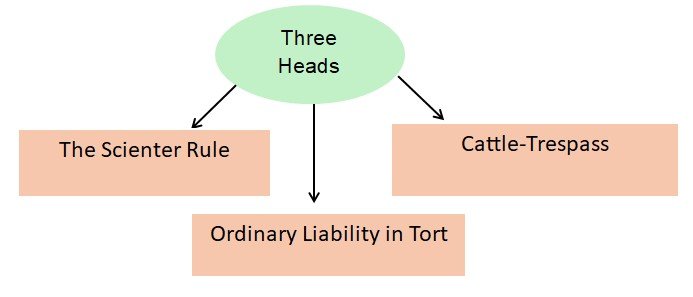
The liability for the damage done by animals can be studied under the following three heads-
1. THE SCIENTER RULE-
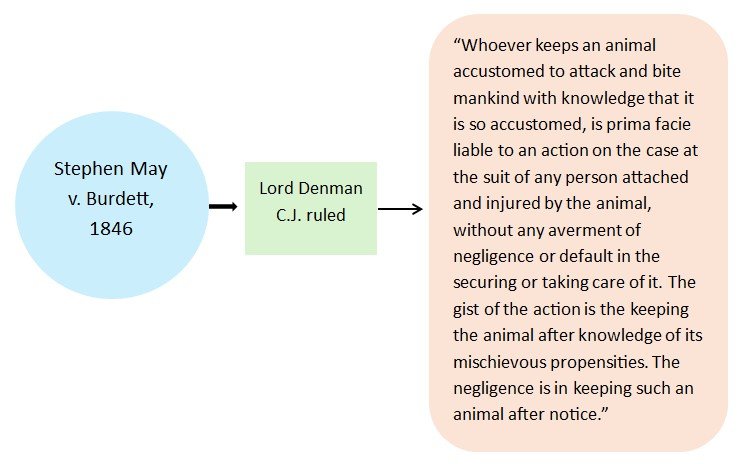
The liability of the defendant under this rule depends upon the knowledge of the dangerous character of the animals. If the defendant has not been able to properly control the animal which he knows or ought to know to be having a tendency to do the harm, he is liable.
Categories-
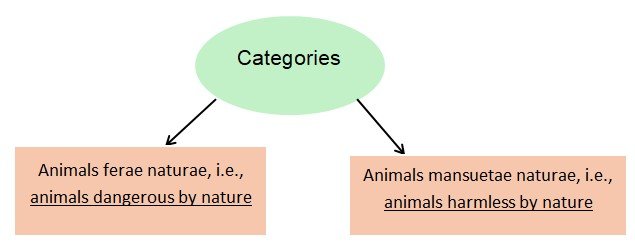
For the purpose of this rule, the animals have been divided into two categories namely-
Can a wrongful act of a third person be a defence to liability for the damage caused by a dangerous animal?
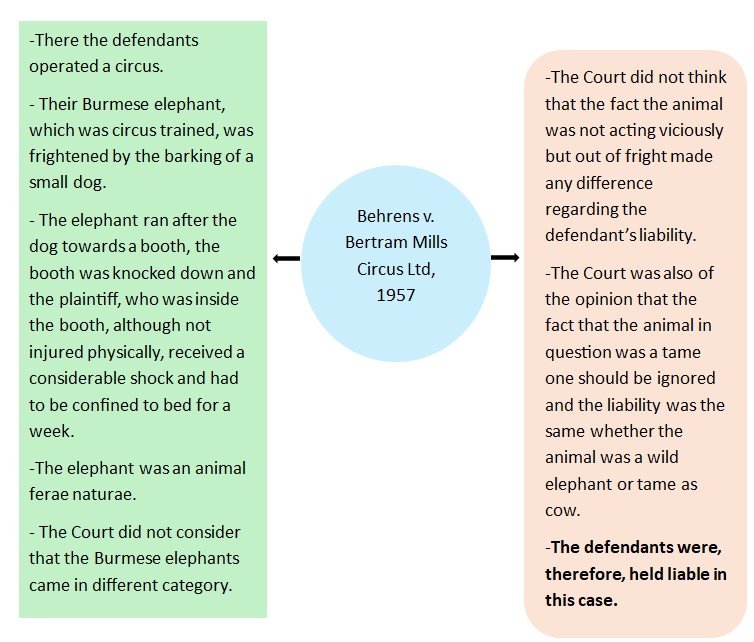
After discussing various judicial precedents based on English Common Law, Queen’s Bench relying on Ryland’s case[Rylands v. Fletcher, (1908) 2 KB 825], in Behrens v. Bertram Mills Circus Ltd. 1957, laid down that the wrongful act of a third party afforded no defence to liability for injury done by a savage animal.
- In the instant case, the plaintiffs, husband and wife, were midgets, who were conducting a funfair booth adjoining to defendant's circus company premises contrary to the defendant's rules. Plaintiff's manager had a small dog which had been introduced into the booth. The dog ran out barking and snapping at one of six elephants belonging to circus, who were passing the booth. The elephants turned and went after the dog; knocking down as a result the plaintiff was seriously injured by falling parts of the booth.
In the above factual matrix, three points were considered by the Queen’s Bench-
(1) None of the elephants directly attacked either of the plaintiffs;
(2) The act of the elephant was caused by the wrongful act of a third party, the plaintiff’s manager in introducing the dog into the funfair;
(3) The midgets were conducting the booth on the licence given by the circus company with the knowledge that the elephants were being kept and brought to circus ring through the passage lying in front of the booth.
Stating that the wrongful act of a third party afforded no defence to liability for injury done by a savage animal, the Queen’s Bench held -The harmfulness of an offending animal was to be judged not by the particular training and habit, but by reference to the general habit of the species to which it belonged.
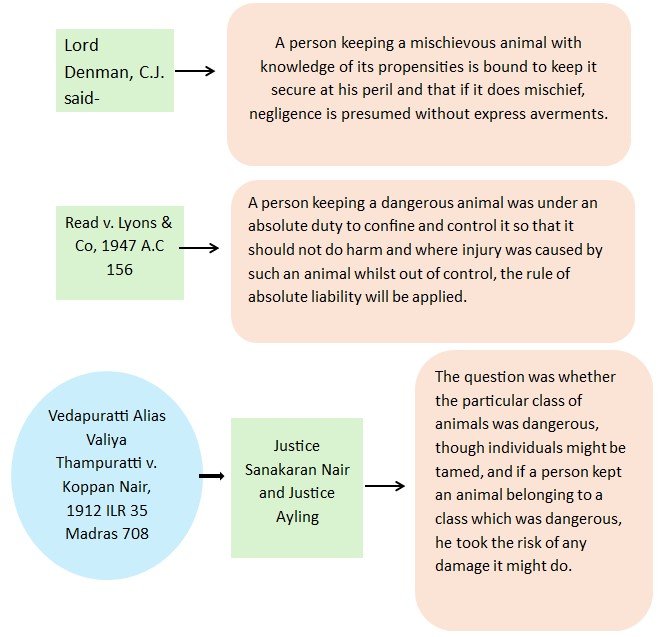
-The keeper of a dangerous animal, the Queen’s Bench, said was under an absolute duty to confine and control it so that it should do not harm, and hence if injury was caused by such an animal whilst out of control, the rule of absolute liability would be applied whether or not the injury resulted from the animal’s vicious or savage propensity.
Liability for keeping animals ‘ferae naturae’-
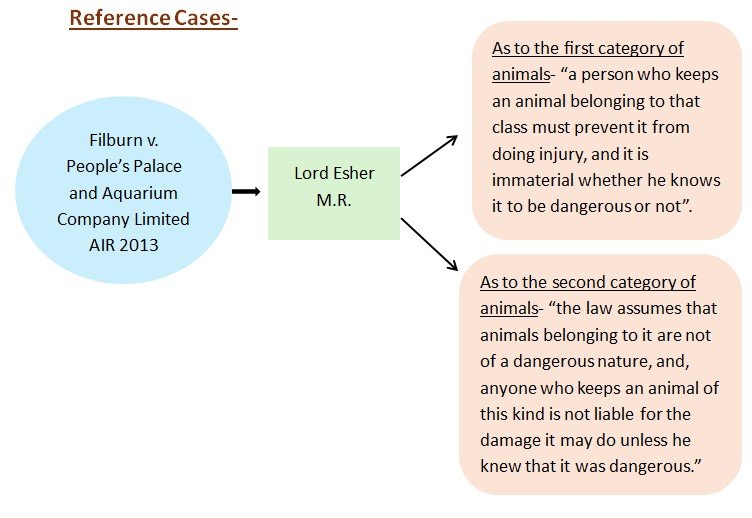
The keeper of the animals ferae naturae knows of their dangerous nature and if such an animal gets out of control and causes damage, he will be liable. The keeper keeps such an animal at his peril and his liability is strict. The liability arises even without the proof of negligence. Thus, if the monkey kept by the defendant bites the plaintiff, the defendant will be liable even without the proof of negligence on the part of the defendant in respect of the control of that monkey. It is no defence to say that the animal in question, though belonging to the category of ferae naturae, is in fact a tame one or even circus trained or the animal was acting out of fright rather than viciously.
Reference Cases-
It appears that placing an elephant in the category of animals of ‘ferae naturae’ under all conditions may not be applicable in India. In India, the elephant is used on various ceremonial occasions and is more or less kept as a pet animal with certain obvious precautions. For unforeseeable damage caused by the elephant there may be no liability.
Persons having elephant joy-ride seriously injured-
Dr. M. Mayi Gowda v. State of Karnataka, 1996-
-The complainant and 5 children of his family took an elephant joy-ride on 7-1-92 at about 8.00 p.m. in Mysore Dasahra Exhibition ground after having purchased tickets for the same. After taking a number of rounds, while the complainant, etc. Were in the process of getting down the cradle, the elephant became panicky in the rush hour and ran forward. The complainant was thrown on the ground as a result of which he received serious injuries resulting in total loss of his eyesight to both the eyes. He was a medical practitioner. He claimed compensation of Rs. 9, 99,000.
-It was found that it was a female elephant having participated in such rides and festivals for 13 years. It had acted in film shootings, various religious functions and honouring the V.I.P.s.
-It was held that there was no negligence on the part of the opposite parties who had organized the joy-ride. The reason of the accident was unusual and unfortunate behaviour of the elephant, and therefore the complaint was dismissed.
Death or injury caused by wild animals-
State of Himachal Pradesh v. Halli Devi, AIR 2000-
-The plaintiff/respondent, a resident of village Rohla in Chamba district, while going to her cattle shed to feed her cows on 27-3-1989, was attacked by a wild animal, i.e., a black bear. She suffered fractures in different parts of her body and also lost complete eyesight of her left eye.
-She was granted Rs. 5,000/- as ex gratia relief.
-She filed a suit for recovery of Rs. 1, 00,000 as damages for the injuries sustained by her. She averred that the Divisional Forest Officer, under the scheme for protection of wildlife, had let loose bears and other protected animals in the jungles.
-It was held that the mere fact that the killing of the wild animals was prohibited under the law did not mean that the State had become the owner of those animals, nor did it create the liability of the State for the death or injury caused by such animals.
-Moreover, there was no provision in the Wildlife Protection Act, 1972 for providing relief to the victims of wild animals. Further, providing ex gratia relief in such cases did not amount to admission of liability by the State and that also did not create any State liability to pay compensation in such cases.
Liability for keeping animals mansuetae naturae -
For making the defendant liable in respect of the damage done by an animal belonging to the class of harmless or domestic animals, two things have to be proved:
(i) That the animals in question had a vicious propensity which is not common to animals of that species; and
(ii) That the defendant had the actual knowledge of the viciousness.
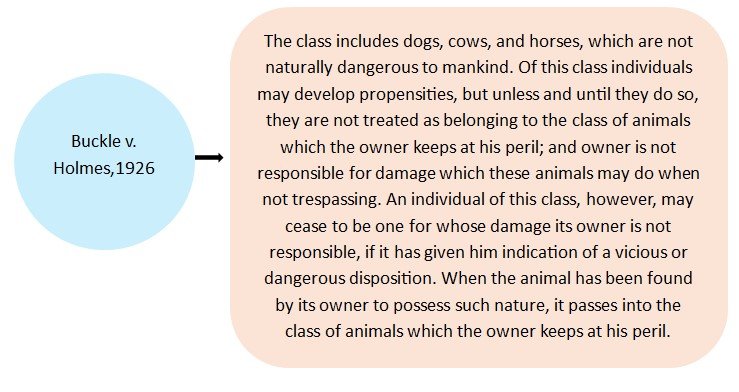
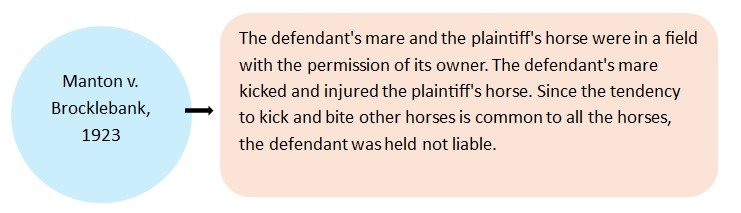
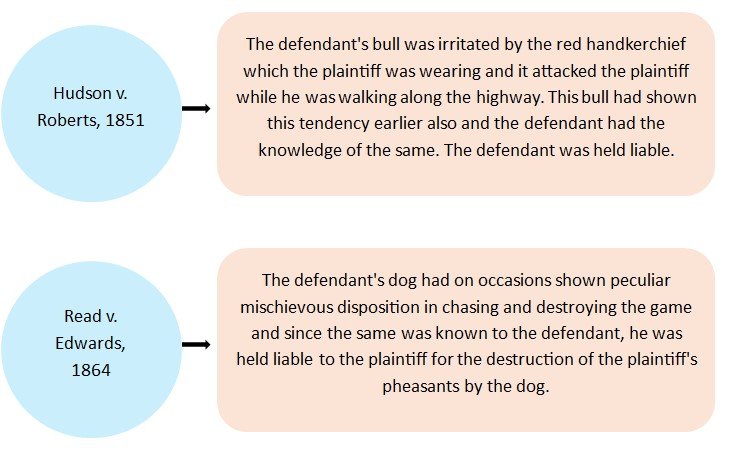
If the plaintiff proves that an animal has previously shown a dangerous propensity and the defendant was aware of the same, the defendant will be liable for the harm caused by such an animal.
2. CATTLE TRESPASS-
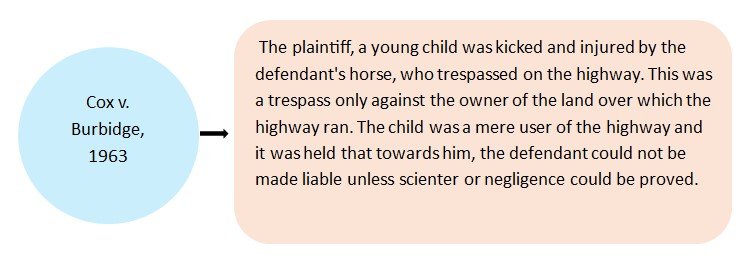
-Apart from the scienter rule, the owner of the cattle may also be liable if his cattle commit trespass on the land of another person. The liability in such a case is strict and the owner of the cattle is liable even if the vicious propensity of the cattle and, owner's knowledge of the same are not proved. There is also no necessity of proving negligence on the part of the defendant.
-Cattle for the purpose include bulls, cows, sheep, pigs, horses, asses and poultry. Dogs and cats are not included in the term and, therefore, there cannot be cattle trespass by dogs and cats.
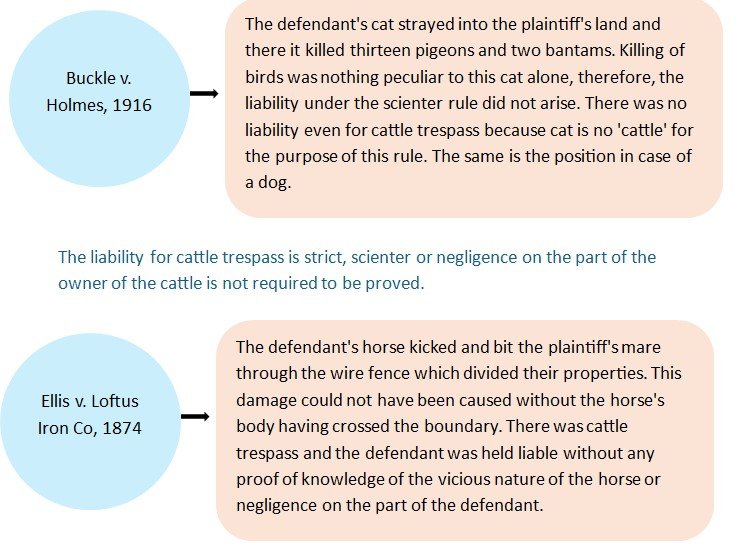
When there is a cattle trespass, the defendant is liable for the damage which directly results from that trespass.
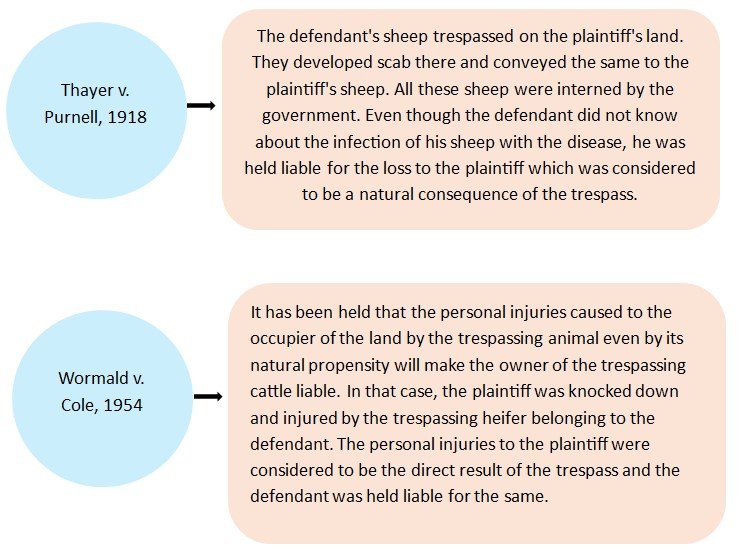
It may be noted that the action for cattle trespass can be brought only by the occupier of land. Persons other than the occupier, such as his family members, guests or strangers on his land can sue under the scienter rule or for negligence and not for cattle trespass.
3. ORDINARY LIABILITY IN TORT-
It may also be possible to commit various torts through the instrumentality of animals. Keeping dogs in some premises which cause unreasonable interference with the neighbour's enjoyment of his property is a nuisance. Similarly, nuisance could be committed through the stench of pigs or making a stable near a neighbour's house or obstructing a right of way through animals. The torts of assault and battery can be committed by setting a dog on the passerby and tort of negligence by not keeping proper control of animals on the highway.
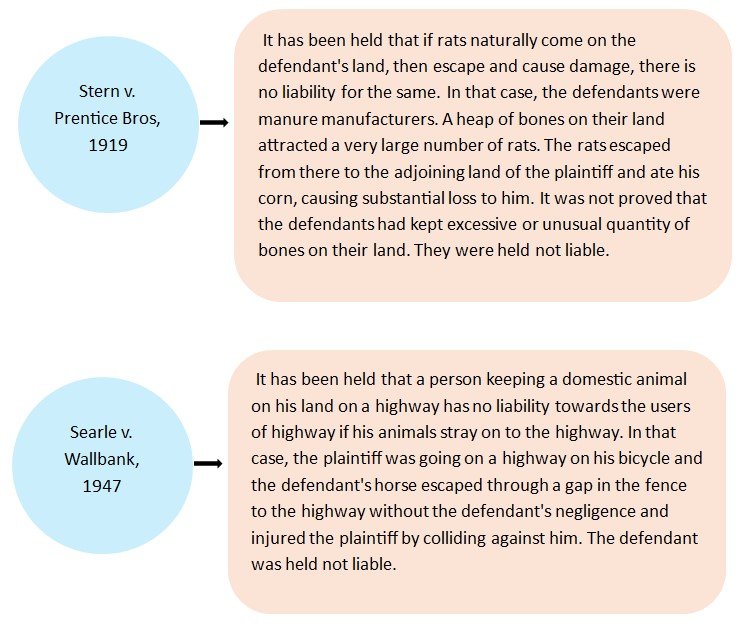
To the above stated rule in Searle v. Wallbank, there are the following exceptions-
(1) If a person has an animal under his control on a highway, he will be liable if he negligently fails to have a reasonable control of the animal there.
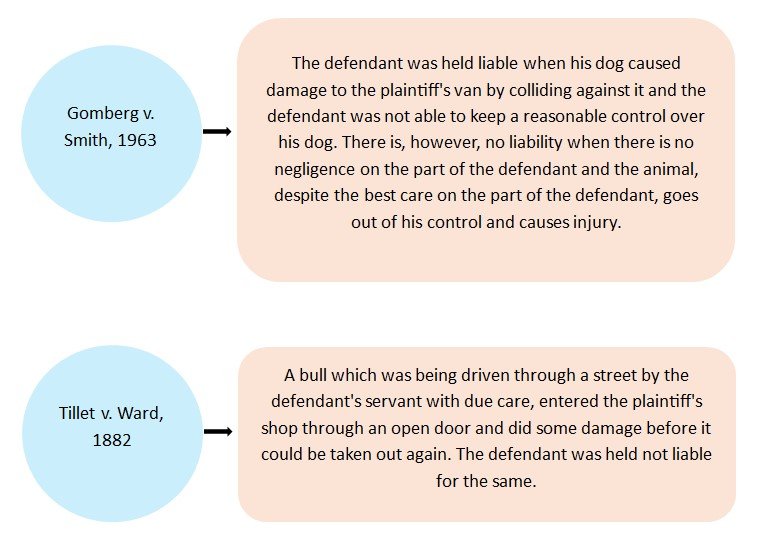
(2) As discussed above, liability for the escaping animal may also arise under the scienter rule. Thus, if a person keeps an animal which is ferae naturae or an animal though a mansuetae naturae but known to its keeper as having some vicious propensity, the keeper is liable if the animal escapes on the highway and causes damage.

we believe in a holistic approach to legal education building not just lawyers, but socially conscious leaders of tomorrow.