LEASE OF IMMOVABLE PROPERTY
Transfer of Property Act, 1882
Dr. Tanmoy Mukherji
Advocate
LEASE OF IMMOVABLE PROPERTY [Section 105-117 of the Transfer of Property Act]-
Tanmoy Mukherji
Advocate
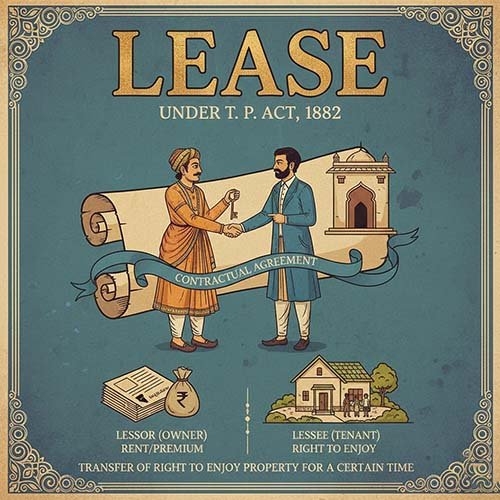
Section 105 to 117 of the Transfer of Property Act, 1882 lay down the provisions relating to 'Lease of Immovable Property'. Section 105 defines the terms lease, lessor, lessee, premium and rent. Section 106 lays down the rule relating to duration of certain leases in the absence of written contract or local usage. Section 107 provides for the modes by which leases may be effected or leases how made. Section 108 deals with the rights and liabilities of lessor or and lessee. Section 109 deals with the right of the lessor's transferee. Section 110 makes provision for exclusion of day on which term commences. In other words, it lays down the rule as to how the period of lease should be compiled. Section 111 provides for various modes by which lease may be determined. Section 112 deals with waiver of forfeiture. It specifies the ways for waiving forfeiture. Section 113 speaks about the waiver of notice to quit. Section 114 relates to relief against forfeiture for non-payment of rent. Section 114 A, inserted by the Amendment Act of 1929 deals with relief against forfeiture in certain other cases. Section 115 deals with the effect of surrender and forfeiture on under leases or sub leases. Section 116 deals with the effect 'holding over'. Finally, Section 117 deals with exemption of Leases for agricultural purposes.
MEANING-
-The expression 'Lease' literally means transfer of right to use or enjoyment of an immovable property for a specific or indefinite period in consideration for some benefit in cash, kind or in service paid or promised to be paid in lump sum or periodically as per terms and the same is accepted.
- Lease' is a transfer of interest, which is limited and qualified, of an immovable property to another for a specific or indefinite period (in perpetuity) in consideration of price in cash or kind or in service paid or promised and the same is accepted by the latter.
-In lease, the transferor is called 'Lessor' and the transferee is called 'Lessee'. The property is called 'Lease hold property'.
-A lease is, not a mere contract but is a transfer of an interest in immovable property. Section 105 of the Transfer of Property Act defines lease as a transfer of right to enjoy immovable property 'for a certain time' or 'in perpetuity' for consideration. The section recognizes also a lease of immovable property in consideration of a share of crops. The fundamental conception of a lease is that it is the separation of the right of possession from ownership.
Definition-
Section 105 defines the terms Lease, Lessor, Lessee, Premium and Rent.
It runs as follows:
A lease of immovable property is a transfer of a right to enjoy property, made for a certain time, express or implied, or in perpetuity, in consideration of a price paid or promised, or of money, a share of crops, service or any other thing of value, to be rendered periodically or on specified occasions to the transferor by the transferee, who accepts the transfer on such terms.
'Lessor', 'Lessee', 'Premium' and 'Rent defined - The transferor is called the lessor, the transferee is called the lessee, the price is called the premium and the money, share, service or other thing to be so rendered is called the rent.
Essential Elements-
To constitute lease (Lease to be valid) the following essentials/requisites are to be satisfied-
(1) Competence of parties;
(2) Subject matter must be an immovable property;
(3) Duration or terms of lease;
(4) Transfer of right to enjoy;
(5) Consideration; and
(6) Registration.
1. Competence of parties-
The parties to lease viz. Lessor and Lessee must be competent to contract (i.e. within the meaning of Section 11 of the Indian Contract Act, 1872). Further the lessor must have a title or authority to transfer.
2. Subject Matter-
The subject matter of lease must be an immovable property. It includes land, buildings/houses, mines, benefits to arise out of land such as fisheries, ferries etc.
3. Duration or Term of Lease-
The lease may be made for a specific or an indefinite period. It is to be decided/determined by the parties to the lease at the time of entering into lease deed.
4. Transfer of right to enjoy-
A lease involves a transfer of an interest in land or right to enjoy. (The interest transferred under lease is limited, not absolute).
5. Consideration-
Consideration means 'something in return'. In lease, the consideration may be in form of cash, kind or service; paid or promised. There can be no lease without consideration.
6. Registration (Section 107)-
Registration of Lease is necessary. It is effected on the basis of the term of lease, not on the basis of the amount. For this purpose, lease may be categorized under two heads-
(1) Leases from year to year; exceeding one year; permanent leases which must be effected by registered document.
(2) The other leases i.e. renewable from month to month or less than one year may be made either by registered document or by mere delivery of possession.
Distinction between License and Lease-
Section 105 of the T.P.Act defines lease, while Section 52 of the Easements, 1882 defines license. Both lease and license are the rights over an immovable property of others.
In B.M.Lall vs. Dunlop Rubber Co. (1968) 1 SCR 23 at p.27; AIR 1968 SC 175 at p.177 - the distinction between the two concepts was brought out:
i) A lease is the transfer of a right to enjoy the premises; whereas a license is privilege to do something on the premises which otherwise would be unlawful.
ii) The transaction is a lease, if it grants an interest in the land; it is a license if it gives a personal privilege with no interest in the land.
Following are the notable points of distinction between the two-
|
Lease
|
License
|
|
1. Lease creates an interest in the property.
|
1. License does not pass an interest in the property.
|
|
2. Lease confers a right on transferee (Lessee) for a fixed period or period in perpetuity.
|
2. License does not confer any such right but makes an unlawful act lawful.
|
|
3. Lease is transferable.
|
3. License is not transferable.
|
|
4. Lessee can bring a suit in his own name.
|
4. Licensee cannot bring a suit in his own name.
|
|
5. It requires registration.
|
5. It does not require registration.
|
|
6. It is heritable.
|
6. It is not heritable.
|
|
7. It is right in rem.
|
7. It is a right in personam.
|

we believe in a holistic approach to legal education building not just lawyers, but socially conscious leaders of tomorrow.
