LANDMARK JUDGMENT IN INDIAN CONTRACT LAW- MOHORI BIBI v. DHARMODAS GHOSE (Privy Council, 1903)
Dr. Tanmoy Mukherji
Advocate
LANDMARK JUDGMENT IN INDIAN CONTRACT LAW- MOHORI BIBI v. DHARMODAS GHOSE (Privy Council, 1903)-
Tanmoy Mukherji
Advocate
1.INTRODUCTION-
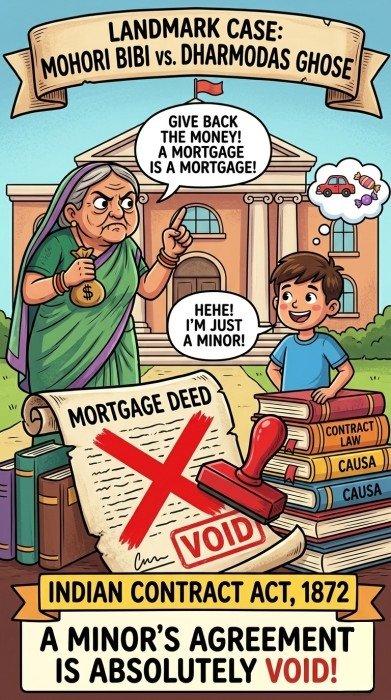
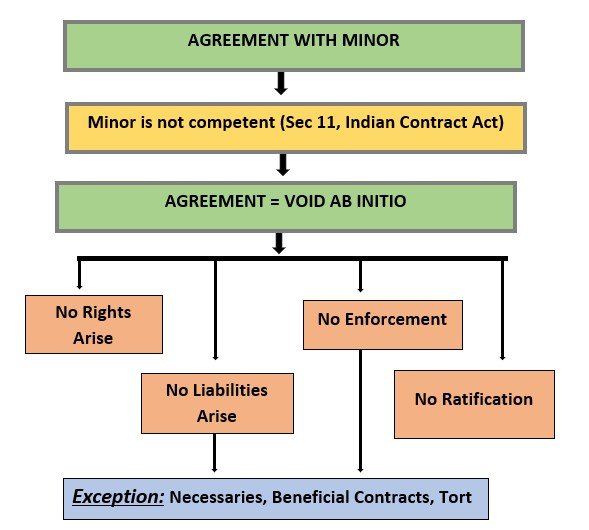
This is a landmark case under the Indian Contract Act, 1872, which lays down the principle that an agreement with a minor is void ab initio (meaning void from the very beginning).
2. FACTS OF THE CASE-
→Dharmodas Ghosh, a minor, through his guardian, mortgaged his immovable property to the plaintiff, Moohuri Bibi, for a loan.
→The moneylender's agent, Kedar Nath, knew that Dharmodas was a minor at the time of the transaction.
→After some time, Dharmodas (through his mother and next friend) filed a suit to cancel the mortgage deed on the ground that he was a minor and the agreement was not binding on him.
→The trial court and the High Court held in favour of the plaintiff. The case was appealed to the Privy Council.
3. ISSUES BEFORE THE COURT-
→Whether the agreement entered into by a minor is void or voidable?
→Whether the minor is bound to return the money advanced under such an agreement?
→Whether the moneylender can enforce the mortgage against the minor?
4. ARGUMENTS-
|
Plaintiff (Moneylender)
|
Defendant (Minor)
|
|
→The minor enjoyed the benefit of the loan. →He should be bound to repay the money. →The agreement should be at least voidable.
|
→As a minor, he was not competent to contract. →The agreement is void ab initio under Section 11 of the Indian Contract Act. →He is not liable to return the money.
|
5. JUDGMENT-
The Privy Council reversed the decisions of the lower courts and held as follows:
→A contract with a minor is absolutely void ab initio and not merely voidable.
→No rights or liabilities arise under such an agreement.
→The minor is not bound to repay the loan nor is the property liable to be charged.
→The mortgage deed executed by the minor was declared void and the suit was decreed.
6.RATIO DECIDENDI-
An agreement with a minor is void ab initio, as he is not competent to contract under Section 11 of the Indian Contract Act, 1872. Such an agreement cannot be ratified on attaining majority and does not create any legal obligation.
7.PRINCIPLES LAID DOWN-
→Minor's agreement is void, not voidable.
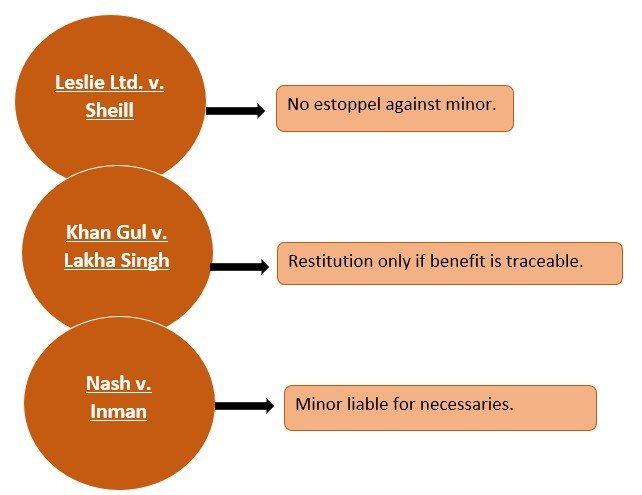
→No estoppel can be raised against a minor.
→The minor is not bound by the contract even if he misrepresents his age.
→The minor cannot be sued for breach of such a contract.
→The contract cannot be ratified after attaining majority.
→Protection of minors is the underlying policy of the law.
8.DOCTRINE OF RESTITUTION-
The Privy Council held that generally a minor is not bound to return the benefits received. However, if the property or money is still traceable in his hands, the court may, in equity and good conscience, order restitution.
9.EXCEPTIONS (Where Minor Can Be Liable)-
→For necessaries supplied (food, clothing, education, medical aid etc.).
→For beneficial contracts (e.g., apprenticeship).
→For torts (independent of contract).
10. IMPORTANCE OF THE CASE-
→It firmly establishes the doctrine that minor's agreement is void ab initio.
→Protects minors from exploitation.
→Forms the foundation of the law relating to capacity to contract.
11. RELATED CASE LAWS-
12. CASE SUMMARY DIAGRAM-
13. KEY TAKEAWAY-
The law gives absolute protection to minors by declaring that any contract entered into by them is void from the very beginning and creates no legal rights or obligations.
“Protection of minors is not a privilege, but a principle of justice."

we believe in a holistic approach to legal education building not just lawyers, but socially conscious leaders of tomorrow.
