LALMAN SHUKLA v GAURI DUTT (1913) - A LANDMARK CASE ON KNOWLEDGE OF OFFER AND ACCEPTANCE
Dr. Tanmoy Mukherji
Advocate
LALMAN SHUKLA v GAURI DUTT (1913) - A LANDMARK CASE ON KNOWLEDGE OF OFFER AND ACCEPTANCE-
Tanmoy Mukherji
Advocate
1. INTRODUCTION-
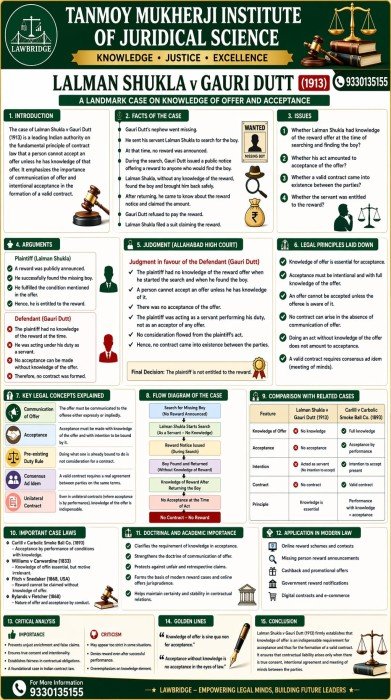
The case of Lalman Shukla v Gauri Dutt (1913) is a leading Indian authority on the fundamental principle of contract law that a person cannot accept an offer unless he has knowledge of that offer. It emphasizes the importance of communication of offer and intentional acceptance in the formation of a valid contract.
2. FACTS OF THE CASE-
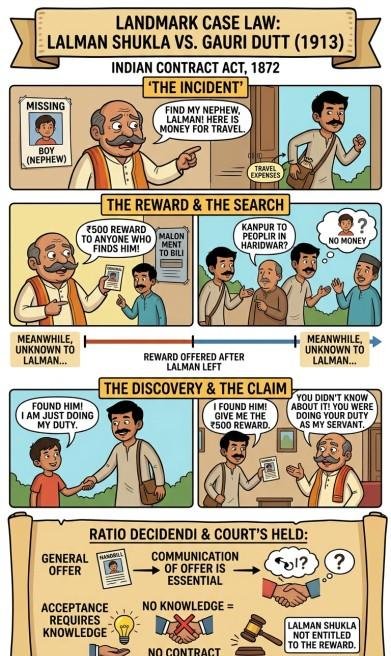
→Gauri Dutt's nephew went missing.
→He sent his servant Lalman Shukla to search for the boy.
→At that time, no reward was announced.
→During the search, Gauri Dutt issued a public notice offering a reward to anyone who would find the boy.
→Lalman Shukla, without any knowledge of the reward, found the boy and brought him back safely.
→After returning, he came to know about the reward notice and claimed the amount.
→Gauri Dutt refused to pay the reward.
→Lalman Shukla filed a suit claiming the reward.
3. ISSUES-
→Whether Lalman Shukla had knowledge of the reward offer at the time of searching and finding the boy?
→Whether his act amounted to acceptance of the offer?
→Whether a valid contract came into existence between the parties?
→Whether the servant was entitled to the reward?
4. ARGUMENTS-
|
Plaintiff (Lalman Shukla)
|
Defendant (Gauri Dutt)
|
|
→A reward was publicly announced. →He successfully found the missing boy. →He fulfilled the condition mentioned in the offer. →Hence, he is entitled to the reward.
|
→The plaintiff had no knowledge of the reward at the time. →He was acting under his duty as a servant. →No acceptance can be made without knowledge of the offer. →Therefore, no contract was formed.
|
5. JUDGMENT (ALLAHABAD HIGH COURT-
Judgment in favour of the Defendant (Gauri Dutt)
→The plaintiff had no knowledge of the reward offer when he started the search and when he found the boy.
→A person cannot accept an offer unless he has knowledge of it.
→There was no acceptance of the offer.
→The plaintiff was acting as a servant performing his duty, not as an acceptor of any offer.
→No consideration flowed from the plaintiff’s act.
→Hence, no contract came into existence between the parties.
Final Decision: The plaintiff is not entitled to the reward.
6. LEGAL PRINCIPLES LAID DOWN-
→Knowledge of offer is essential for acceptance.
→Acceptance must be intentional and with full knowledge of the offer.
→An offer cannot be accepted unless the offeree is aware of it.
→No contract can arise in the absence of communication of offer.
→Doing an act without knowledge of the offer does not amount to acceptance.
→A valid contract requires consensus ad idem (meeting of minds).
7. KEY LEGAL CONCEPTS EXPLAINED-
a. Communication of Offer: The offer must be communicated to the offeree either expressly or implicitly.
b. Acceptance: Acceptance must be made with knowledge of the offer and with intention to be bound by it.
c. Pre-existing Duty Rule: Doing what one is already bound to do is not consideration for a contract.
d. Consensus Ad Idem: A valid contract requires a real agreement between parties on the same terms.
e. Unilateral Contract: Even in unilateral contracts (where acceptance is by performance), knowledge of the offer is indispensable.
8. FLOW DIAGRAM OF THE CASE-

9. COMPARISON WITH RELATED CASES-
|
Feature |
Lalman Shukla v Gauri Dutt (1913) |
Carlill v Carbolic Smoke Ball Co. (1893)
|
|
Knowledge of Offer |
No knowledge |
Full knowledge
|
|
Acceptance |
No acceptance |
Acceptance by performance |
|
Intention |
Acted as servant (No intention to accept) |
Intention to accept present
|
|
Contract |
No contract |
Valid contract |
|
Principle |
Knowledge is essential |
Performance with knowledge = acceptance
|
10. IMPORTANT CASE LAWS-

11. DOCTRINAL AND ACADEMIC IMPORTANCE-
→Clarifies the requirement of knowledge in acceptance.
→Strengthens the doctrine of communication of offer.
→Protects against unfair and retrospective claims.
→Forms the basis of modern reward cases and online offers jurisprudence.
→Helps maintain certainty and stability in contractual relations.
12. APPLICATION IN MODERN LAW-
→Online reward schemes and contests
→Missing person reward announcements
→Cashback and promotional offers
→Government reward notifications
→Digital contracts and e-commerce
13. CRITICAL ANALYSIS-
|
IMPORTANCE
|
CRITICISM
|
|
→Prevents unjust enrichment and false claims. →Ensures true consent and intentionality. →Establishes fairness in contractual obligations. →A foundational case in Indian contract law.
|
→May appear too strict in some situations. →Denies reward even after successful performance. →Overemphasizes on knowledge element.
|
14. GOLDEN LINES-
→"Knowledge of offer is sine qua non for acceptance."
→"Acceptance without knowledge is no acceptance in the eyes of law."
15. CONCLUSION
Lalman Shukla v Gauri Dutt (1913) firmly establishes that knowledge of offer is an indispensable requirement for acceptance and thus for the formation of a valid contract. It ensures that contractual liability arises only when there is true consent, intentional agreement and meeting of minds between the parties.

we believe in a holistic approach to legal education building not just lawyers, but socially conscious leaders of tomorrow.
