Jurisdiction of Civil Court
TANMOY MUKHERJI INSTITUTE OF JURIDICAL SCIENCE
Dr. Tanmoy Mukherji
[Advocate]
Jurisdiction of Civil Court-
Tanmoy Mukherji
[Advocate]
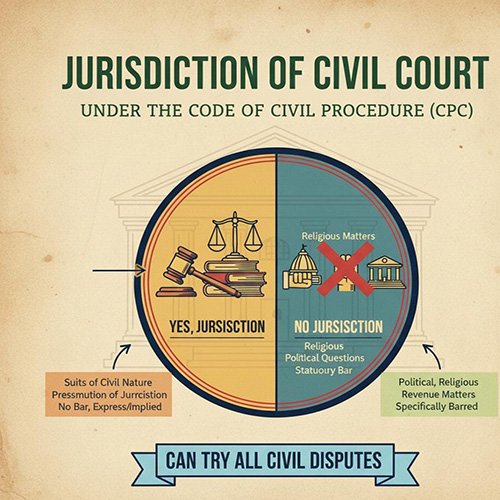
According to section 9 of CPC, 1908, the Courts shall (subject to the provisions herein contained) have Jurisdiction to try all the suits having of a civil nature excepting suits of which their cognizance is either expressly or impliedly barred.
Explanation 1- A suit in which the right to a property or to an office is contested is a civil suit of civil nature, notwithstanding that such right may entirely depend on the questions as to religious rites or ceremonies.
Explanation 2- For the purposes of this section, it is immaterial whether or not any fees are attached to the office referred to in Explanation 1 or whether or not such fees office is attached to a particular place.
Jurisdiction means the authority or power conferred. It is the authority of a Civil Court to hear and decide the case.
Suits of Civil Nature-
Civil wrong is a wrong which is not criminal or political. It refers to disputes involving civil rights.
It such as-
-Right to Property
-Right to Contract
-Right to hold office
-Right to enjoy religious freedoms
-Right to damages or compensation for civil wrong
Expressly Barred-
A suit is expressly barred when a specific law or statutory provision clearly states that the civil court has no jurisdiction to entertain such matters.
Examples of Statutes where Suits are Expressly Barred-
|
Statute
|
Expressly barred Provision
|
Effect
|
|
Income tax Act, 1961
|
Section 293
|
Civil court cannot entertain any suit to set aside or modify orders under the Act.
|
|
Industrial Disputes Act, 1947
|
Section 10, 11, etc.
|
Disputes must be referred to Labour Court or Industrial Tribunal.
|
|
Administrative Tribunals Act, 1985
|
Section 28
|
Jurisdiction of Civil Court barred for service matters of government employees.
|
|
Representation of People Act, 1951
|
Section- 80, 100
|
Election disputes must be decided by Election Tribunal - no civil suit allowed.
|
|
Land Acquisition Act, 1894 / 2013
|
Section 9, 11, 12, etc.
|
Disputes regarding acquisition or compensation must go to the Collector or Reference Court.
|
|
Consumer Protection Act, 2019 |
Implied via exclusive forum |
Consumer disputes must go before consumer commissions, not civil courts. |
|
Railways Act, 1989 |
Section 124 A and Section 22 |
Claims for accidents/damages go to the Railway Claims Tribunal
|
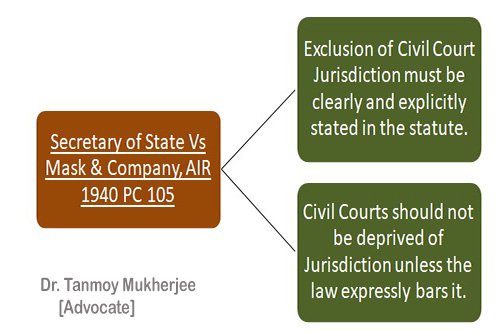
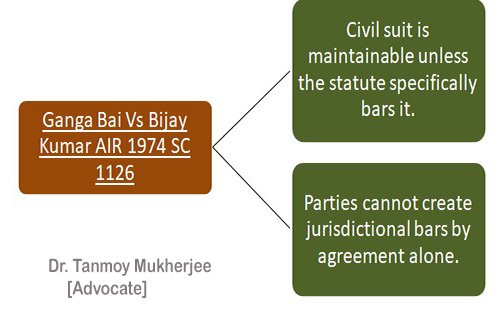
Reference Cases-
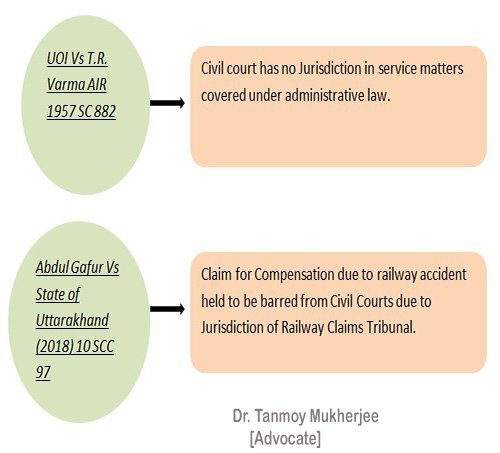
Effects of express bar-
-Civil courts must reject suits where jurisdiction is expressly barred.
→ Filing a suit in violation of such bar leads to -
-Rejection of plaint under order 7 Rule 11(d), CPC.
-Wasted costs / time.
-Appeal or revision might not lie if the bar is statutory.
Impliedly Barred-
Implied bar arises when a special statute-
-Creates a special right or liability,
-Provides a special remedy and
-Lays down a complete adjudicatory mechanism, so civil court intervention is not needed and is not allowed.
- Even without express words, courts can infer that civil Jurisdiction is excluded by necessary implication.
Reference Cases-
Dhula Bhay Vs State of MP, AIR 1969 SC 78
-Where a statute gives finality to decisions of special tribunals, civil court jurisdiction is barred, if:
1. The statute provides an adequate remedy, and
2. No civil right outside the statute is involved.
-Civil court have jurisdiction if:
1. The tribunal acted without jurisdiction.
2. There is fraud on malafide.
3. The statute does not provide an adequate remedy.
-Presumption is in favour of civil jurisdiction unless exclusion is clearly established.
Premier Automobiles Ltd. Vs Kamlekar Santaram Wadky AIR 1976 SC 2238-
Civil Court’s jurisdiction in industrial or labour disputes is impliedly barred if:
-The dispute is an Industrial dispute.
-It involves a workman and employer.
-The Industrial Disputes Act provides a complete mechanism.
But civil court jurisdiction is not barred when:
-The dispute involves purely civil rights, like torts, wrongful dismissal (not covered under Industrial Dispute Act).
Rajasthan State Road Transport Corporation vs. Krishna Kant
(1995) 5 SCC 75-
-If the right is created under special statute, and the statute gives a remedy and forum, then civil Courts cannot try the suit.
-However, if the dispute involves common law rights, civil Courts can hear it.
State of A.P. v/s Manjeti Laxmi Kantha Rao (2000) 3 SCC 689-
-Disputes under the Land Acquisition Act must follow the statutory procedure.
-Civil court cannot entertain suits challenging acquisition proceedings once award is passed - Jurisdiction is impliedly barred.
Commissioner of Income tax v/s Parameswari Devi Sood AIR 1994 SC 1163-
-Tax disputes under the Income Tax Act must be handled by the Income Tax Appellate Authorities.
-Civil courts have no jurisdiction in tax assessment or refund issues.
Sulochana Amma vs. Narayanan Nair (1994) 2 SCC 14-
-Even when Jurisdiction is impliedly barred, if the dispute involves basic civil rights like title, civil Courts can still be approached.
Abdul Waheed Khan vs. Bhawani AIR 1966 SC 1718-
-In wakf property matters, if the Wakf Act provides a specific tribunal, civil court jurisdiction is impliedly barred.
Other Cases-
|
Case |
Held |
|
Dwarka Nath vs 190 AIR 1966 SC 81 |
Writ jurisdiction can still be even if civil court jurisdiction is barred.
|
|
K.S. Venkataraman vs UOI AIR 1979 SC 49 |
Civil courts can test validity of actions taken under statutory powers if fraud is alleged.
|
|
Balavant Rao vs UOI AIR 1969 BOM 351 |
Civil court jurisdiction impliedly barred in service matters (to be dealt by Administrative Tribunals)
|

we believe in a holistic approach to legal education building not just lawyers, but socially conscious leaders of tomorrow.