JUDICIAL REVIEW IN ADMINISTRATIVE LAW
TANMOY MUKHERJI INSTITUTE OF JURIDICAL SCIENCE
Dr. Tanmoy Mukherji
Advocate
JUDICIAL REVIEW IN ADMINISTRATIVE LAW
Tanmoy Mukherji
Advocate
1. INTRODUCTION-
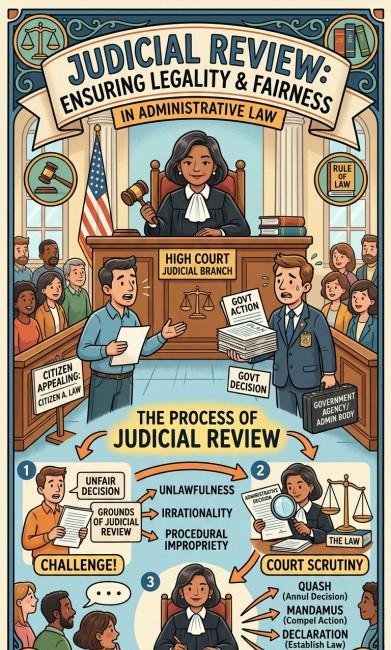
Judicial Review is the power of courts to examine the legality, validity and constitutionality of:
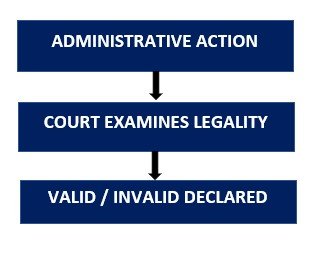
→Administrative actions
→Executive decisions
→Delegated legislation
→Quasi-judicial orders
It ensures that authorities act:
→Within law
→Fairly
→Reasonably
→Constitutionally.
2. MEANING-
Judicial Review means the power of judiciary to review actions of the legislature, executive and administrative authorities to determine whether they are:
→Constitutional
→Legal
→Fair.
3. BASIC IDEA-
4. OBJECTIVES-
→Control administrative authorities
→Protect Fundamental Rights
→Maintain Rule of Law
→Prevent abuse of power
→Ensure fairness
→Protect natural justice
→Maintain constitutional supremacy
→Ensure accountability.
5. CONSTITUTIONAL BASIS (INDIA)-
Article 13: Laws violating Fundamental Rights void
Article 32: Writs by Supreme Court
Article 136: Special Leave Petition
Article 141: Law declared by SC binding
Article 142: Complete justice powers of SC
Article 226: Writs by High Courts
Article 227: Supervisory jurisdiction of High Courts.
6. NATURE OF JUDICIAL REVIEW-
Supervisory: Courts supervise administrative authorities.
Corrective: Courts correct illegal or improper actions.
Protective: Courts protect rights of citizens.
Constitutional: Based on Constitutional provisions.
7. SCOPE OF JUDICIAL REVIEW-
→Legality of action
→Procedural fairness
→Jurisdiction of authority
→Mala fide intention
→Abuse of discretion
→Violation of natural justice
→Irrationality / Unreasonableness
→Constitutional validity
→Proportionality.
8. GROUNDS OF JUDICIAL REVIEW-
→Illegality
→Irrationality (Wednesbury Unreasonableness)
→Procedural Impropriety
→Mala Fide
→Abuse of Discretion
→Proportionality
→Legitimate Expectation
→Violation of Natural Justice
9. PRINCIPLES OF NATURAL JUSTICE-
Audi Alteram Partem (Hear the other side): No person should be condemned without being heard.
Nemo Judex in Causa Sua (No one should be a judge in his own cause): Authority must be impartial.
10. GROUNDS – DETAILED EXPLANATION WITH EXAMPLES-
ILLEGALITY:
Authority must act within powers granted by law. If it acts beyond jurisdiction, the action is ultra vires.
Example: Municipality demolishes property without authority.
IRRATIONALITY:
Decision must not be arbitrary, illogical or unreasonable. If it is so unreasonable that no reasonable authority would take it, it is irrational.
Case: Associated Provincial Picture Houses v. Wednesbury Corp.
PROCEDURAL IMPROPRIETY:
Authority must follow proper procedure prescribed by law and principles of natural justice.
Example: Employee dismissed without show cause notice.
MALA FIDE:
Action taken in bad faith, for improper purpose or with ill-will is invalid.
Example: Transfer ordered to victimize an employee.
ABUSE OF DISCRETION: Discretion must be exercised reasonably, considering only relevant factors and excluding irrelevant factors.
Example: License refused for irrelevant reasons.
PROPORTIONALITY:
Punishment or action must be proportionate to the purpose of the action.
Example: Minor misconduct punished with permanent dismissal.
LEGITIMATE EXPECTATION:
When an authority has, by past practice or representation, created an expectation, it must act fairly and consistently.
Case: Navjyoti Co-operative Group Housing Society v. UOI.
VIOLATION OF NATURAL JUSTICE:
If authority does not follow the principles of natural justice, its action is void.
Example: Order passed without hearing the affected party.
11. WRITS IN JUDICIAL REVIEW-
HABEAS CORPUS: A writ to produce a person before the court. Protects personal liberty from illegal detention.
MANDAMUS: A writ issued to compel a public authority to perform a public duty which it has failed to perform.
CERTIORARI: A writ issued to quash the order of an inferior court or tribunal which has acted without jurisdiction or in excess of jurisdiction.
PROHIBITION: A writ issued to prohibit an inferior court or tribunal from exceeding their jurisdiction.
QUO WARRANTO: A writ issued to question the legality of a person holding a public office.
12. IMPORTANT CASE LAWS-
|
Case Name |
Key Principles
|
|
Kesavananda Bharati v. State of Kerala AIR 1973 SC 1461 |
Judicial Review is part of the Basic Structure |
|
Minerva Mills v. Union of India AIR 1980 SC 1789
|
Judicial review and limited government are essential features.
|
|
L. Chandra Kumar v. Union of India AIR 1997 SC 1125
|
Power under Arts. 32 & 226 is part of basic structure. Tribunal decisions reviewable.
|
|
A.K. Kraipak v. Union of India AIR 1970 SC 150
|
Natural justice applies to administrative actions.
|
|
Maneka Gandhi v. Union of India AIR 1978 SC 597
|
Procedure must be fair, just and reasonable
|
|
Tata Cellular v. Union of India AIR 1996 SC 11
|
Courts review process of decision making, not the merits.
|
|
Council of Civil Service Unions v. Minister for Civil Service (GCHQ Case) (1985)
|
Grounds: Illegality, irrationality, procedural impropriety |
|
E.P. Royappa v. State of Tamil Nadu AIR 1974 SC 555
|
Arbitrariness is antithetical to equality.
|
|
State of Punjab v. V.K. Khanna
|
Mala fide administrative action is invalid.
|
|
Om Kumar v. Union of India AIR 2000 SC 3689
|
Doctrine of proportionality recognized.
|
|
Navjyoti Co-operative Group Housing Society v. Union of India AIR 1992 SC 477
|
Legitimate expectation protected |
|
ADM Jabalpur v. Shivkant Shukla AIR 1976 SC 1207
|
Controversial case on judicial review during emergency.
|
|
I.R. Coelho v. State of Tamil Nadu AIR 2007 SC 861 |
Judicial review integral to constitutional supremacy.
|
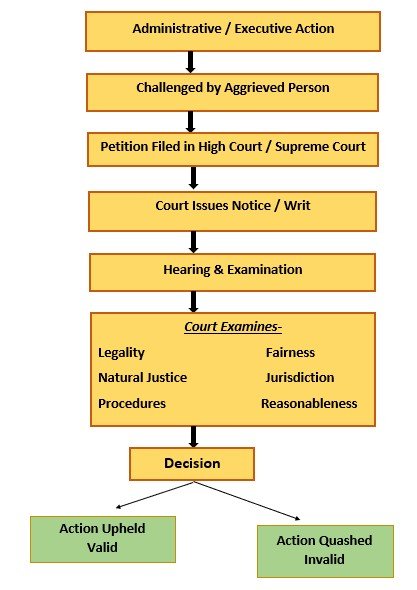
13. JUDICIAL REVIEW PROCESS-
14. JUDICIAL REVIEW OF DELEGATED LEGISLATION-
Courts review rules, regulations, bye-laws, notifications made by executive authorities.
GROUNDS:
→Ultra Vires (Beyond enabling Act)
→Excessive Delegation
→Mala Fide
→Unreasonableness
→Violation of Fundamental Rights
→Conflict with Parent Act / Constitution.
15. LIMITATIONS OF JUDICIAL REVIEW-
Courts do not interfere in:
→Policy matters
→Technical / expert matters
→Political questions
Unless there is:
→Illegality
→Mala fide
→Irrationality
→Unconstitutional action.
16. DIFFERENCE BETWEEN APPEAL AND JUDICIAL REVIEW-
|
BASIS
|
APPEAL
|
JUDICIAL REVIEW
|
|
Concern
|
Correctness of decision
|
Legality of decision
|
|
Focus
|
Merits of the case
|
Decision-making process
|
|
Scope
|
Wide
|
Limited
|
|
Objective
|
Reconsideration
|
Control legality
|
|
Court
|
Higher forum
|
High Court / Supreme Court
|
|
Result
|
Confirm / Modify / Reverse
|
Quash / Set aside / Issue directions
|
17. ADVANTAGES-
→Protects Fundamental Rights
→Prevents arbitrariness
→Ensures accountability
→Maintains constitutional supremacy
→Strengthens democracy
→Protects natural justice
→Controls abuse of power.
18. RELATED DOCTRINES-
→Rule of Law
→Natural Justice
→Ultra Vires
→Legitimate Expectation
→Proportionality
→Wednesbury Principle
→Abuse of Discretion
→Reasonableness.
19. ROLE IN ADMINISTRATIVE LAW-
→Controls administrative discretion
→Reviews delegated legislation
→Ensures fairness and propriety
→Protects citizens from abuse
→Maintains balance between individual and State.
20. IMPORTANCE FOR LAW STUDENTS-
→Understands control of administration
→Helps in constitutional remedies
→Essential for exams and moot courts
→Important for litigation
→Helps in analysing cases and judgments.

we believe in a holistic approach to legal education building not just lawyers, but socially conscious leaders of tomorrow.
