Indian Contract Act, 1872
An agreement made by a minor is void.
TANMOY MUKHERJI INSTITUTE OF JURIDICAL SCIENCE
[Advocate]
An agreement made by a Minor is void:
TANMOY MUKHERJI
[ADVOCATE]
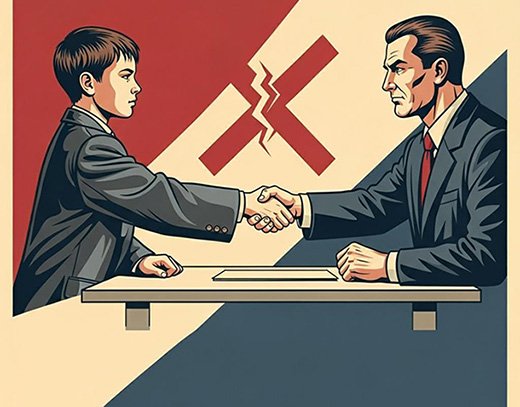
According to Sec. 3 of the Indian Majority Act, 1875, a minor is a person who has not completed eighteen years of age.
The rules governing minors’ agreements are based on two fundamental rules:
Minor’s Agreements:
The position of a minor as regards his agreements may be summed up as under:
1. An agreement with or by a minor is void and inoperative ab initio
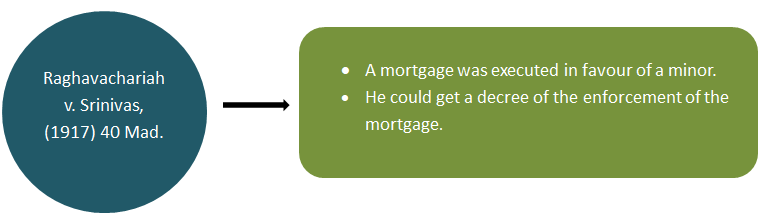
2.Can be a promisee or a beneficiary-
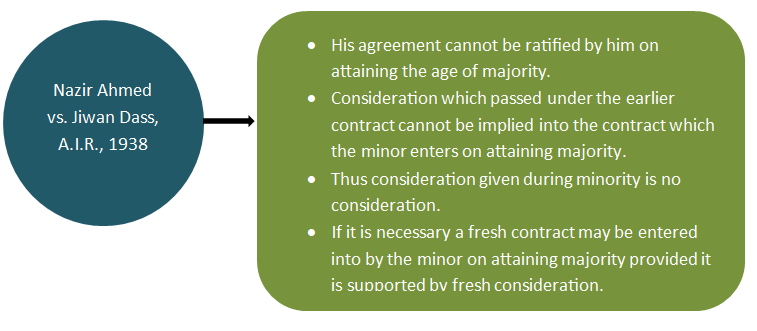
3. His agreement cannot be ratified by him on attaining the age of majority-
Examples:
a) P, a minor, borrows ? 5,000 from A and executes a promissory note in favour of A. After attaining majority, he executes another promissory note in settlement of the first note. The second promissory note is void for want of consideration [Indran Ramaswamy v. Anthiappa Chettiar, 1906].
4. If he has received any benefit under a void agreement, he cannot be asked to compensate or pay for it-
According to Section 65 of the Indian Contract Act, 1872- When an agreement is discovered to be void, or when a contract becomes void, any person who has received any advantage under such agreement or contract is bound to restore it, or to make compensation for it to the person from whom he received it.
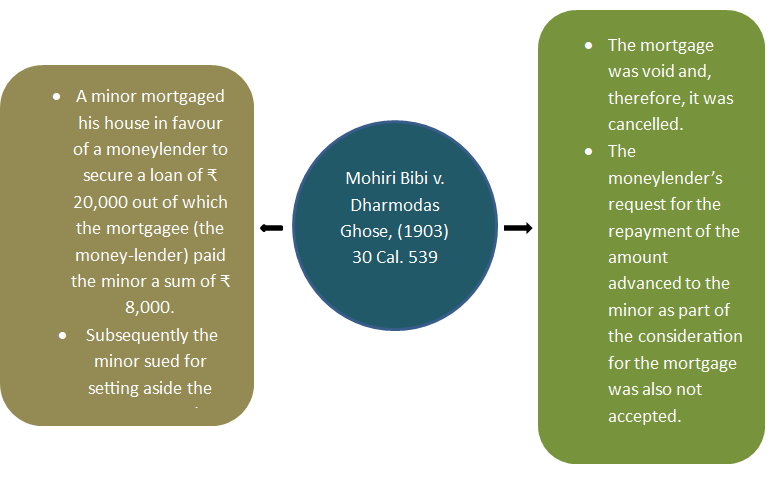
Section 65 which provides for restitution in case of agreements discovered to be void does not apply to a minor.
Example- T a minor obtains a loan by mortgaging his property. He is not liable to refund the loan. Not only this, even his mortgaged property cannot be made liable to pay the debt.
5. He can always plead minority-
Even if he has by misrepresenting his age, induced the other party to contract with him, he cannot be sued either in contract or in tort for fraud because if the injured party were allowed to sue for fraud it would be giving him an indirect means of enforcing the void agreement.
Example- S, a minor, by fraudulently representing himself to be of full age, induced L to lend him £ 400. He refused to repay it and L sued him for the money. Held, the contract was void and S was not liable to repay the amount [Leslie v. Shiell, (1914)].
The Court may, where a loan or some property is obtained by the minor by some fraudulent representation and the agreement is set aside, direct him, on equitable considerations, to restore the money or property to the other party. Whereas the law gives protection to the minors, it does not give them liberty “to cheat men”.
6.There can be no specific performance of the agreements entered into by him as they are void ab initio- A contract entered into on his behalf by his parent/guardian or the manager of his estate can be specifically enforced by or against the minor provided the contract is (a) within the scope of the authority of the parent/guardian/manager, and (b) for the benefit of the minor.
7. He cannot enter into a contract of partnership- But he may be admitted to the benefits of an already existing partnership with the consent of the other partners.
8. He cannot be adjudged insolvent- This is because he is incapable of contracting debts.
9. He is liable for ‘necessaries’ supplied or necessary services rendered to him or anyone whom he is legally bound to support.
10.He can be an agent- An agent is merely a connecting link between his principal and a third party. As soon as the principal and the third party are brought together, the agent drops out. A minor binds the principal by his acts without incurring any personal liability.
11. His parents/guardian are/is not liable for the contract entered into by him, even though the contract is for the supply of necessaries to the minor. But if the minor is acting as an agent for the parents/guardian, the parents/guardian shall be liable under the contract.
12. A minor is liable in tort (a civil wrong)- where a tort arises out of a contract a minor is not liable in tort as an indirect way of enforcing an invalid contract [Leslie v. Shiell (1914)].
Minors’ Liability for Necessaries:
According to Sec 68 of the Indian Contract Act, 1872 — If a person, incapable of entering into a contract, or any one whom he is legally bound to support, is supplied by another person with necessaries suited to his condition in life, the person who has furnished such supplies is entitled to be reimbursed from the property of such incapable person.
A minor is liable to pay out of his property for ‘necessaries’ supplied to him or to anyone whom he is legally bound to support (Sec. 68). The claim arises not out of contract but out of what are called quasi-contracts. Again, it is only the property of the minor which is liable for meeting the liability arising out of such contracts. He is not personally liable. The law has to live with this exception intentionally because if it were not so, it would be impossible for minors even to live.
The term ‘necessaries’ is not defined in the Indian Contract Act. The English Sale of Goods Act, 1893, defines it in Sec. 2 as “goods suitable to the condition in life of such infant or other person, and to his actual requirement at the time of sale and delivery”. Such goods need not necessarily pertain to a class of useful goods, but they must be (i) suitable to the position and financial status of the minor, and (ii) necessaries both at the time of sale and at the time of delivery.
Necessary goods are not restricted to articles which are required to maintain a bare existence, such as bread and clothes, but include articles which are reasonably necessary to the minor having regard to his station in life. A watch and a bicycle may well be considered to be necessaries. An engagement ring may be a necessary, but not a vanity bag bought for the minor’s finance.
Example- P, a minor, bought eleven fancy waistcoats from N. He was at that time adequately provided with clothes. Held, the waistcoats were not necessaries, and P was not liable to pay for any of them.
Certain services rendered to a minor have been held to be necessaries. These include: education, training for a trade, medical advice [Chappel v. Cooper, (1844)], legal advice, provision of a funeral for deceased husband of a minor widow, and a house given to a minor on rent for the purpose of living and continuing his studies.
Loans incurred to obtain necessaries.
A loan taken by a minor to obtain necessaries also binds him and is recoverable by the lender as if he himself had supplied the necessaries [Martin v. Gale, (1876)]. But the minor is not personally liable. It is only his estate which is liable for such loans.

we believe in a holistic approach to legal education building not just lawyers, but socially conscious leaders of tomorrow.
