Improper Admission or Rejection of Evidence
Bharatiya Sakshya Adhiniyam, 2023
TANMOY MUKHERJI INSTITUTE OF JURIDICAL SCIENCE
Dr. Tanmoy Mukherji
[Advocate]
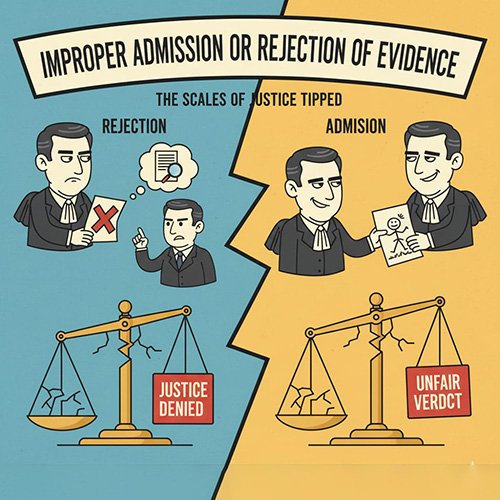
Improper Admission or Rejection of Evidence-
Tanmoy Mukherji
[Advocate]
Statutory Basis-
Bharatiya Sakshya Adhiniyam, 2023 - Sec. 169 (Sec-167 IEA)
Improper admission or rejection of evidence is not by itself a ground for new trial or, reversal of decision, if:
a) There is sufficient evidence to justify the decision independently of wrongfully admitted evidence, or
b) The rejected evidence, even if admitted , would not have changed the result.
Civil Procedure Code, 1908 - Sec. 99
A decree shall not be reversed for misjoinder, non-joinder, or improper admission/rejection of evidence unless it affects the merits of the case.
Bharatiya Nagarik Suraksha Sanhita, 2023 - Sec. 511 (Sec. 465 CrPC)
No, finding/sentence/order shall be reversed on account of any error or irregularity in admission/rejection of evidence unless it has caused a failure of justice.
Judicial Approach-
-Rameshwar v. S.O. Rajasthan (AIR 1952 SC 54)
Facts: Conviction based partly on improper admission of child witness testimony.
Held: Conviction sustained because there was other reliable evidence -> improper admission not fatal.
-Radha Kishan v. S.O. Hyderabad (AIR 1956 SC 171)
Held: Mere rejection of some evidence is not a ground for reversal if other legal evidence supports the judgement.
-Narpal Singh v. S.O. Haryana (1977) 2 SCC 508
Held: Even if some evidence was improperly admitted, conviction can stand provided there is independent legal evidence.
-State of U.P. v Anil Singh (AIR 1988 SC 1998)
Held: Courts must not discard credible testimony merely because some evidence was wrongly admitted / rejected.
-Kalyan Kumar Gogoi v. Ashutosh Agnihotri (2011) 2 SCC 532
Held: Reiterated principle of Sec. 167: No reversal unless miscarriage of justice is shown.
-Shyamal Ghosh v. S.O. West Bengal (2012) 7 SCC 646
Held: Wrongful admission of some materials (confessions, documents) is not enough; appellate court must see if it influenced the outcome.
-State of Rajasthan v. Kashi Ram (2006) 12 SCC 254
Held: Court clarified that improperly admitted evidence may be ignored, but if remaining evidence is sufficient, conviction will stand.
-Hari Charan Kurmi v. S.O. Bihar (AIR 1964 SC 1184)
Held: Even if some confession/evidence is excluded, other corroborative evidence may sustain conviction.
Principles Emerging-
1. Not automatic ground - Admission or rejection does not by itself vitiate proceedings.
2. Effect on decision - The appellate/revisional court checks if the error materially affected the decision.
3. Doctrine of prejudice - Only if prejudice or miscarriage of justice is shown, retrial/reversal is ordered.
4. Independent evidence - If sufficient legal evidence exists without the tainted part, judgement stands.
Comparative Position-
|
Law Provision
|
Principle
|
|
BSA, Sec. 169 (Sec. 167 IEA)
|
Error in admission/rejection not fatal unless outcome affected.
|
|
CPC, Sec. 99
|
Decree not reversed unless merits affected.
|
|
BNSS, Sec. 511 (Sec. 465 CrPC)
|
Judgement not set aside unless failure of justice caused.
|
-Improper admission or rejection of evidence is not in itself a ground for a new trial or reversal under Section 169 BSA, Section 99 CPC, and Section 511 BNSS.
-Courts consistently hold that only when such error causes prejudice or miscarriage of justice, retrial or reversal will be granted

we believe in a holistic approach to legal education building not just lawyers, but socially conscious leaders of tomorrow.
