Gift (Hiba)
Muslim Law
Dr. Tanmoy Mukherji
[Advocate]
GIFT (HIBA)-
Tanmoy Mukherji
[Advocate]
Under Muslim law, a person is allowed to lawfully make a gift of his property to another during his life time; this is called a disposition inter vivos.
Muslim law permits a man to give away the whole of his property during his life time.
Definitions-
Hedaya-
A hiba or simple gift inter vivos (between living person) literally means "the donation of a thing from which the donee may derive benefit."
Mulla-
According to Mulla "Gift is a transfer of property, made immediately, and without any exchange, by one person to the other and accepted by or on behalf of the latter.
Fyzee-
According to Fyzee, hiba is the immediate and unqualified transfer of the corpus of the property without any return.
Baillie-
According to Baillie, Hiba is "the conferring of a right in something specific without an exchange".
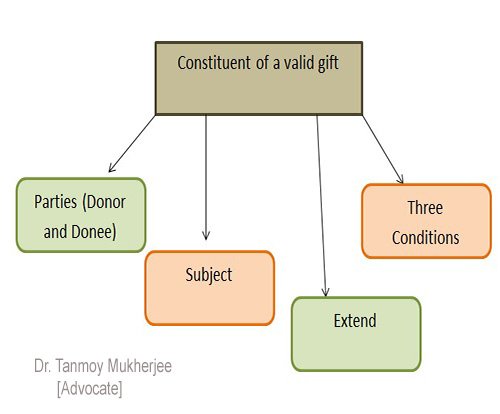
Constituent of a Valid gift-
Parties -
There are two parties in a transaction of gift:
i) Donor (the person who makes gift)
ii) Donee (the person who takes something as gift)
i) The Donor-
The competency of a donor depends on the following factors-
-Under Muslim Law, the donor must be a Muslim.
-He must have attained the age of majority.
The age of majority for the purpose of gifts, wills, waqf etc. is governed by the Indian Majority Act, 1875.
According to sec. 3 of the Act, the age of majority is 18 years and minority of a person terminates at that age.
-He must be of sound mind and understanding of the transaction.
-He must be free of any fraud or coercive influence.
Gift by Pardanashin lady-
A gift by a pardanashin lady is valid, but in case of a dispute the burden of proving that it was not induced by undue influence and the donor understood the nature of the transaction while making it lies on the donee.
Reference Cases-
-Mst. Hussaina Bai v/s Mst. Zohra Bai, AIR 1960 MP 60.
-Kaireem Bi v/s Mariam Bi, AIR 1960 Mad 447.
ii) The Donee-
-Any person irrespective of sex, age, creed or religion, who is capable of holding property, may be the donee of a gift.
-The donee must be in existence at the time of making the gift.
When donee is a minor or lunatic-
In the case of a minor or lunatic, possession must be handed over to the legal guardian.
Reference Case-
Thumman v/s Hussain
-It was held that a gift in favor of a minor by any person other than the father or guardian of such minor must be accompanied with delivery of possession to the father or guardian of the minor.
When donee is an unborn person-
Gift in favor of an unborn person is void. However, a gift may be made in favor of a child in mother's womb, if it is born alive within six months from the date of gift.
As a child in the mother's womb is regarded in law as a person in existence a gift may be validly made in favor of it but it is necessary that the child must be born alive otherwise the gift would be void.
Reference Case-
Ghulam Hussein v/s Faker Mohammad-
It was held that a gift of future usufruct to unborn person is valid.
When donee is a Mosque or any other institution-
A gift may validly be made in favor of a juristic person. Mosque or any other institutions, being juristic persons are competent donee.
Subject of a gift-
Which things can be the subject of gift-
The subject of a gift can be the following-
i) Anything over which dominion, or right of property may be exercised; or
ii) Anything which can be reduced to possession; or
iii) Anything which exists either as a specific entity or as an enforceable right; or
iv) Anything which comes within the meaning of the word mal or ayn.
Requisites for a subject of a gift to be valid-
A property in order to be a valid subject of gift must satisfy the following conditions-
i) It can be designated under the term mal or ayn;
ii) It must be in existence at the time when the gift is made.
iii) The donor must possess it.
Gift of Life Interest-
|
Nawazish Ali Khan v/s Ali Raza Khan-
|
It was held by the Privy Council that a life estate is unknown to Mohammedan law as administered in India. But life interests are valid and can be lawfully created.
|
|
Amjad Khan v/s Ashraf Khan-
|
It was declared By the Privy Council that under Sunni law, a gift of a life interest is valid and such life interest is not enlarged into an absolute estate.
|
Extent of donor's right of making gift-
The donor has unlimited power to gift his property. He may give the whole of his property by the way of gift.
Limitations during death illness (marz-ul-maut)-
There are some restrictions to the power of a Muslim to gift his property:
i) During death illness he cannot gift more than one-third of his whole property; and
ii) It cannot be in favor of an heir.
Three Conditions-
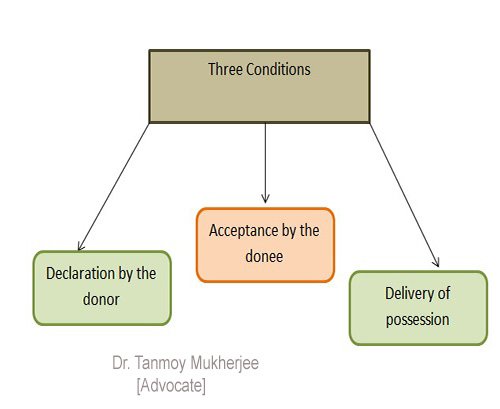
i) Declaration by the Donor-
There must be a clear and unambiguous intention of the donor to make the gift.
|
Mahboob Sahab v/s Syed Ismail-
|
It was held that a gift by a Mohammadan need not to be in writing or registered under the Registration Act, a gift to be complete, there should be a declaration of the gift by the donor, acceptance by or on behalf of the donee and delivery of possession of the property.
|
ii) Acceptance by the Donee-
The gift must be accepted by the donee. It may either be actual or constructive according to the circumstances of the case.
iii) Delivery of Possession-
Generally, in the case of tangible or corporeal property delivery of possession is necessary.
In the case of incorporeal property or where the property is corporeal but is not capable of physical delivery, constructive delivery of possession is sufficient.
When the property is movable-
When the property is movable, the gift is not complete until actual delivery.
When the property is immovable-
When the property is immovable, two things are essential:
i) The donor must physically depart from the premises;
ii) The donee formally enters into possession.
Cases in which actual delivery of possession is not necessary-
In the following cases actual delivery of possession is not necessary:
i) Gift by a father to his minor or lunatic son or daughter or by a guardian to his ward.
ii) Where the donor and donee resides in the same house which is to be gifted.
iii) Gift by husband to wife and vice versa.
iv) Gift by one co-sharer to another.
v) Part delivery.
vi) Zamindari villages.
Kinds of gift (Hiba) under Mohammedan Law-
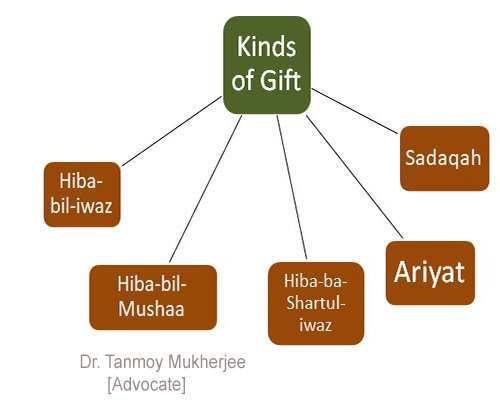
i) Hiba-bil-iwaz (Gift for consideration)-
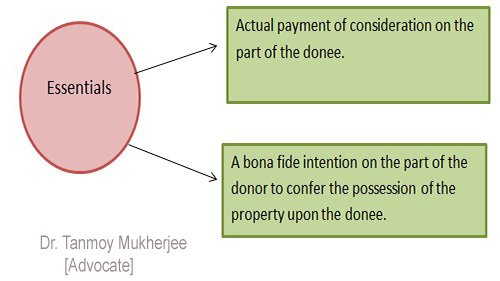
Hiba means gift and iwaz means consideration. Hiba-bil-iwaz means gift for consideration already received.
The Hiba-bil-iwaz is an exception to the general rule of hiba. It is a transaction in which one gift is made from the donor to donee and the other from donee to donor.
Essentials-
ii) Hiba-ba-shartul-iwaz-
'Shart' means stipulation. Hiba-ba-shartul-iwaz means a gift made with stipulation, for a return.
In a Hiba-ba-shartut-iwaz, the payment of consideration is postponed and not immediate therefore, the delivery of possession is essential.
After the payment of consideration, it assumes the character of sale.
iii) Hiba-bil-Mushaa-
The Arabic word 'Mushaa' is derived from 'saayu' which means "un-divided share in property".
According to Hedaya, "a gift of a part of a thing which is capable of division is not valid unless the said part is divided off and separated from the property of the donor whereas a gift of an indivisible thing is valid".
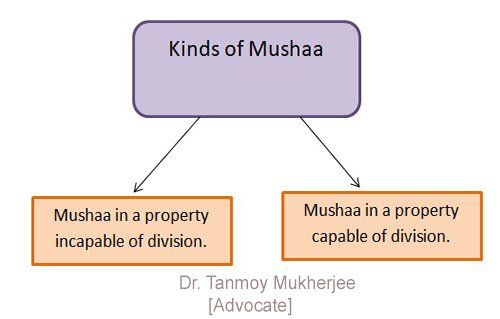
Kinds of Mushaa-
Mushaa in a property incapable of division –
A gift of an undivided share in a property which is not capable of division is Valid.
Mushaa in a property capable of division -
If the property is capable of division, the gift of mushaa will be irregular and not void. It can be rendered valid by subsequent partition and delivery.
iv) Sadaqah-
-Sadaqah is a gift with a religious purpose in which there is a desire to get religious merit.
-Delivery of possession is necessary in the case of sadaqah and once the possession is delivered it becomes irrevocable.
v) Ariyat-
Ariyat is a type of gift recognized under Muslim Law in which the right of enjoyment in a property is transferred for a specific period.
According to Mulla, "The grant of a licence, resemble at the grantor's option to take and enjoy the usufruct of a thing is called Ariyat."
-In ariyat, the donee only obtains the use or beneficial enjoyment for a limited period, and the ownership in the property does not pass to him. It can be revoked.
Void Gifts-
The following gifts cannot be made validly-
i) Gift to unborn person.
ii) Gift of anything to be produced in future.
iii) Contingent gift.
iv) Gift with a condition.
Revocation of Gift-
Under Mohammedan law, a Muslim has the right to revoke gifts either before or after the delivery of possession or after the delivery of possession.
Revocation of gift before delivery of possession-
The gift is not complete before the delivery of possession therefore the donor has unrestricted right to revoke it.
Revocation of gift after delivery of possession-
After the delivery of possession the donor may revoke the gift either with the consent of the donee or by a formal decree of the Court.

we believe in a holistic approach to legal education building not just lawyers, but socially conscious leaders of tomorrow.