GENERALIA SPECIALIBUS NON DEROGANT
TANMOY MUKHERJI INSTITUTE OF JURIDICAL SCIENCE
Dr. Tanmoy Mukherji
Advocate
GENERALIA SPECIALIBUS NON DEROGANT-
Tanmoy Mukherji
Advocate
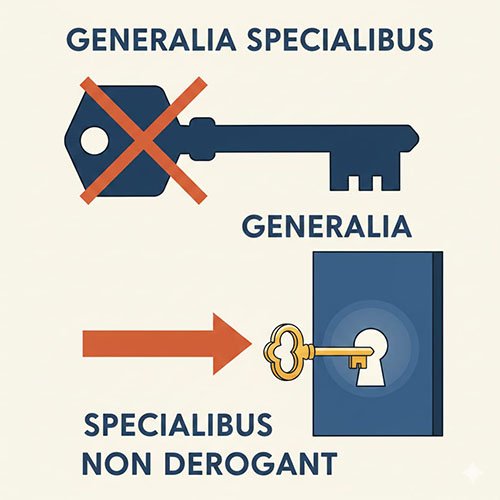
In statutory interpretation, conflicts often arise between a general law and a special law operating in the same field. To resolve such conflicts, courts apply the maxim Generalia specialibus non derogant, which ensures that special legislative intent is not defeated by general provisions.
Meaning of the Maxim-
The Latin maxim Generalia specialibus non derogant means:
“General things do not derogate from special things.”
In other words, a general provision does not override or repeal a special provision, even if both deal with the same subject-matter.
Explanation of the Rule-
This rule lays down that where:
→There is a general statute covering a broad subject, and
→There is a special statute dealing with a particular aspect of the same subject,
then the special statute will prevail in case of inconsistency or conflict.
The rule applies even when:
→Both statutes are enacted by the same legislature, and
→The general statute is enacted later in time, unless there is a clear intention to repeal the special law.
Rationale and Object of the Maxim-
Preservation of Special Legislative Intent
Special statutes are enacted to deal with specific situations requiring special treatment.
Avoidance of Conflict and Confusion
Prevents overlapping and contradictory application of laws.
Harmonious Interpretation
Encourages courts to give effect to both statutes without nullifying either.
Presumption against Implied Repeal
Repeal of a special law by a general law is not presumed unless expressly stated.
Scope and Application-
The maxim is commonly applied in:
→Labour laws
→Taxation statutes
→Criminal procedure
→Administrative and service laws
→Special economic and regulatory laws
It applies where both statutes:
→Operate in the same field, and
→Are irreconcilable to the extent of conflict.
Conditions for Application-
→Existence of a general law and a special law
→Both laws relate to the same subject-matter
→There is a conflict or inconsistency
→No express repeal of the special law by the general law
Reference Cases
J.K. Cotton Spinning & Weaving Mills Co. Ltd. v. State of U.P. (1961)
The Supreme Court held that special provisions override general provisions and both must be harmoniously construed where possible.
South India Corporation (P) Ltd. v. Secretary, Board of Revenue (1964)
The Court ruled that a special law prevails over a general law even if the general law is later in point of time, unless expressly repealed.
Life Insurance Corporation of India v. D.J. Bahadur (1981)
The Supreme Court held that Industrial Disputes Act, being a special law, prevailed over the general provisions of the LIC Act in matters of service conditions.
Maharashtra State Board of Secondary & Higher Secondary Education v. Paritosh Bhupeshkumar Sheth (1984)
Special statutory regulations were held to prevail over general principles of natural justice.
Commercial Tax Officer v. Binani Cements Ltd. (2014)
The Supreme Court reaffirmed that special fiscal statutes override general taxation provisions.
Solidaire India Ltd. v. Fairgrowth Financial Services Ltd. (2001)
The Court held that when there is conflict between two special laws, the later special law will prevail.
Ashoka Marketing Ltd. v. Punjab National Bank (1990)
The Court observed that when both statutes are special in nature, the one having dominant purpose should prevail.
Relationship with Doctrine of Implied Repeal
The maxim strongly supports the principle that implied repeal is not favoured in law. A general statute does not repeal a special statute unless:
→There is a clear and unavoidable inconsistency, and
→The intention to repeal is explicit or necessarily implied.
Limitations of the Maxim
→Does not apply if the legislature expressly repeals the special law.
→Not applicable where both laws are equally special and irreconcilable.
→Cannot be used to defeat the clear intention of Parliament.
→Requires careful judicial analysis to avoid misuse.
Critical Evaluation-
→The doctrine ensures legal certainty and respects legislative specialization. However, mechanical application may lead to rigidity. Courts must carefully identify the true nature of the statutes involved.
→The maxim Generalia specialibus non derogant is a vital principle of statutory interpretation. It ensures that:
→Special laws receive due respect,
→Legislative intent is preserved, and
→Conflicts between statutes are resolved logically and justly.
→By upholding this rule, courts maintain coherence, harmony, and consistency within the legal system.

we believe in a holistic approach to legal education building not just lawyers, but socially conscious leaders of tomorrow.
