General Rules of Muslim Inheritance
TANMOY MUKHERJEE INSTITUTE OF JURIDICAL SCIENCE
Dr. Tanmoy Mukherjee
Advocate
General Rules of Muslim Inheritance
Tanmoy Mukherjee
Advocate

Muslim inheritance is governed mainly by the Qur’an, Hadith, Ijma and Qiyas. The rules are based on the principle of immediate devolution of property on death.
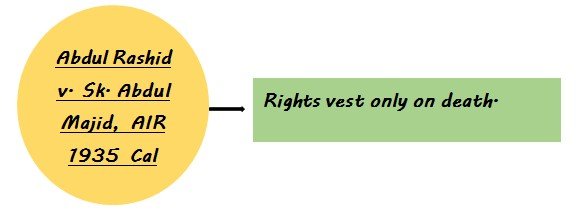
1. Inheritance opens on death-
Succession only arises on the death of a Muslim person. There is no survivorship concept as in Hindu law.
2. No distinction between movable and immovable property-
All types of property — ancestral, self-acquired, movable, and immovable — are governed by the same doctrine.

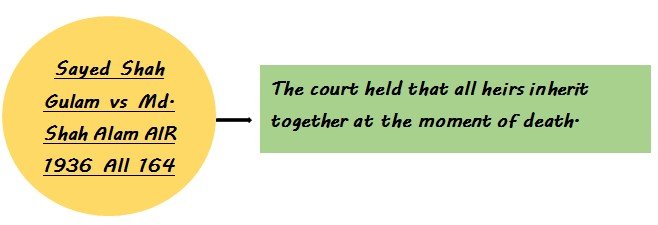
3. Heirs succeed simultaneously-
All heirs inherit at the same time, not successively. No heir has a prior or preferential right except as fixed by law.
4. Nearer heir excludes the remoter
A closer heir excludes a more distant heir completely.
Examples:
Son excludes grandson
Father excludes grandfather
Well-settled principle in cases involving excluded heirs.

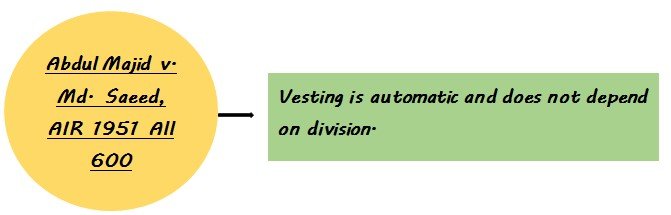
5. Rights of heirs vest immediately
The share of each heir vests immediately on death, even if distribution is delayed.
Vesting, not enjoyment — legal entitlement crystallises on death.
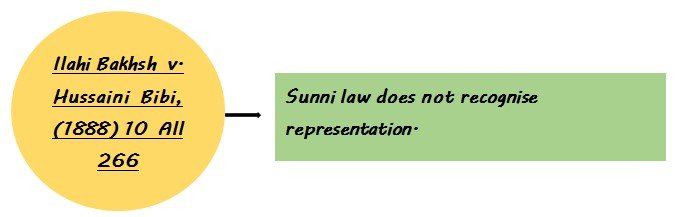
6. Doctrine of representation not recognised (Sunni law)
Under Sunni law, children of a predeceased heir generally do not step into the shoes of their parent, though some limited representation exceptions exist in Shia law.
Shia law recognises representation in limited cases.
7. Male generally gets double share of female
As a general rule, a male heir gets twice the share of a female in the same degree.
Example: Son gets double of daughter.
Principle: “Male is to female as twice to once.”
This applies to children of the same degree (e.g., son vs daughter).

8. No birth-right
An heir has no right by birth. Rights arise only after the death of the propositus.

9. Muslim law does not recognise primogeniture
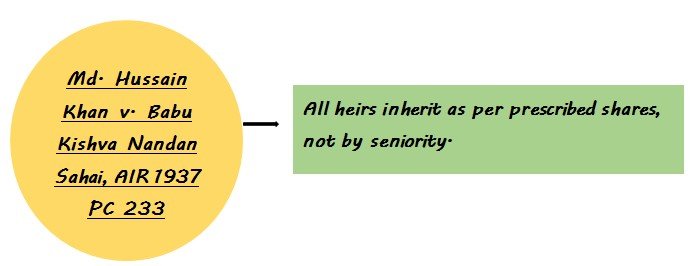
The eldest son has no special right. All heirs inherit according to prescribed shares.
10. Disqualification Due to Homicide-
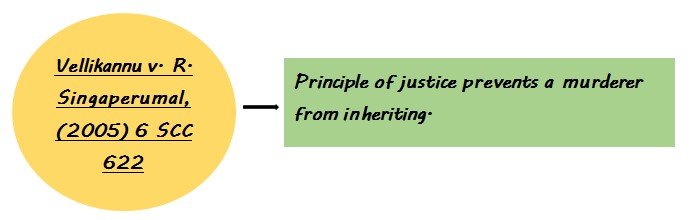
A person who causes the death of the propositus can not inherit.
Vellikannu vs R. Singaperumal, (2005)6 SCC 622- Principle of justice prevents a murderer from inheriting.
11. Rule of exclusion applies strictly
Certain heirs completely exclude others, e.g.:
Father excludes grandfather
Son excludes grandson
12. Shares fixed by law
Shares of Quranic heirs are strictly fixed and cannot be altered by personal choice.
13. Estate first applied to liabilities
Before distribution, the estate is applied in the following order:
Funeral expenses
Debts
Legacies (up to 1/3rd)
Distribution among heirs

14. No will beyond one-third
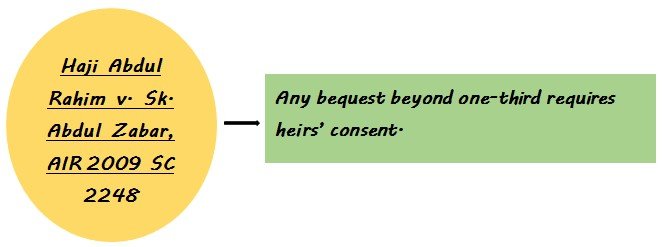
A Muslim can make a will only for up to one-third of the estate without heirs’ consent. Beyond that requires written consent of all heirs.
15. Escheat to the State
If no heirs exist, the property escheats to the State (Bait ul-Mal)

16. A person causing death is disqualified
Anyone who caused the death of the deceased (even by negligence) is disqualified from inheriting.
17. Categories of Heirs
Sharers (Zawil Furud) – fixed shares (wife, husband, mother, father, etc.)
Residuaries (Asabah) – take residue after sharers
Distant Kindred
18. Partition & Residuary System
Islamic law applies a fixed fractional share first, and the remaining estate goes to residuaries.
Recent & Ongoing Developments
Grandchildren’s Rights Clarified (High Court)
Hamzah Muneer v. Mohd Aqil & Ors. (Delhi HC, 2025) — clarified grandchildren’s inheritance rights when a son predeceased; majority view under Sunni law is Grandchildren do not inherit through predeceased parent if other heirs exist.
40-year Inheritance Dispute Over Will (SC 2025)
Supreme Court restored full ownership rights to a second wife under a valid registered will, rejecting the High Court’s limitation.
This is significant because it upholds valid wills recognized even under Muslim personal law, so long as procedural requirements are met.
Supreme Court to Examine Optional Succession Law
The SC has agreed to consider if Muslims can opt for the secular Indian Succession Act, 1925 (instead of Muslim Personal Law) for inheritance without renouncing Islam.
Notices issued; multiple cases tagged together (e.g., Safiya PM & Naushad KK petitions).
Significance:
If accepted, it allows Muslims greater testamentary autonomy and equality, challenging fixed Shariat constraints.
Waqf Law Amendments & SC Review (2025)
The Waqf (Amendment) Act, 2025 modernises the Waqf regime, clarifies waqf creation and protects heirs’ inheritance rights in waqf-alal-aulad situations. SC has partially stayed controversial clauses.
Impact:
Waqf management now faces constitutional scrutiny, potentially affecting how endowments are treated in succession matters.
Gender Justice Movements in Islamic Jurisprudence
Outside India, courts like the Federal Shariat Court of Pakistan (2025) held that customary practices denying women’s Quranic share are illegal and without force — reinforcing gender equality within Islamic law.

we believe in a holistic approach to legal education building not just lawyers, but socially conscious leaders of tomorrow.
