Functions of the Judiciary-
Dr. Tanmoy Mukherji
Advocate
Functions of the Judiciary-
Tanmoy Mukherji
Advocate
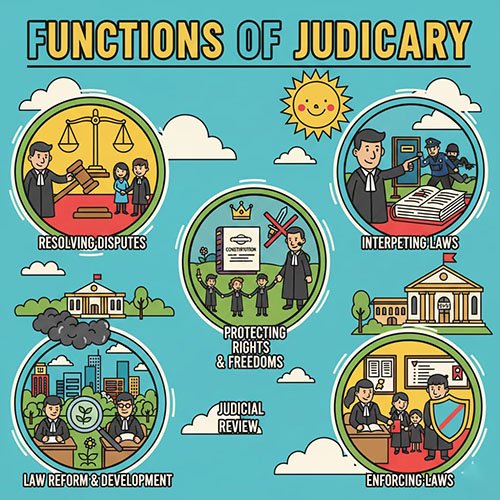
→The judiciary is an essential organ of the State entrusted with the responsibility of interpreting laws, delivering justice, and safeguarding the Constitution. It ensures the rule of law and acts as a check on the legislative and executive branches.
Administration of Justice-
The primary function of the judiciary is the administration of justice. Courts adjudicate civil, criminal, and constitutional disputes by applying legal principles to facts. Justice may be civil (relating to rights, property, and contracts) or criminal (punishing offenders). The judiciary ensures fairness, impartiality, and equality before law while resolving disputes.
Interpretation of Laws-
The judiciary interprets statutes enacted by the legislature. Where the language of a law is vague, ambiguous, or silent on certain aspects, courts clarify its meaning through rules of interpretation such as literal, golden, and mischief rules. Judicial interpretation ensures uniformity and prevents misuse or misapplication of laws.
Guardian of the Constitution-
The judiciary acts as the guardian and protector of the Constitution. It ensures that all laws and governmental actions conform to constitutional provisions. Any act contrary to the Constitution can be struck down by the courts, thereby preserving constitutional supremacy.
Judicial Review-
Judicial review is a crucial function of the judiciary. Courts examine the constitutionality of legislative enactments and executive actions. If found violative of constitutional provisions, particularly fundamental rights or the basic structure of the Constitution, such actions are declared void. This power prevents abuse of authority and maintains balance among organs of the State.
Protection of Fundamental Rights-
The judiciary protects fundamental rights guaranteed to citizens. In India, the Supreme Court and High Courts can issue constitutional writs like habeas corpus, mandamus, certiorari, prohibition, and quo warranto. Through Public Interest Litigation (PIL), courts have widened access to justice for marginalized sections.
Settlement of Disputes-
The judiciary settles disputes-
→Between individuals
→Between individuals and the State
→Between the Union and States
→Between two or more States
Such adjudication ensures peaceful resolution of conflicts and prevents chaos and arbitrariness.
Advisory Function-
The judiciary performs an advisory role when the executive seeks its opinion on questions of law or fact of public importance. In India, under Article 143, the President may refer matters to the Supreme Court for advisory opinion. Though not binding, such opinions carry high constitutional value.
Punishment and Prevention of Crime-
In criminal matters, the judiciary determines guilt and awards punishment as prescribed by law. By imposing penalties, courts deter criminal behavior and contribute to maintenance of public order and social discipline.
Protection of Rule of Law-
The judiciary ensures supremacy of law by preventing arbitrary exercise of power. It guarantees equality before law and ensures that no one, including the State, is above the law. This function is essential for democracy and good governance.
Safeguarding Judicial Independence-
The judiciary protects its own independence by ensuring security of tenure, fair appointment procedures, and freedom from executive interference. Independent judiciary is essential for fair adjudication and public confidence in the legal system.
Law-Making through Judicial Precedents-
Although not a legislative body, the judiciary contributes to law-making through judicial precedents. When courts interpret laws or fill legislative gaps, their decisions become binding precedents, helping in the development and evolution of law.
Equity, Justice and Good Conscience-
Where no specific law exists, courts decide cases based on principles of equity, justice, and good conscience. This function allows the judiciary to ensure fairness and moral justice beyond rigid legal rules.
Social and Economic Justice-
Through progressive interpretation, the judiciary promotes social justice, gender equality, environmental protection, and labor welfare. Judicial activism has expanded the scope of rights such as the right to life and dignity.
-The judiciary plays a pivotal role in maintaining constitutional governance, protecting rights, and ensuring justice. Its functions go beyond dispute resolution to include interpretation, review, protection of liberty, and development of law, making it the backbone of a democratic State.

we believe in a holistic approach to legal education building not just lawyers, but socially conscious leaders of tomorrow.
