FIVE YEAR PLANNING IN INDIAN ECONOMY
Dr. Tanmoy Mukherji
Advocate
FIVE YEAR PLANNING IN INDIAN ECONOMY-
Tanmoy Mukherji
Advocate
Introduction-
Five Year Plans were centralized economic planning programs introduced in India after independence for economic and social development.
Planning Commission was established in 1950 under the leadership of Jawaharlal Nehru.
India adopted planning to:
→Reduce poverty
→Increase production
→Promote industrialization
→Achieve self-reliance
→Improve living standards
Meaning of Five-Year Plan-
A Five Year Plan refers to a comprehensive economic program prepared for five years to achieve specific national goals.
Objectives of Five-Year Planning-
→Economic Growth
→Poverty Reduction
→Employment Generation
→Self-Reliance
→Balanced Regional Development
→Modernization and Technology
Features of Indian Planning-
Democratic Planning: Planning within democratic framework.
Mixed Economy: Both public sector and private sector worked together.
Centralized Planning: Major decisions made by central government.
Socialistic Pattern: Focus on social justice and equality.
Planning Commission-
Established: 15 March 1950
Functions:
→Formulate plans
→Allocate resources
→Monitor development
→Evaluate progress.
Importance of Five-Year Planning-
Agricultural Development: Improved irrigation, fertilizers and food production.
Industrial Development: Heavy industries established and expanded.
Infrastructure Growth: Development of roads, electricity, dams, railways, etc.
Employment Generation: Various employment schemes introduced.
Poverty Reduction: Anti-poverty programmes launched.
The Five-Year Plans of India-
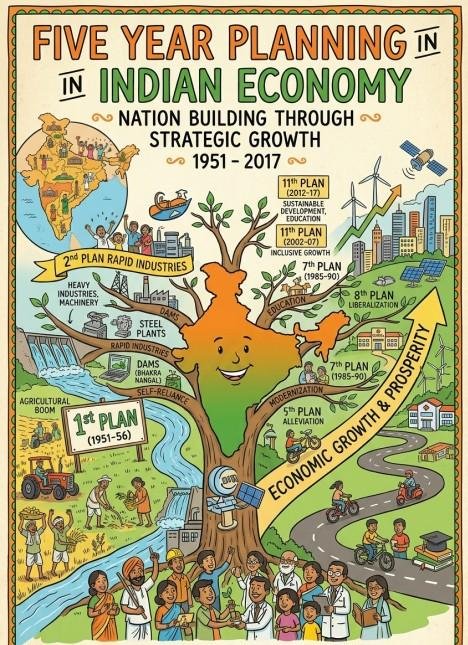
1st Plan (1951-1956):
Focus: Agriculture, Irrigation, Rural Development
Objectives: Increase food production, control inflation, rehabilitate refugees
Achievements: Bhakra Nangal Project, agricultural growth, community development.
2nd Plan (1956-1961):
Based on: Mahalanobis Model
Focus: Heavy industries, Industrialization
Objectives: Rapid industrial growth, public sector expansion
Achievements: Steel plants, heavy engineering, machine tools
3rd Plan (1961-1966):
Focus: Self-reliance in food grains, agriculture and industry
Problems: Indo-China War, Indo-Pak War, drought
Result: Plan failed to achieve targets
Plan Holiday (1966-1969):
Three Annual Plans introduced.
Focus: Agriculture, price stability, economic stability.
4th Plan (1969-1974):
Objectives: Growth with stability and self-reliance
Achievements: Green Revolution expansion
5th Plan (1974-1979):
Achievements: Green Sector self-reliance
Rolling Plan:
Theme: "Faster More Inclusive Growth"
Focus: Education, health, women empowerment, poverty alleviation, transport, energy.
6th Plan (1980-1985):
Achievements: Economic growth improved; technology adoption increased.
7th Plan (1985-1990):
Objectives: Food production, employment, productivity
Focus: Modernization, self-reliance, social justice
8th Plan (1992-1997):
After: economic reforms of 1991
Focus: Human resource development, liberalization, employment
Achievements: High economic growth, IT sector expansion
9th Plan (1997-2002):
Focus: Growth with social justice
Objectives: Poverty reduction, rural development
10th Plan (2002-2007):
Main Objective: Achieve 8% GDP growth
Focus: Employment, education, infrastructure.
Failures / Limitations-
→Poverty continued
→Unemployment remained high
→Regional imbalance
→Economic inequality increased
→Rapid population growth reduced benefits
Five Year Planning & Indian Economy-
→Transformed India from an agrarian economy to a mixed industrial economy.
→Major sectors developed: Agriculture, Industry, Transport, Energy, Education.
→Public sector became important in steel, mining, railways, energy, etc.
→Planning supported Green Revolution through HYV seeds, irrigation and fertilizers.
Achievements of Five-Year Plans-
→Green Revolution increased food grain production
→Industrialization developed heavy industries
→Self-Reliance reduced import dependence
→Expansion of Public Sector enterprises
→Improvement in education and health.
Planning Commission vs NITI Aayog-
|
Aspect
|
Planning Commission
|
NITI Aayog
|
|
Established |
1950 |
2015 |
|
Nature |
Centralized planning body |
Policy think tank |
|
Approach
|
Top-down approach
|
Bottom-up approach
|
|
Structure
|
Hierarchical
|
Cooperative federalism
|
|
Role
|
Formulated plans, allocated resources
|
Advisory role, promotes collaboration
|
|
Plans
|
Five Year Plans
|
No fixed plans
|
NITI Aayog-
Established in 2015 (Planning Commission abolished).
Promotes cooperative federalism and sustainable development.
Overall Impact of Planning-
→Agriculture Development
→Industrialization
→Infrastructure Expansion
→Employment Generation
→Economic Growth
Conclusion-
Five Year Plans played a vital role in the development of the Indian economy after independence. They helped in agricultural growth, industrialization, infrastructure development and poverty reduction efforts. Despite limitations, these plans laid the foundation for economic modernization, self-reliance and overall socio-economic progress of India.

we believe in a holistic approach to legal education building not just lawyers, but socially conscious leaders of tomorrow.
