FEATURES OF THE BRITISH CONSTITUTION-
TANMOY MUKHERJI INSTITUTE OF JURIDICAL SCIENCE
Dr. Tanmoy Mukherji
Advocate
FEATURES OF THE BRITISH CONSTITUTION-
Tanmoy Mukherji
Advocate
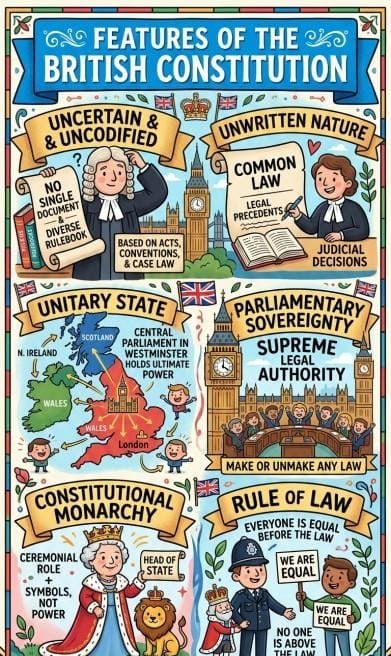
1. Unwritten (Uncodified) Constitution
→The British Constitution is described as unwritten, though this does not mean the absence of written material. It means that the constitution is not contained in a single, authoritative document like the Constitution of India or the USA. Instead, it is derived from diverse sources such as statutes, judicial decisions, conventions, customs, and authoritative works of jurists.
→Important constitutional statutes include the Magna Carta (1215), Petition of Right (1628), Bill of Rights (1689), Act of Settlement (1701), Parliament Acts (1911 and 1949), and Human Rights Act (1998). Along with these, common law principles developed by courts and conventions play a crucial role in governance.
→This nature makes the British Constitution evolutionary rather than revolutionary.
2. Flexibility of the Constitution
→One of the most distinctive features of the British Constitution is its flexibility. There is no distinction between constitutional law and ordinary law in terms of procedure. Parliament can amend constitutional provisions by passing an ordinary Act with a simple majority.
→For example, the House of Lords’ powers were reduced by the Parliament Acts of 1911 and 1949 through ordinary legislative procedure. This flexibility allows the constitution to adapt easily to changing political and social conditions.
→However, critics argue that excessive flexibility may endanger fundamental liberties if misused by Parliament.
3. Parliamentary Sovereignty
→Parliamentary sovereignty is the bedrock of the British constitutional system. According to A.V. Dicey, Parliament has the right to make or unmake any law whatsoever, and no person or body can override or set aside its legislation.
This means:
→Parliament can legislate on any subject
→No Parliament can bind its successors
→Courts cannot declare an Act of Parliament invalid
Even laws affecting fundamental rights or altering constitutional structures are valid if passed by Parliament.
4. Rule of Law-
→The principle of Rule of Law, also propounded by A.V. Dicey, is another cornerstone of the British Constitution. Dicey explained it through three principles:
First, supremacy of law, meaning no person can be punished except for a breach of law established by ordinary courts.
Second, equality before law, implying that all individuals, including ministers and officials, are subject to the same law administered by ordinary courts.
Third, the constitution is the result of judicial decisions protecting individual liberties rather than being the source of those rights.
Thus, individual freedom in Britain depends heavily on judicial interpretation.
5. Constitutional Monarchy-
→Britain follows a constitutional monarchy, where the monarch is the formal head of the state, but real executive authority lies with the elected government. The monarch performs duties on the advice of the Prime Minister and the Cabinet.
In practice, the monarch’s role is limited to:
→Appointing the Prime Minister
→Summoning and dissolving Parliament
→Giving Royal Assent to Bills
→As famously stated, “The King reigns but does not rule.”
6. Cabinet System of Government-
→The British Constitution operates under a parliamentary or cabinet system of government. The executive is drawn from the legislature, and the Cabinet is collectively responsible to the House of Commons.
→The Prime Minister is the real executive head, coordinating government policies and leading the Cabinet. If the House of Commons passes a vote of no confidence, the government must resign.
→This ensures democratic accountability.
7. Bicameral Legislature
The British Parliament is bicameral, consisting of:
→House of Commons (Lower House)
→House of Lords (Upper House)
→The House of Commons is the dominant chamber, as it controls finance and the executive. The House of Lords plays a revisory role, delaying and suggesting amendments but cannot permanently block legislation.
→The Parliament Acts curtailed the powers of the House of Lords, reinforcing democratic supremacy.
8. Unitary Form of Government
→Britain has a unitary system where all governmental powers are vested in the central authority. Local governments derive their powers from Parliament and can be reorganized or abolished by it.
→Even though devolution has granted powers to Scotland, Wales, and Northern Ireland, sovereignty still rests with Parliament, not with the devolved bodies.
9. Conventions
Conventions are non-legal but binding rules that regulate the functioning of the constitution. They are not enforceable by courts but are essential for smooth governance.
Examples include:
→The monarch appoints the leader of the majority party as Prime Minister
→Ministers are collectively responsible to Parliament
→The House of Lords does not reject money bills
→Conventions fill the gaps left by the unwritten constitution.
10. Absence of Judicial Review
Unlike India or the USA, Britain does not have judicial review of parliamentary legislation. Courts cannot declare Acts of Parliament unconstitutional.
However, courts can:
→Interpret laws
→Review administrative actions
→Ensure adherence to natural justice
→This reinforces parliamentary supremacy.
11. Independent Judiciary
→Despite the absence of judicial review, Britain has a highly independent judiciary. Judges enjoy security of tenure and are free from executive interference.
→The judiciary safeguards individual liberties through fair interpretation of laws and common law principles.
12. Fusion of Powers
→The British Constitution follows a fusion of powers rather than strict separation. The executive is part of the legislature, as ministers are members of Parliament.
→This ensures coordination but reduces checks and balances compared to presidential systems.
The British Constitution is unique due to its unwritten character, flexibility, parliamentary sovereignty, rule of law, conventions, and cabinet government. It has evolved gradually over centuries, reflecting political wisdom rather than rigid legalism. Its strength lies in adaptability, though critics point to the risks of excessive parliamentary power.

we believe in a holistic approach to legal education building not just lawyers, but socially conscious leaders of tomorrow.
