Expert medical evidence, not binding on ocular evidence
Dr. Tanmoy Mukherji
[Advocate]
Expert medical evidence, not binding on ocular evidence-
Tanmoy Mukherji
[Advocate]
OCULAR EVIDENCE-
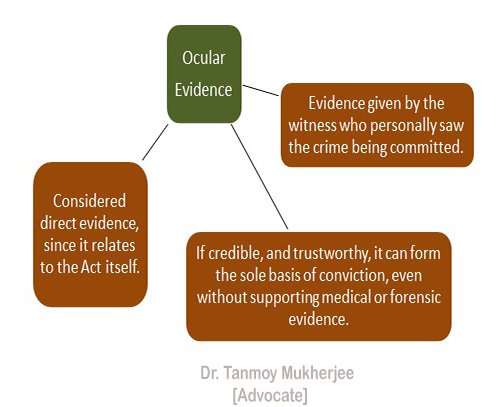
Ocular evidence refers to eye-witness testimony- i.e.; the account of a person who has personally seen (with their own eyes) the incident or event in question.
In legal terms, it is known as direct evidence because it is based on direct observation of the facts, not inference or opinion.
Ocular evidence is the evidence of a person who was present at the scene of the crime, and witnessed the event with their own eyes.
EXPERT MEDICAL EVIDENCE-
Opinion provided by a medical professional, typically about:
-Nature and cause of injuries/death
-Time since death.
-Weapon used.
-Possibility or impossibilities of injuries as claimed.
It is opinion evidence, admissible u/s 39 BSA (Sec. 45 IEA)
Considered advisory, not conclusive.
LEGAL PRINCIPLE-
The Judiciary has consistently held that-
Expert Medical opinion cannot override direct, credible and trustworthy ocular evidence, unless the medical evidence makes the ocular version impossible.
REFERENCE CASES-
RAM NARAIN SINGH v. STATE OF PUNJAB, AIR 1975 SC 1727-
-Where the direct evidence is not contradicted by the medical evidence, it has to be accepted.
-The opinion given by the medical witness need not be the last word on the subject.
State of U.P. v. Krishna Gopal, and Anr, (1988 vol 4) SCC 302-
-Medical evidence is opinionative and not direct evidence.
-It can support the prosecution or defence cases but cannot overrule reliable ocular evidence, unless the version is medically impossible.
Solanki Chimanbhai Ukabhai v. S.O. Gujarat (AIR 1983 SC 484)-
-Medical evidence is only corroborative.
-If the eye witness account is credible and trustworthy, minor contradictions with the medical evidence don't make it unreliable.
Mano Dutt v. State of U.P, (2012 vol 4) SCC 79-
When there is inconsistency between medical and ocular evidence, the ocular evidence has to be given primacy, unless the medical evidence completely rules out the possibility of the Ocular version.
EXAMPLE -
Minor Inconsistency-
- Eye witness says the victim was stabbed in the chest.
-Medical report shows wounds in the abdomen.
-Minor inconsistency alone does not discredit the eye witness if they are otherwise reliable.
Direct contradiction-
-Eye witness says the victim was shot.
-Medical report shows no bullet injury at all.
-Here, the medical evidence may prevail if the eye witness account seems false.
EXCEPTIONS -when medical evidence prevails-
Medical evidence may override ocular testimony only when-
1. The medical findings make it physically or scientifically impossible for the incident to have occurred as described.
2. The eyewitness account is improbable or fabricated.
3. The eyewitness is not wholly reliable or is a chance witness with no corroboration.
Balancing both type of evidence-
Courts adopted holistic approach-
-They corroborate ocular evidence with medical findings
-Minor inconsistencies do not damage the case.
-But if the conflict is fundamental, and the medical experts' findings are clear and reliable, the court may reject the eye witness version.

we believe in a holistic approach to legal education building not just lawyers, but socially conscious leaders of tomorrow.

