EXCEPTIONS of -AN AGREEMENT WITHOUT CONSIDERATION IS VOID
Indian Contract Act, 1872
TANMOY MUKHERJI INSTITUTE OF JURIDICAL SCIENCE
Dr. Tanmoy Mukherji
Advocate
EXCEPTIONS of –AN AGREEMENT WITHOUT CONSIDERATION IS VOID-
Tanmoy Mukherji
Advocate
The general rule is ex nudo pacto non oritur actio, i.e., an agreement made without consideration is void. Section 25 and 185 of Indian Contract Act, 1872 deals with the exceptions to this rule. In such cases the agreements are enforceable even though they are made without consideration. The exceptions are-
Exceptions-
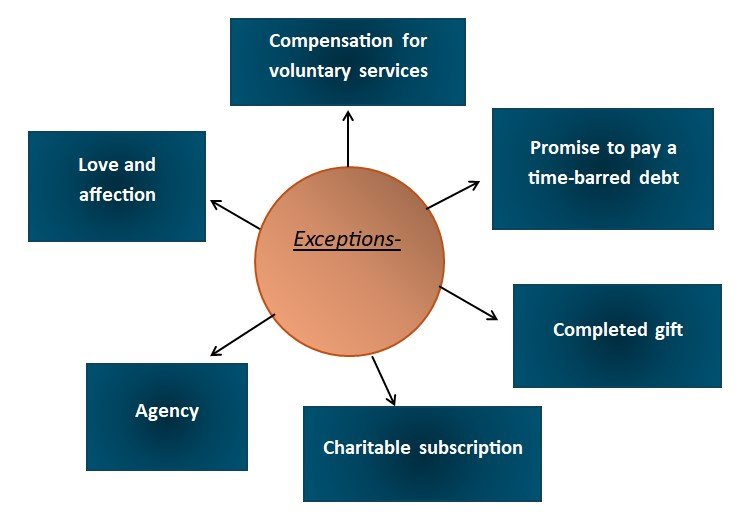
1.Love and affection [Sec. 25 (1)]-
Where an agreement is expressed in writing and registered under the law for the time being in force for the registration of documents and is made on account of natural love and affection between parties standing in a near relation to each other, it is enforceable even if there is no consideration. In simple words, a written and registered agreement based on natural love and affection between near relatives is enforceable even if it is without consideration.
[Ram Dass v. Krishan Dev, A.I.R. (1986) H.P. 9].
Examples-
(a) F, for natural love and affection, promises to give his son, S, ? 1,000. F puts his promise to S in writing and registers it. This is a contract.
(b) By a registered agreement, V, on account of natural love and affection for his brother, R, promises to discharge his debt to B. If V does not discharge the debt, R may discharge it and then sue V to recover the amount [Venkataswamy v. Rangaswamy (1903) 13 M.L.J. 428].
Nearness of relationship, however, does not necessarily import natural love and affection.
Example-
A Hindu husband, after referring to quarrels and disagreement between him and his wife, executed a registered document in favour of his wife agreeing to pay her for maintenance, but no consideration moved from the wife. Held, the agreement was void for want of consideration [Rajlukhy v. Bhoothnath, (1900) C.W.N. 488], as the essential requirement that the agreement is made on account of natural love and affection between the parties was missing.
2. Compensation for voluntary services [Sec. 25 (2)]-
A promise to compensate, wholly or in part, a person who has already voluntarily done something for the promisor, is enforceable, even though without consideration. In simple words, a promise to pay for a past voluntary service is binding.
Examples-
(a) A finds B’s purse and gives it to him. B promises to give A ? 50. This is a contract.
(b) A supports B’s infant son. B promises to pay A’s expenses in so doing. This is a contract.
(c) A says to B, “At the risk of your life you saved me from a serious accident. I promise to pay you ? 1,000”. There is a contract between A and B.
3. Promise to pay a time-barred debt [Sec. 25 (3)]-
A promise by a debtor to pay a time-barred debt is enforceable provided it is made in writing and is signed by the debtor or by his agent generally or specially authorised in that behalf. The promise may be to pay the whole or any part of the debt. The debt must be such “of which the creditor might have enforced payment but for the law for the limitation of suits”.
-A debt is barred by limitation if it remains unpaid or unclaimed for a period of three years. Such a debt becomes legally irrecoverable.
Example-
D owes C ? 1,000 but the debt is barred by the Limitation Act. D signs a written promise to pay C ? 500 on account of the debt. This is a contract.
4. Completed gift (Expl. 1 to Sec. 25)-
The rule “No consideration, no contract” does not apply to completed gifts. According to Explanation 1 to Sec. 25, nothing in Sec. 25 shall affect the validity, as between the donor and donee, of any gift actually made.
5. Agency (Sec. 185)-
No consideration is necessary to create an agency.
6. Charitable subscription-
Where the promisee on the strength of the promise makes commitments, i.e., changes his position to his detriment. [Kedar Nath v. Gauri Mohamed]

we believe in a holistic approach to legal education building not just lawyers, but socially conscious leaders of tomorrow.
