Euthanasia
TANMOY MUKHERJI INSTITUTE OF JURIDICAL SCIENCE
Dr. Tanmoy Mukherji
[Advocate]
Euthanasia
Tanmoy Mukherji
[Advocate]
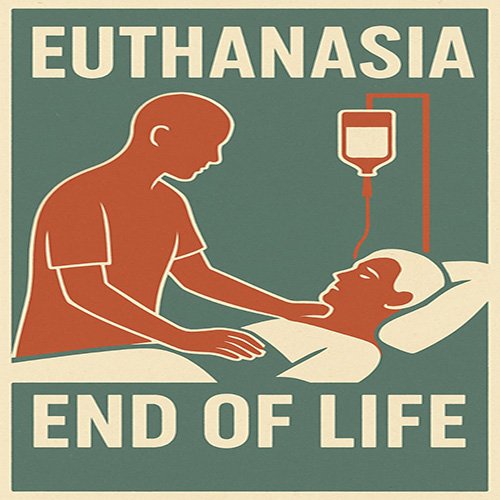
Euthanasia refers to the practice of intentionally ending a person’s life to relieve pain and suffering.
1.Active Euthanasia:
2.Passive Euthanasia:
3.Voluntary Euthanasia:
4.Non-Voluntary Euthanasia:
(E.g. Coma).
5.Involuntary Euthanasia:
6.Physician- Assisted Suicide:
1. Netherlands-
-Legal since 2002.
-Voluntary, well considered request.
-Patient is suffering from unbearable pain.
-Doctor consults at least one other independent physician.
2. Belgium-
-Legalized in 2002.
-Patient must be suffering from an incurable condition, causing unbearable physical and mental suffering.
3. Switzerland-
-Euthanasia is not legal.
-Assisted Suicide is allowed.
4. Canada-
-Medical Assistance in Dying legalized in 2016.
-Expanded in 2021 to include people with serious illness, even if death is not imminent.
5. United States-
-Active Euthanasia is illegal.
-Physician assisted Suicide is legal.
6. United Kingdom-
-Both active and passive Euthanasia are illegal.
-Considered murder.
7. Germany-
-In 2020, Germany decriminalized assisted suicide.
-Active Euthanasia is illegal.
8. Australia-
-Voluntary assisted dying is legal in most of the states.
9. Colombia-
-Colombia legalized Euthanasia.
-In 2022, Colombia decriminalized Assisted Suicide.
1.Universal Declaration of Human Rights:
Article 3- Right to life, liberty and security.
2.European Convention on Human Rights-
Article 2- Right to life.

3.International Covenant on Civil and Political Rights (ICCPR)-
Does not recognize a Right to die.
-Active Euthanasia is illegal and punishable under Section 103 BNS (sec 302 IPC) and Sec. 105 BNS (Sec-304 IPC).
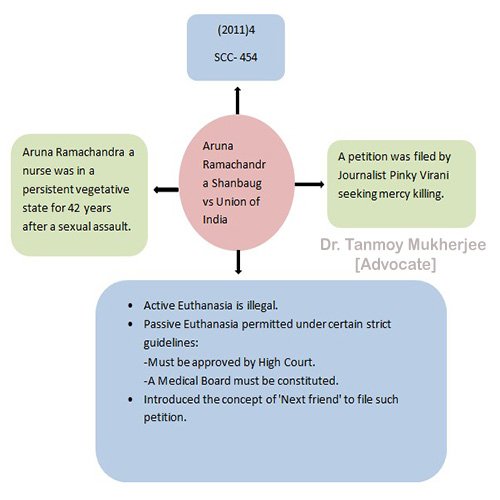
-Passive Euthanasia is legal but only under specific guidelines.
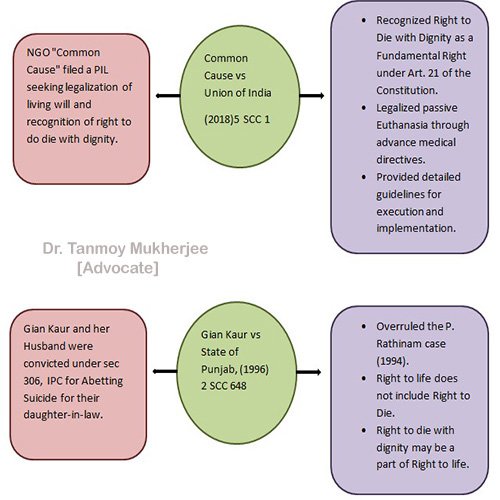
Article - 21 of Indian Constitution-
Protection of life and personal liberty includes Right to die with dignity.
Article - 226 -
High courts can be approached for enforcement of living will.

we believe in a holistic approach to legal education building not just lawyers, but socially conscious leaders of tomorrow.