Estoppel-
Dr. Tanmoy Mukherji
Advocate
Estoppel-
Tanmoy Mukherji
[Advocate]
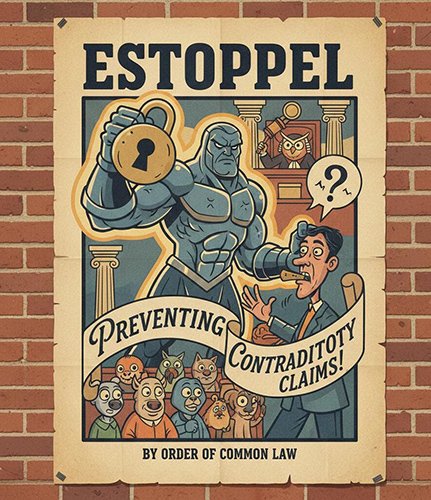
The word 'estoppel' is derived from the French word 'estoupe' which means 'stopper'. The term 'estoppel' was adopted by the English Jurisprudence for the purpose of shutting the mouth of a person who are pleading the contrary of a fact or state of thing which he has formerly asserted by words or conduct.
Essential Elements-
In order to bring a case within the scope of section 121 BSA, following things are necessary-
i) One party should make a representation to the other party about an existing fact as distinct from a mere promise.
ii) The representation must be made with the intention to be acted upon.
iii) The other party should accept and rely upon the aforesaid factual representation i.e., there must have been belief on the part of the other.
iv) There must have been action arising out of the belief i.e., the representation must have been acted upon.
Types of Estoppel-
Estoppel by Matter of Record-
Estoppel by record is estoppel of the parties from reopening and re-litigating the matter which has been finally settled between them by a court of competent jurisdiction. Estoppel by record is covered under Section 11 of the Code of Civil Procedure, 1908 (CPC) and section 40 to 44 of the Indian Evidence Act, 1872 (IEA). This type of estoppel is also known as estoppel by judgement.
Estoppel by Deed-
When a party has entered into a solemn engagement by deed as to certain facts, neither he nor anyone claiming through or under him is permitted to deny such facts. There is no estoppel where the deed is affected by fraud or illegality.
Estoppel in pais or by conduct-
In pais means "before the public" and estoppel in pais is also freely translated as estoppel by conduct/representation. Estoppel by conduct can either arise from a contract or de hors (outside a contract) by unilateral statements, acts or omissions which include another party to believe and act on that belief.
Promissory Estoppel-
Promissory estoppel is a legal doctrine that allows a party to recover on a promise made without a formal contract if they have relied on that promise to their detriment. It is an equitable remedy to prevent injustice that can arise when one party relies on the promise of another.
Essentials of Promissory Estoppel-
For promissory estoppel to apply, certain elements must be satisfied:
There must be a clear and unequivocal promise made by the promisor.
The promisee must have reasonably relied on the promise.
The reliance must have caused a detriment or harm to the promisee.
It must be shown that it would be unjust not to enforce the promise.
A person having knowledge of facts cannot take advantage of the principle of estoppel.
Where both parties acted under common misapprehension, there could be no estoppel until the position is cleared up.
A mere promise to do something in future will not create an estoppel.
If both parties establish a case for application of estoppel, then the parties are set free and court will have to proceed as if there is no plea of estoppel on either side.
If there is a fraud on the part of the other party, which could not be detected by the promisor with ordinary care, the estoppel will not operate.
Attestation does not involve the witness of any knowledge of the contents of the deed, it can at the best be used for the purpose of cross-examination, but it will neither create estopped nor imply consent.
There can be no estoppel on a point of law or on a settled proposition of law or to defeat the provisions of a valid law.
There cannot be any estoppel against the Government in the exercise of its sovereign, legislative and executive functions.
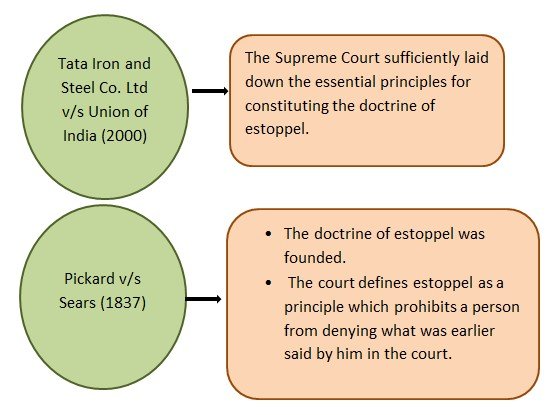
Reference Cases-

we believe in a holistic approach to legal education building not just lawyers, but socially conscious leaders of tomorrow.
