Essential Elements of Partnership
Partnership Act, 1932
TANMOY MUKHERJI INSTITUTE OF JURIDICAL SCIENCE
Dr. Tanmoy Mukherji
[Advocate]
Essential Elements of PARTNERSHIP-
TANMOY MUKHERJI
[ADVOCATE]
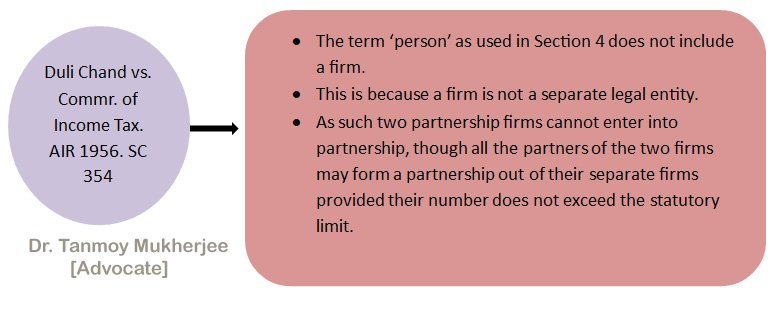
Partnership is the relation between persons who have agreed to share the profits of a business carried on by all or any of them acting for all (Sec. 4, para 1). Persons who have entered into partnership with one another are called individually ‘partners’ and collectively ‘a firm’ (Sec. 4, para 2).
There should be minimum two capable persons to form a partnership. As regards the maximum number of partners in a firm, Sec. 11 of the Companies Act, 1956 provides that the number of partners in a firm carrying on banking business should not exceed ten and in any other business twenty. If the number of partners exceeds this limit, the partnership becomes an illegal association. It ceases to be a partnership if the number gets reduced to one by any reason.
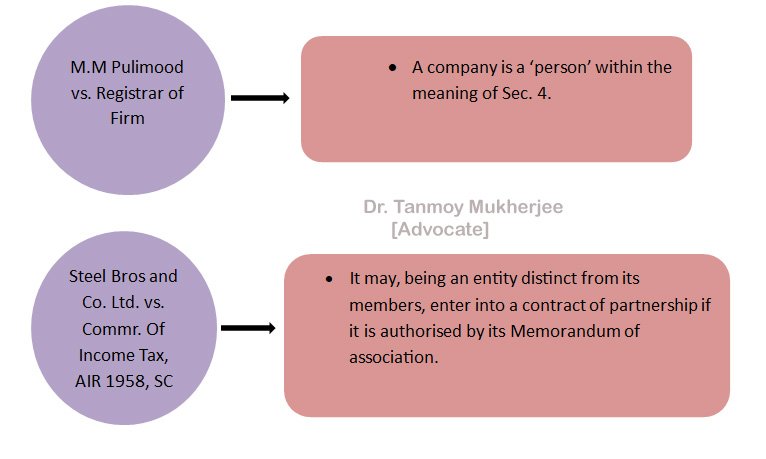
The partnership relation is one of juridical nature. It arises from contract and not from status (Sec. 5), as agreement between the partners is the basis of this contract. The agreement may be expressed (i.e., oral or written) or implied. Implied agreement may be inferred from the course of dealing or the conduct of the parties. The agreement may be for a fixed period, or for the implementation of a particular adventure, or it may give option to the partners to withdraw from the partnership at any time. Partnership is thus created by contract; it does not arise by operation of law (as in the case of co-owners) or from status (as in the case of a Joint Hindu Family) or from inheritance. Partnership agreement, like any other contract, must have all the essential elements of a valid contract.
A partnership can be formed only for the purpose of carrying on some business. ‘Business’ covers every trade, occupation and profession [(Sec. 2 (b)]. The word ‘business’ generally conveys the idea of a running business involving numerous transactions. Besides that a person may become a partner with another in a particular adventure. The business to be carried on by the firm must be legal.
The object of partnership must be to make profit. Profit means net profit, i.e., excess of returns over outlays, the excess of what is obtained over the cost of obtaining it. Profit must be distributed among the partners in an agreed ratio. If any person claiming to be a partner is deprived of his right to share in the profits of the business, he is not a partner as his carrying on the business is not for profit. But the reverse is not necessarily true. A person may share in the profits of partnership, but still he may not be a partner. The sharing of profit also involves sharing of loss which in fact is negative profit. But as between the partners, it may be agreed that one or more of the partners shall not be liable for losses.
The business of partnership may be carried on by all the partners or any of them acting for all. A partner is both an agent (in the sense that he can bind by his acts the other partners) and the principal (in the sense that he can be bound by the acts of the other partners). The question if a person is or is not a partner depends in nearly all cases upon whether he has the authority to act for those who are admittedly partners and whether those admitted partners have the mastery to act for him.

we believe in a holistic approach to legal education building not just lawyers, but socially conscious leaders of tomorrow.