Employer’s Responsibility for Payment of Wages under the Payment of Wages Act, 1936
Dr. Tanmoy Mukherji
Advocate
Employer’s Responsibility for Payment of Wages under the Payment of Wages Act, 1936
Tanmoy Mukherji
Advocate
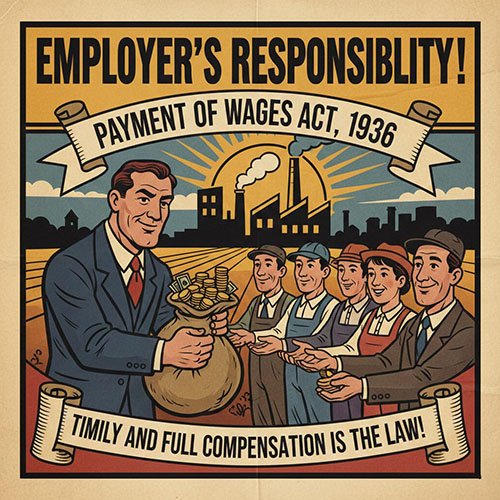
→The Payment of Wages Act, 1936 was enacted to regulate the payment of wages to certain classes of employed persons and to ensure that wages are paid regularly, without delay and without unauthorized deductions. The Act casts a statutory responsibility on the employer to comply with its provisions.
Primary Responsibility of Employer (Section 3)-
Under Section 3, the employer is primarily responsible for the payment of wages. In a factory, the manager is deemed to be the employer; in industrial establishments, the person responsible for supervision and control is liable; and in railways, the person nominated by the railway administration bears responsibility.
Ref. Case-
In Basti Sugar Mills Co. Ltd. v. Ram Ujagar (AIR 1964 SC 355), the Supreme Court held that the person who has ultimate control over the affairs of the establishment is responsible for payment of wages under the Act.
Fixation of Wage Period (Section 4)-
The employer must fix wage periods, and such wage periods shall not exceed one month. This provision ensures regular income to workers and prevents exploitation through long wage intervals.
Ref. Case
In Payment of Wages Inspector v. Surajmal Mehta (1956 I LLJ 182), it was held that failure to fix a wage period as prescribed amounts to violation of the Act.
Timely Payment of Wages (Section 5)
The employer must ensure that wages are paid within the prescribed time:
→Before the 7th day of the following month if fewer than 1,000 employees are employed.
→Before the 10th day if 1,000 or more employees are employed.
→In case of termination, wages must be paid within two working days.
Ref. Case
In Manganese Ore (India) Ltd. v. Chandi Lal Saha (1991 I LLJ 307 SC), the Supreme Court held that delay in payment of wages defeats the very object of the Act and attracts liability.
Mode of Payment of Wages (Section 6)
Wages must be paid in current coin or currency notes. Payment through cheque or bank transfer is permitted with the consent of the employee. Payment in kind is generally prohibited unless authorized by the government.
Ref. Case
In CESC Ltd. v. Inspector of Payment of Wages (1992 I LLJ 474 Cal), it was held that payment must strictly comply with Section 6 and any deviation without authority is illegal.
Responsibility Regarding Deductions (Sections 7–13)
The employer must ensure that no deduction is made from wages except those authorized under the Act, such as:
→Fines
→Absence from duty
→Damage or loss
→House rent
→Provident fund contributions
→Unlawful deductions are prohibited.
Ref. Case-
In C.M. Hospital Mazdoor Sabha v. State of Bihar (AIR 1960 SC 610), the Supreme Court observed that the Act aims to protect workmen from arbitrary and excessive deductions by employers.
Prohibition of Unjust Fines (Section 8)
Fines can be imposed only for acts approved by the government and must be recorded in the prescribed register. The employer has the responsibility to follow this procedure strictly.
Ref. Case-
In Hindustan Steel Ltd. v. State of Orissa (AIR 1970 SC 253), it was held that fines imposed without following statutory procedure are invalid.
Maintenance of Registers and Records (Section 13A)
Employers must maintain registers of wages, deductions, fines, and advances. Failure to maintain records amounts to a breach of statutory duty.
Ref. Case
In Regional Labour Commissioner v. T.S. Hazari (1968 I LLJ 564), the court held that non-maintenance of records raises a presumption of non-payment or illegal deduction.
Employer’s Liability in Case of Contract Labour
If wages are not paid by the contractor, the principal employer is responsible for payment and may recover the amount from the contractor.
Ref. Case
In People’s Union for Democratic Rights v. Union of India (AIR 1982 SC 1473), the Supreme Court held that the principal employer cannot escape liability for payment of wages under labour welfare laws.
Redressal of Claims and Compensation (Section 15)
An employed person can approach the authority appointed under the Act for delayed or illegal deductions. The employer may be directed to pay:
→The deducted amount, and
→Compensation up to ten times the deducted wages.
Ref. Case
In M/s. Shri Ambica Mills v. S.B. Bhatt (AIR 1961 SC 970), the Supreme Court upheld the power of authorities to award compensation for delayed wages.
Penalties for Default (Section 20)-
Employers who fail to comply with provisions relating to payment, deductions, or records are liable to fines and prosecution.
Ref. Case
In Bharat Barrel & Drum Mfg. Co. v. ESI Corporation (AIR 1972 SC 1935), the Supreme Court reiterated that labour welfare legislation must be strictly enforced against employers.
The Payment of Wages Act, 1936 imposes a mandatory and non-delegable responsibility on employers to ensure timely payment of wages, lawful deductions, proper records, and fair treatment of employees. Judicial decisions have consistently reinforced that the Act is a beneficial legislation and must be interpreted in favour of employees.

we believe in a holistic approach to legal education building not just lawyers, but socially conscious leaders of tomorrow.
