Dr. B. R. Ambedkar’s Concept of Social Justice
Dr. Tanmoy Mukherji
Advocate
Dr. B. R. Ambedkar’s Concept of Social Justice-
Tanmoy Mukherji
Advocate
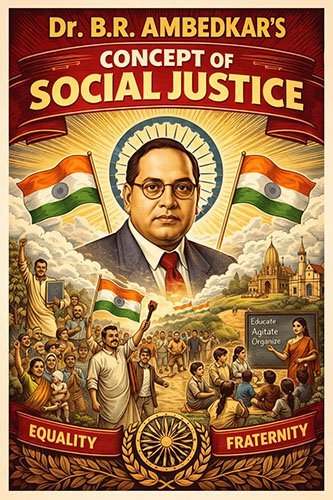
Dr. Bhimrao Ramji Ambedkar, the chief architect of the Indian Constitution, viewed social justice as the cornerstone of democracy. For Ambedkar, political democracy was meaningless without social and economic democracy. His idea of social justice aimed at destroying caste inequality, ending untouchability, and ensuring human dignity, equality, and liberty for all.
Meaning of Social Justice According to Ambedkar-
Ambedkar defined social justice as a system where:
→All individuals enjoy equal rights and opportunities,
→Social inequalities based on caste, birth, religion or gender are eliminated,
→The oppressed are empowered through law, education and state action.
“Political democracy cannot last unless there lies at the base of it social democracy.”
Social Democracy: Liberty, Equality and Fraternity-
Ambedkar adopted the principles of the French Revolution as the foundation of social justice:
Liberty – freedom of thought, expression and belief
Equality – equality before law and equal social status
Fraternity – sense of brotherhood and social unity
He emphasized fraternity as essential to overcome caste divisions.
Caste System as the Main Obstacle to Social Justice-
Ambedkar regarded the caste system as the greatest enemy of social justice because it:
→Denied equality and dignity,
→Enforced social segregation,
→Prevented social mobility,
→Institutionalized discrimination.
He famously stated:
“Caste is not merely a division of labour, it is a division of labourers.”
Abolition of Untouchability-
For Ambedkar, abolition of untouchability was central to social justice.
Constitutional Provisions-
Article 17 – Abolition of untouchability
Protection of Civil Rights Act, 1955
SC/ST (Prevention of Atrocities) Act, 1989
These laws aimed to ensure substantive equality, not merely formal equality.
Equality Before Law-
Ambedkar insisted that social justice must be backed by legal justice.
Relevant Constitutional Articles:
Article 14 – Equality before law
Article 15 – Prohibition of discrimination
Article 16 – Equality of opportunity in public employment
Law, for Ambedkar, was a tool of social transformation.
Reservation and Affirmative Action-
Ambedkar strongly supported reservations as a means of achieving social justice.
Objectives-
→Correct historical injustice,
→Ensure representation of marginalized communities,
→Provide equal opportunities in education and employment.
→He viewed reservations as compensatory justice, not charity.
Education as an Instrument of Social Justice
Ambedkar believed education was the most powerful weapon against oppression.
“Educate, Agitate, And Organize.”
Education enables:
→Awareness of rights,
→Economic independence,
→Social empowerment.
Economic Justice and Social Justice-
Ambedkar emphasized that social justice is incomplete without economic justice.
He supported:
→State intervention in the economy,
→Protection of labour rights,
→Minimum wages,
→Reduction of economic inequality.
Role of the Constitution-
Ambedkar regarded the Constitution as a vehicle of social revolution.
Key features promoting social justice:
→Fundamental Rights
→Directive Principles of State Policy
→Protective discrimination
→Independent judiciary
Criticism of Ambedkar’s Approach-
Some criticisms include:
→Over-dependence on state action,
→Reservations allegedly creating divisions,
→Legal methods ignoring social reform from within society.
However, Ambedkar defended his approach as necessary for real equality.
Relevance in Contemporary India-
Ambedkar’s vision remains relevant in:
→Debates on reservation and equality,
→Social inclusion policies,
→Protection of Dalits and minorities,
→Strengthening constitutional morality.
Conclusion
Dr. B. R. Ambedkar’s concept of social justice is rooted in human dignity, equality, and empowerment of the oppressed. He transformed social justice from a moral idea into a constitutional reality, making him one of the greatest social reformers in Indian history.

we believe in a holistic approach to legal education building not just lawyers, but socially conscious leaders of tomorrow.
