Dower (Mahr)
Muslim Law
Dr. Tanmoy Mukherji
[ Advocate]
Dower (Mahr)
Tanmoy Mukherji
[Advocate]
Mahr or dower is a sum that becomes payable by the husband to the wife on marriage, either by agreement between the parties or by operation of law.
Definition—
-According to Wilson, "Dower" is a consideration for the surrender of person by the wife.
-According to Ameer Ali, "Dower" is a consideration which belongs absolutely to the wife.
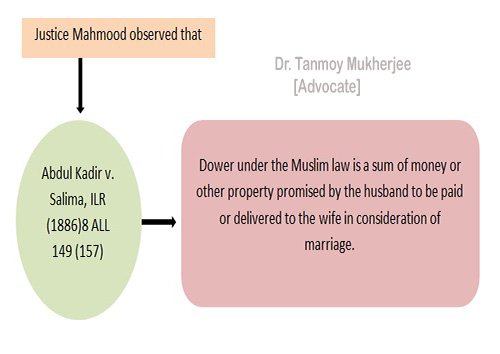
-According to Mulla, "Dower" is a sum of money or other property which the wife is entitled to receive from the husband in consideration of the marriage.
Object -
The object of dower is three fold:
I) to impose an obligation on the husband for the purpose of giving respect to the wife;
II) to place a restriction on the husband for restraining the capricious use of divorce.
III) to provide for the subsistence of the wife after the dissolution of the marriage either by death of the husband or divorce.
Classification of dower— The dower may be classified into:
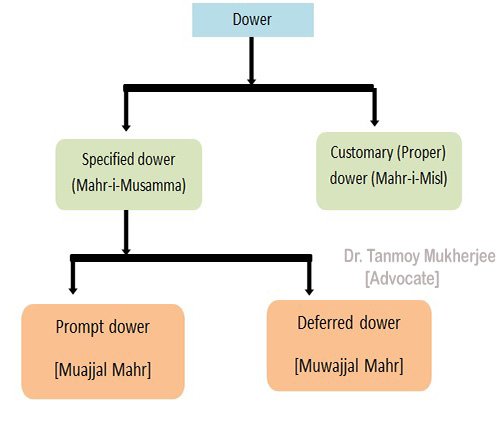
1.Specified dower (Mahr-i-Musamma)-
If the amount of dower is stated in the marriage contract, it is called the specified dower.
Specified dower is again subdivided into-
1.Prompt dower[Muajjal Mahr]
Prompt Dower [Muajjal Mahr]-
Prompt dower is payable immediately after the marriage on demand.
The points to be highlighted are-
-It is payable immediately after the marriage taking place unless delay is stipulated or agreed.
-The wife has the right to refuse to enter into conjugal domicile of husband until the payment of prompt dower.
-The husband is bound to maintain the wife, although she is residing apart from him.
-Even after consummation, prompt dower does not become deferred and the right of the wife to sue the husband for recovering prompt dower remains intact; but after consummation the wife can't resist the conjugal rights of the husband.
-The period of limitation for prompt dower is 3 years which begins to run from the date of demand and refusal.
Deferred dower (Muwajjal Mahr)-
Deferred dower is payable on the dissolution of marriage either by death or divorce.
The points to be highlighted are-
-If there is any agreement regarding the early payment of deferred dower, such an agreement would be valid and binding.
-The wife has not any right to demand the early payment of deferred dower; but the husband can treat it prompt and pay or transfer of property in lieu of it.
-The wife may voluntarily relinquish her dower during the funeral of her husband by reciting a formula.
-The interest of the wife in the deferred dower is a vested one and not a contingent one.
2. Proper/Customary Dower (Mahr-i-Misl)-
When the amount of dower is not fixed in the marriage contract it is called Proper dower.
The proper dower is to be determined by considering the following factors-
(a) Personal qualifications of wife; her age, beauty, fortune, understanding and virtue.
(b) Social position of her father's family.
(c) Dower given to her female paternal relations.
(d) Economic condition of her husband.
(e) Circumstances of time.
Wife's Rights and Remedies on unpaid dower-
Muslim law confers upon a wife the following three rights to compel payment of her dower-
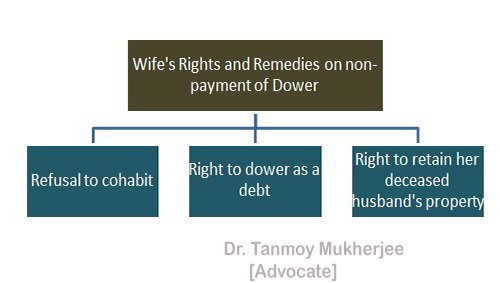
1. Refusal to cohabit-
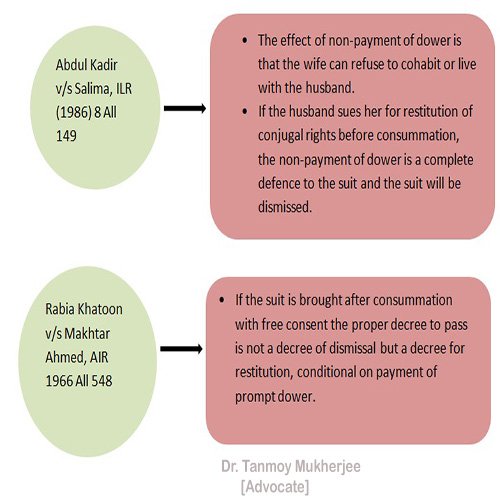
If the marriage has not been consummated, the wife has a right to refuse to cohabit with her husband until the prompt dower is paid.
In the case of a minor or insane wife, the guardian of the wife has a right to refuse to send her to her husband's house.
Reference Case Laws-
2. Right to dower as a debt-
-The dower ranks as a debt and the widow is entitled to have it satisfied from the estate of the husband.
-If the husband is alive, the wife can recover the debt from the husband by instituting a suit against him.
-After the death of the husband, if the dower debt remains unpaid, the widow still can enforce her claim by instituting a suit against the heirs of the husband.
-The heirs are not personally liable for the debt but to the extent to which and in the proportion in which they inherit the property of the deceased husband.
Reference Cases-
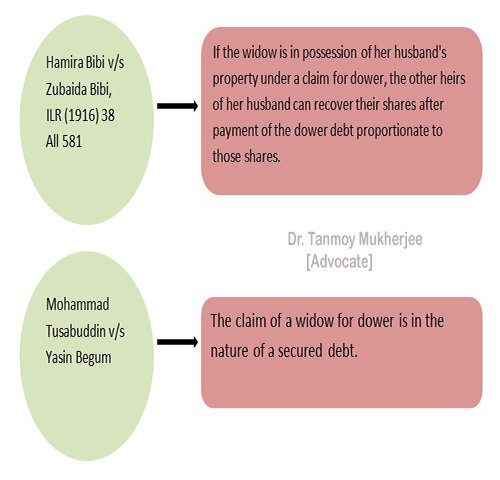
3. Right to retain possession in lieu of unpaid dower-
If the widow has lawfully and without force or fraud obtained in lieu of her dower actual possession of her deceased husband's property, she is entitled to retain the possession as against other heirs and other creditors of her husband, until the dower is paid.
The following essentials must be taken into consideration-
-No right of retention during continuance of marriage.
-Actual possession.
-The right of retention not analogous to a mortgage.
-Not a charge.
-A possessory lien on property is no title.
-Widow in possession liable to account.
-Can sue heirs.
-The right of retention whether heritable or transferable.
Difference between Sunni and Shia Laws relating to dower
|
Sunni Law
|
Shia Law
|
|
A minimum limit of 10 dirhams is prescribed for specified dower.
|
No minimum limit is prescribed.
|
|
There is no limit to proper dower.
|
Proper dower cannot exceed 500 dirhams. |
|
There is no maximum limit for specific dower.
|
Fixing of dower exceeding 500 dirhams is considered abominable though not illegal.
|
|
If marriage is dissolved by death and dower has not been specified, or it is agreed that no dower shall be payable, proper dower would be due whether the marriage was consummated or not.
|
In such case no dower would be due if the marriage was not consummated.
|
|
An agreement that no dower shall be due is void. |
Such agreement by sane and adult wife is valid.
|
|
In the absence of an agreement only a reasonable part of the dower is presumed to be prompt.
|
The whole dower is presumed to be prompt.
|

we believe in a holistic approach to legal education building not just lawyers, but socially conscious leaders of tomorrow.