Doctrine of Notional Extension of Premises-
Dr. Tanmoy Mukherji
Advocate
Doctrine of Notional Extension of Premises-
Tanmoy Mukherji
Advocate
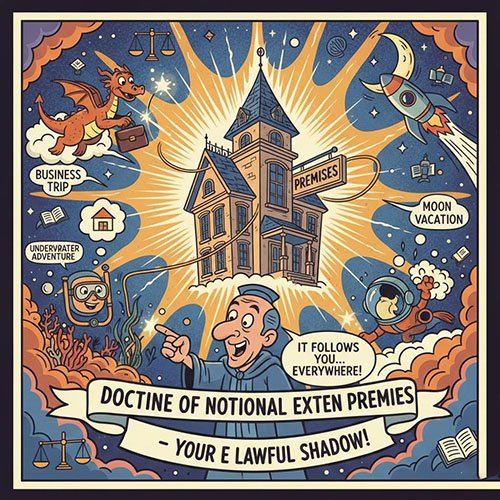
The doctrine of notional extension of premises is a judicially developed principle under labour welfare legislation, particularly under the Employees’ Compensation Act, 1923, Factories Act, 1948, and Employees’ State Insurance Act, 1948.
-The doctrine enlarges the scope of the expression “arising out of and in the course of employment” so as to provide social security to workers.
-Courts have consistently held that employment should not be interpreted in a narrow or technical sense, as labour laws are beneficial legislations intended to protect workers from hardship.
Meaning of Notional Extension-
Ordinarily, employment begins when a worker enters the employer’s premises and ends when he leaves it. However, under the doctrine of notional extension, the employer’s premises are constructively extended to include certain areas outside the actual workplace.
Thus, if an employee meets with an accident:
→while approaching the place of work, or
→while leaving the place of work, or
→while using means of access or transport connected with employment,
such accident may still be treated as occurring in the course of employment.
Legal Basis of the Doctrine-
The doctrine is based on the interpretation of-
→Section 3 of the Employees’ Compensation Act, 1923
→Section 2(8) and Section 46 of the ESI Act
-Judicial interpretation of the phrase “in the course of employment”
-Courts apply the doctrine to ensure that workers are not deprived of compensation due to strict geographical limitations.
Tests Applied by Courts-
Test of Proximity
There must be a reasonable proximity of time and place between the accident and employment.
The farther the accident from the workplace, the weaker the claim.
Test of Nexus (Causal Connection)
There must be a direct or indirect connection between the employment and the accident.
Test of Control or Obligation
If the employer:
→provides transport, or
→controls the route, or
→requires the employee to be present at a particular place,
the doctrine is more readily applied.
Test of Incidental Act
The act being performed must be incidental to employment, such as:
→entering or leaving the factory
→boarding employer-provided transport
→using customary access routes
Reference Cases-
1. Saurashtra Salt Manufacturing Co. v. Bai Valu Raja (1958)
→This is the leading case on notional extension.
→Workers crossed a creek to reach salt works. A worker drowned while crossing.
→The Supreme Court held that employment extended to the area which the workman had to cross as a necessary means of access.
→The accident arose out of and in the course of employment.
→Employer’s premises may be notionally extended to include customary and necessary access routes.
2. B.E.S.T. Undertaking v. Agnes (1964)
→An employee was injured while boarding a bus provided by the employer.
→The Supreme Court ruled that employment does not strictly begin inside the workplace.
→The accident occurred within the extended zone of employment.
→Employer-provided transport forms part of notional extension.
3. General Manager, B.E.S.T. v. Mrs. Agnes (1964)
→The Court emphasized that employment includes acts which are reasonably incidental to employment.
4. Mackinnon Mackenzie & Co. v. Ibrahim Mahmmed Issak (1969)
→The Supreme Court explained the meaning of “arising out of employment”.
→Employment must expose the worker to a special risk.
→If employment increases the risk of injury, the employer is liable.
5. E.S.I. Corporation v. Francis De Costa (1996)-
→Employee met with an accident while travelling independently to work.
→The Supreme Court refused to apply notional extension.
The doctrine does not apply where:
→the employer has no control
→the travel is purely personal
6. Regional Director, ESI v. Ramanuja Match Industries (1985)
→If the accident occurs at a place where the employee is required to be for work-related reasons, notional extension applies.
Situations Where Doctrine Applies
→Accident on access road used exclusively by workers
→Accident while boarding or alighting employer’s transport
→Accident inside or near factory gate
→Accident in employer-controlled premises outside factory
Situations Where Doctrine Does Not Apply
→Accident during personal errands
→Accident on public road without employer control
→Accident after long deviation from work
→Accident during independent commuting
Importance of the Doctrine-
→Prevents denial of compensation on technical grounds
→Advances the objective of social justice
→Reflects a humanitarian approach of courts
→Protects workers in modern industrial conditions
The doctrine of notional extension of premises plays a crucial role in labour jurisprudence by ensuring that the concept of employment is interpreted liberally and purposively. Courts have balanced the interests of employers and employees by applying reasonable tests of proximity and nexus. When an accident occurs within the zone of employment, even outside the physical workplace, the employer may be held liable.

we believe in a holistic approach to legal education building not just lawyers, but socially conscious leaders of tomorrow.
