DOCTRINE OF ELECTION [Section 35]
Transfer of Property Act, 1882
Dr. Tanmoy Mukherji
[ Advocate]
DOCTRINE OF ELECTION [Section 35]
Tanmoy Mukherji
[Advocate]
-Section 35 of the Transfer of Property Act, 1882 deals with the Doctrine of Election. The word 'Elect' literally means, "to choose by vote or to decide on a course of action". The doctrine of election is an exception to the general/popular rule, 'Nemo dat quod non habet' which means, "no one can convey a better title than, what he himself has". It is based on the principle of equity and is applicable to all kinds of properties, movable or immovable.
-Suppose, a property is given to you and in the same deed of gift, you are asked to transfer something belonging to you to another person. If you want to take the property, you should transfer your property to someone else; otherwise, you cannot take the property, which is transferred to you by someone. Similarly, A transfers to you, one acre of his land and in the same deed of transfer, A asks you to transfer your house to C. Now, you have to elect whether to accept land at the cost of your house or to refuse the land to retain the house.
-As stated above, election is an obligation to choose between two inconsistent or alternative rights in cases where there is a clear intention (express or implied) of the grantor that the grantee should not enjoy both the rights and once. The very foundation of this doctrine is that the person taking a benefit under an instrument must also bear the burden.
-When a person wants to transfer property, which he has no right to transfer, confers in return some benefit on the owner of the property. Such owner must elect whether to confirm such transfer or to dissent from it.
Election when necessary (Section 35):
Where a person professes to transfer property which he has no right to transfer, and as part of the same transaction confers any benefit on the owner of the property, such owner must elect either to confirm such transfer or to dissent from it; and in the latter case he shall relinquish the benefit so conferred, and the benefit so relinquished shall revert to the transferor or his representative as if it had not been disposed of, subject nevertheless, where the transfer is gratuitous, and the transferor has, before the election, died or otherwise become incapable of making a fresh transfer, and in all cases where the transfer is for consideration, to the charge of making good to the disappointed transferee the amount or value of the property attempted to be transferred to him.
Illustrations-
The farm of Sultanpur is the property of C worth Rs.800. A by an instrument of gift professes to transfer it to B, giving by the same instrument Rs-1000 to C. C, elects to retain the farm. He forfeits the gift of Rs.1000.
Exception to the last preceding four rules –
Where a particular benefit is expressed to be conferred on the owner of the property which the transferor professes to transfer, and such benefit is expressed to be in lieu of that property, if such owner claims the property, he must relinquish the particular benefit but he is not bound to relinquish any other benefit conferred upon him by the same transaction.
Acceptance of the benefit by the person on whom it is conferred constitutes an election by him to confirm the transfer, if he is aware of his duty to elect and of those circumstances which would influence the judgment of a reasonable man in making an election, or if he waives enquiry into the circumstances.
Such knowledge or waiver shall, in the absence of evidence to the contrary, be presumed, if the person on whom the benefit has been conferred has enjoyed it for two years without doing any act to express dissent.
Such knowledge or waiver may be inferred from any act of his which renders it impossible to place the persons interested in the property professed to be transferred in the same condition as if such act had not been done.
Illustration-
A transfers to B an estate to which C is entitled, and as part of the same transaction gives C a coal-mine. C takes possession of the mine and exhausts it. He has thereby confirmed the transfer of the estate to B.
Section 35 lays down the principle of highest equity and applies to all classes of persons irrespective of their religion/personal laws.
Who can elect-
A person, getting some benefit in lieu of losing something can elect.
Underlying Principles of the Doctrine-
The Doctrine of Election is borrowed from the English Equity Jurisprudence basing on the following rules:
(1) The person taking the benefit must also bear the burden.
(2) The donee shall not be allowed to 'approbate and reprobate'. If he approbates, he shall do all in his favor to confirm the same.
(3) No one can blow 'hot' and 'cold' in the same breath.
The Doctrine of Election was stated by Maithland in the following words-
He, who accepts a benefit under a will or deed or any other instrument must-
(i) adopt the whole contents of the instrument;
(ii) confirm to all its provisions; and
(iii) renounce all the rights that are inconsistent with it.
Indian Courts applied the Doctrine in several cases, and it was observed that- 'a person cannot approbate and reprobate the same'.
Underlying Principle-
The underlying principle of the doctrine was enunciated by Lord Coirus in the leading case:
Conditions of the Doctrine-
To attract Section 35, the following conditions are to be satisfied:
(1)There must be transfer of property.
(2) The transferor has to transfer the property of which he is not a real owner or has no authority to transfer.
(3)The transferor should confer some benefit upon the owner of the property, which he professes to dispose of.
(4) Disposal (of property) and conferment of benefit must be part of the same transaction.
(5) The benefit must be directly conferred on him.
(6) The beneficiary (put to election) should have an independent priority right.
The person put to election is called 'refractory donee' and the person who suffers is called the 'disappointed donee'.
Effect of Election-
If the election is made to repudiate the transaction, the consequences that follow immediately are simple. He shall be relinquished of the benefit. Such benefit reverts (goes back) to the transferor.
Compensation to disappointed donee-
If the donee elects against the instrument the transferor or his representative is liable to make good to the disappointed donee or transfer the amount of the value attempted to be transferred to him on two specific cases.
The two cases are:
(1) Where the transfer is gratuitous and the transferor had before the election died or otherwise become incapable of making fresh transfer; and
(2) In all cases where the transfer is for consideration.
Time for Election-
In English Law, no time is fixed. If the time is fixed and election does not take effect within the time, it is deemed to have been elected against the document. In India, the time fixed is one year. If the donee is silent, it is deemed to have been elected.
Mode of Election-
Election may be direct or indirect. For direct election no form is prescribed and no formula is laid down. Anything that conveys the intention clearly is sufficient for the purpose. A letter, telegram, a word spoken orally in presence and within hearing range of the transferor or any other sign made or marked at the desire of or to understanding of the transferor is enough. In case of indirect election, the following three modes are given in Section 351, Clauses 5, 6 and 7.
Exceptions to the Doctrine-
(1) In the absence of any condition stated above is satisfied.
(2) Where there is an express declaration to the contrary.
(3) Where they are not in the same instrument; and
(4) Grant by the Crown.
Indian Law-
The provisions relating to the doctrine are enshrined (contained) in Section 35 of the Transfer of Property Act. Similar provisions are contained in Sections 180 to 190 of the Indian Succession Act.
Section 187 –
When acceptance of benefit given by will constitutes election to take under will – Acceptance of a benefit given by a will constitutes an election by the legatee to take under the will, if he had knowledge of his right to elect and of those circumstances which would influence the judgment of a reasonable man in making an election, or if he waives inquiry into the circumstances.
Illustrations:
(1) A is owner of an estate called Sultanpur Khurd, and has a life interest in another estate Sultanpur Buzurg to which upon his death his son B will be absolutely entitled. The will of A gives the estate of Sultanpur Khurd to B, and the estate of Sultanpur Buzurg to C. B, in ignorance of his own right to the estate of Sultanpur Buzurg, allows C to take possession of it, and enters into possession of the estate of Sultanpur Khurd. B has not confirmed the bequest of estate of Sultanpur Buzrug to C.
(2) B, the eldest son of A, is the possessor of an estate called Sultanpur. A bequeaths Sultanpur to C, and to B the C to take possession of Sultanpur. He afterwards discovers that the residue does not amount to more than Rs.500. B has not confirmed the bequest of the estate of Sultanpur to C.
Section 188 –
Circumstances in which knowledge or waiver is presumed or inferred:
(1) Such knowledge or waiver of inquiry shall, in the absence of evidence to the contrary be presumed if the legatee has enjoyed for two years the benefits provided for him by the will without doing any act to express dissent.
(2) Such knowledge or waiver of inquiry may be inferred from any act of the legatee, which renders it impossible to place the persons interested in the subject-matter of the bequest in the same condition as if such act had not been done.
Illustration:
A bequeaths to B an estate to which C is entitled and to C a coal-mine. C takes possession of the mine and exhausts it. He has thereby confirmed the bequest of the estate to B.
Section 189 –
When testator's representatives may call upon legatee to elect - If the legatee does not within one year after the death of the testator, signify to the testator's representatives his intention to confirm or to dissent from the will, the representatives shall, upon the expiration of that period, require him to make his election; and if he does not comply with such requisition within a reasonable time after he has received it, he shall be deemed to have elected to confirm the will.
Section 190-
Postponement of election in case of disability - In case of disability the election shall be postponed until the disability ceases, or until the election is made by some competent authority.
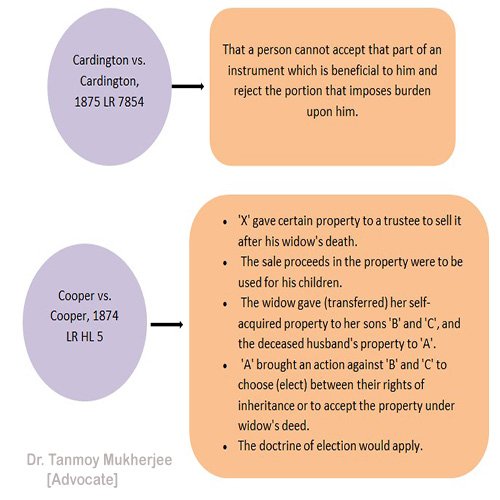
Case References-
Distinction between English Law and Indian Law-
|
English Law
|
Indian Law
|
|
The Doctrine is based on compensation.
|
Based on forfeiture.
|
|
No time limit is prescribed for election.
|
Time limit is one year (failure of which amounts to acceptance). |
|
If the person to elect has disability, the court will elect for the disabled.
|
Election is postponed during the period of disability (E.g. Minority).
|
Suspension of election-
Where the donee suffers from some disability by reason of infancy, lunacy and so forth, the election shall be postponed until the disability ceases or until the election is made by some competent authority, e.g. a guardian of a minor.
Disability or Legal Disability refers to Minority or Insanity or Idiocy or Insolvency. A minor or insane person or Insolvent is legally disabled or incompetent to contract.

we believe in a holistic approach to legal education building not just lawyers, but socially conscious leaders of tomorrow.

