DOCTRINE OF CONTRIBUTION
Section 82 of the T.P.Act, 1882
TANMOY MUKHERJI INSTITUTE OF JURIDICAL SCIENCE
[Advocate]
DOCTRINE OF CONTRIBUTION [Section 82 of the Transfer of Property Act, 1882]-
Tanmoy Mukherji
[Advocate]
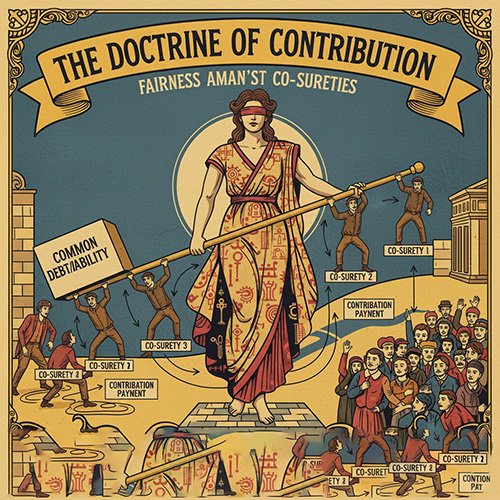
The Doctrine of Contribution refers/pertains to mortgages, where there are two or more mortgagors for the same property/properties. The doctrine of contribution is a corresponding right of the mortgagor against mortgagee's right of marshalling. Just as marshalling is an adjustment between the mortgagees, the right of contribution is an adjustment between the mortgagors. Section 82 of the T.P.Act, 1882 deals with the 'Doctrine of Contribution'. It refers to distribution of liability between/among the debtors (i.e. mortgagors). Where property subject to a mortgage belongs to two or more persons having distinct and separate rights of ownership therein, the different shares in or parts of such property owned by such persons are, in the absence of a contract to the contrary, liable to contribute ratably to the debt secured by the mortgage, and, for the purpose of determining the rate at which each such share or part shall contribute, the value thereof shall be deemed to be its value at the date of the mortgage after deduction of the amount of any other mortgage or charge to which it may have been subject on that date.
-Where, of two properties belonging to the same owner, one is mortgaged to secure one debt and then both are mortgaged to secure another debt, and the former debt is paid out of the former property, each property is, in the absence of a contract to contrary, liable to contribute ratably to the latter debt after deducting the amount of the former debt from the value of the property out of which it has been paid,
-Nothing in this section applies to a property liable under Section 81 to the claim of the subsequent mortgagee.
Amendments-
The amendment by the amending Act 20 of 1929 makes two modifications. In the first place, it covers cases not only where several properties are mortgaged but where mortgaged property is subsequently divided into shares held in severalty. And in the second place it fixes the date of the mortgage on the date at which the valuation for the purpose of contribution should be made. The words 'in the absence of a contract to the contrary' relate to a contract to which the mortgagee is a party and not to one between co-mortgagors. In the third paragraph the word 'subsequent' has been substituted for the word 'second'. This amendment is merely consequential. The Privy Council has held that the amendments are not retrospective.
Meaning-
Sometimes two or more properties separately owned by different persons are mortgaged jointly to the same mortgagee for securing a debt. In such a case, if one mortgagor repays the entire debt, the other mortgagors are released from the liability. Then the mortgagor who cleared the debt has a right to claim from other mortgagor or mortgagors from the amount paid on his /their behalf. In other words he is entitled to the right of contribution. This obligation of the mortgagor or mortgagors to repay is enshrined in the doctrine of contribution and inserted in the Section 82 of the TP Act.
Illustration-
A and B, two brothers mortgaged their joint property to C for Rs.10000/-. After the mortgage they effected a partition of the property. Each taking one half. On the failure of A and B to redeem the mortgage, C sold A's share and realized his money. A is entitled to claim contribution from B which shall be Rs.5000/-.
Incidents or Circumstances-
The doctrine applies under the following incidents or circumstances:
(1) Where the properties mortgaged belong to two or more persons; and
(2) Where the property/properties mortgaged belongs to single person.
1. Owned by two or more persons-
Where different properties are owned by two or more persons and are mortgaged jointly to the same mortgagee for securing a debt, all the mortgagors have a joint obligation to release the debt. If one Mortgagor alone releases the debt, the other mortgagors have an obligation to contribute (or repay their respective share) to the Mortgagor who cleared the debt.
Example-
Property 'X' belongs to 'A'.
Property 'Y' belongs to 'B'.
Property 'Z' belongs to 'C'.
'X' 'Y' 'Z' are mortgaged jointly by 'A' 'B' 'C' to a mortgagee for Rs.15000 and they (A B C) enjoyed the amount equally (i.e., @ Rs.5000/- each). If 'A' repays the entire debt, 'B' and 'C' have an obligation to contribute. ('B' and 'C' have to repay their respective share of Rs.5000/- each to 'A').
2. Properties owned by one person-
Out of different properties belonging to a person, one property is mortgaged to one mortgagee, and two or more properties jointly to another mortgagee, and the latter sells the mortgaged properties to others, then contribution arises between the purchasers.
Distinction between Marshalling and Contribution:
The Doctrine of Marshalling and the Doctrine of Contribution confer certain rights on the parties to the Mortgage. Both the doctrines are based on the principles of Equity. However, there are certain differences between these two doctrines. The following points draw a line between the two-
|
Doctrine of Marshalling (Section 81, T.P.Act)
|
Doctrine of Contribution (Section 82, T.P.Act)
|
|
1. It refers to Mortgagees.
|
1. It refers to Mortgagors.
|
|
2. In Marshalling, debtor (Mortgagor) is common, but Mortgagees are two or more (and different).
|
2. There are two or more Mortgagors. The Mortgagee may be one or more.
|
|
3. This doctrine settles the conflicting (competing) rights between/ among Mortgagees.
|
3. This doctrine settles the conflicting/competing interests/rights between Mortgagors or Purchasers, in case of subsequent sale.
|
|
4. In marshalling, the Creditor (Mortgagee) has an option to confine to one security leaving the other securities, where there are more than one security.
|
4. In Contribution, there is no such option. All Securities shall contribute equally.
|

we believe in a holistic approach to legal education building not just lawyers, but socially conscious leaders of tomorrow.
