DIVORCE (TALAQ)
Muslim Law
DIVORCE (TALAQ)-
Tanmoy Mukherji
[Advocate]
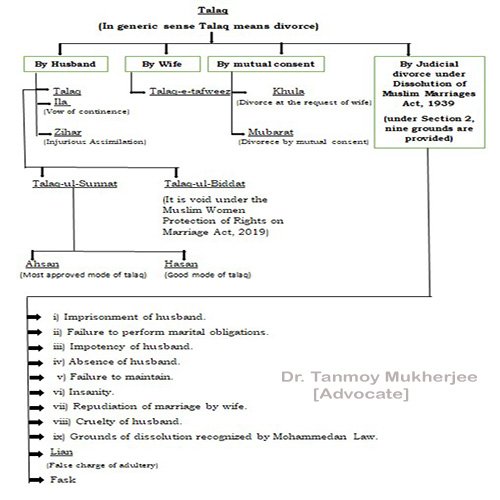
In generic sense 'talaq' means divorce but in Islamic law, it means the repudiation by or on behalf of husband.
Talaq-ul-Sunnat-
Talaq-ul-Sunnat is regulated in accordance with the traditions of prophet. It is further sub-divided into:
(i) Ahsan (Most approved mode of talaq)
(ii) Hasan (Good mode of talaq)
(i) Ahsan (Most approved mode of talaq)-
The Arabic word 'ahsan' means 'best' or as Wilson puts it, 'very proper'.
In ahsan form, the proceedings of divorce must satisfy the following conditions-
-the husband must pronounce the formula of divorce in a single sentence;
-the pronouncement of divorce must be in a state of purity (tuhr);
- (tuhr) is a period when a woman is free from her menstrual course;
-he must abstain from inter-course for the period of iddat.
Irrevocability-
Talaq ahsan becomes irrevocable on expiry of the period of iddat.
(ii) Hasan (Good mode of talaq)-
In Arabic Hasan means 'good'. Wilson translates it as 'proper'.
In Hasan form, the proceedings of divorce must satisfy the following conditions-
-there must be three successive pronouncements of the formula of divorce;
-in the case of menstruating wife, the first pronouncement should be made during a period of tuhr, the second during the next tuhr and the third during the succeeding tuhr;
-in the case of non-menstruating wife, the pronouncement should be made during the successive intervals of 30 days;
-No sexual intercourse should take place during these three periods of tuhr.
Irrevocability-
Talaq Hasan becomes irrevocable on the third pronouncement irrespective of the iddat.
Talaq-ul-Biddat (Disapproved mode of talaq)-
It is a sinful form of divorce. It is the irregular mode of talaq introduced by Omeyyads in order to escape the strictness of law.
According to section 2(c) of THE MUSLIM WOMEN PROTECTION OF RIGHTS ON MARRIAGE Act, 2019 "talaq" means talaq-e-Biddat or any other similar form of talaq having the effect of instantaneous and irrevocable divorce pronounced by a Muslim husband.
Talaq to be void and illegal-
According to section 3 of the Act, any pronouncement of talaq by a Muslim husband upon his wife, by words, either spoken or written or in electronic form or in any other manner whatsoever, shall be void and illegal.
According to section 7(a), notwithstanding anything contained in the Bharatiya Nagarik Suraksha Sanhita, 2023 an offence punishable under this Act shall be cognizable.
Ila (Vow of continence)-
Where a husband had attained majority and is of sound mind, swears by God that he will not have sexual intercourse with his wife and leaves the wife, to observe iddat, he is said to make ila.
Essentials of Ila-
-The husband must be of sound mind and must have attained majority.
-He swears by God or takes a vow.
-He swears that he will not have sexual intercourse with his wife.
-In pursuance of the vow he abstains from sexual intercourse with his wife for four months or more.
Termination of Ila:
Ila is terminated by -
-The husband resuming sexual intercourse within the period of four months, or
-A verbal retraction thereof.
Zihar (Injurious Assimilation)-
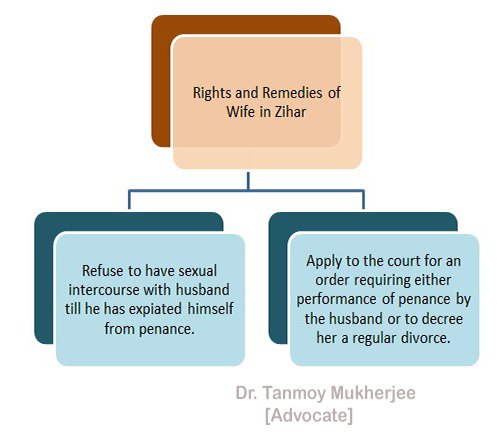
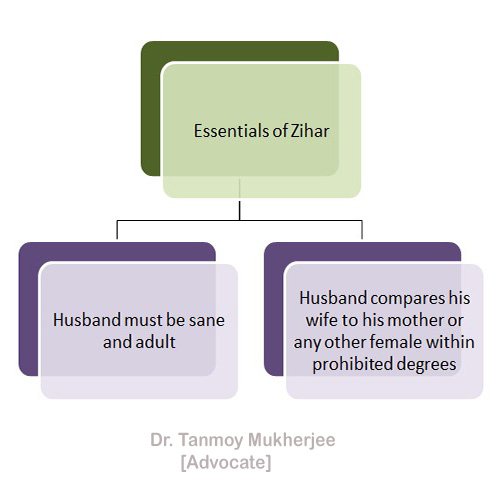
If the husband who is sane and adult compares his wife to his mother or any other female within a prohibited degree, the wife has a right to refuse herself to him until he has performed penance.
Talaq-e-tafweez:
-A husband may, either himself, repudiate his wife or delegate this power of repudiating her to a third party.
-Such delegation of power is called tafweez.
-This agreement is made either before or after the marriage.
-The wife may use this power under certain specified conditions i.e., in case the husband marries a second wife or fails to maintain her for a specific period.
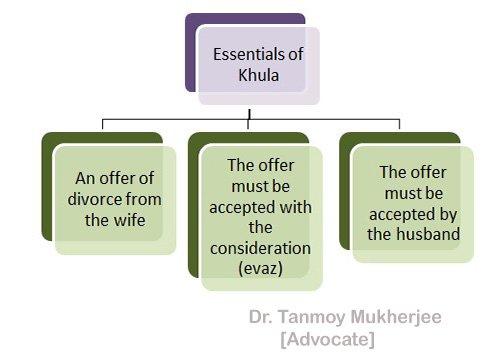
Khula (Divorce at the request of wife)-
Khula or Redemption literally means "to lay down". In law it means laying down by a husband of his right and authority over his wife.
Mubarat (Divorce by mutual agreement)-
-Mubarat signifies a mutual discharge from the marriage claims.
-The aversion is mutual and both the sides desire separation.
-The offer may be either from the side of wife or from the side of husband.
-When an offer of mubarat is accepted, it becomes an irrevocable divorce (talaq-ul-bain) and iddat is necessary.
Lian (False charge of adultery)-
Where a husband charges his wife of adultery and the charge is false the wife is entitled to sue for and obtain divorce.
Procedure-
The wife must file a regular suit for dissolution of the marriage.
Fask (Cancellation of marriage)-
Fask means the cancellation, abolishment, revocation, abrogation, annulment.
If the husband and wife both come to the conclusion that they cannot live as husband and wife, they can refer the matter to Qazi who can after careful examination terminate the marriage.
Applicability-
Before the passing of the Dissolution of Muslim Marriages Act, 1939 the Muslim ladies could only apply for the dissolution of their marriages under the doctrine of fask.
Dissolution of Muslim Marriages Act, 1939-
Section 2 of Dissolution of Muslim Marriages Act, 1939 provides nine grounds under which a Muslim wife can obtain a decree for the dissolution of her marriage.
Grounds under the Dissolution of Muslim Marriages Act, 1939-
i) Absence of Husband.
ii) Failure to maintain.
iii) Imprisonment of husband.
iv) Failure to perform marital obligations.
v) Impotency of husband.
vi) Insanity.
vii) Repudiation of marriage by wife.
viii) Cruelty of husband.
ix) Grounds of dissolution recognized by Mohammedan Law.

we believe in a holistic approach to legal education building not just lawyers, but socially conscious leaders of tomorrow.