DIFFERENCE BETWEEN WARRANTY AND GUARANTEE under Sale of Goods Act, 1930
Dr. Tanmoy Mukherji
Advocate
DIFFERENCE BETWEEN WARRANTY AND GUARANTEE under Sale of Goods Act, 1930-
Tanmoy Mukherji
Advocate
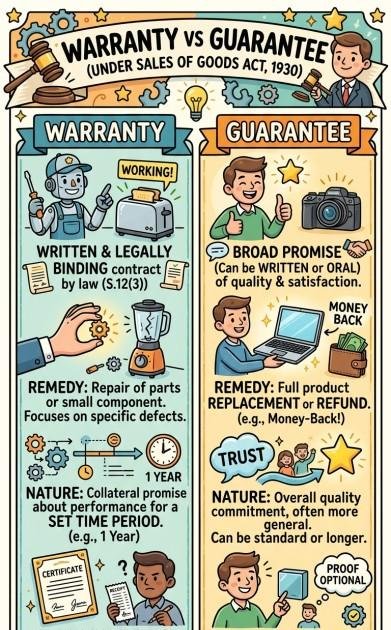
1. INTRODUCTION-
In commercial transactions, sellers or manufacturers give assurances regarding quality, performance, durability etc. of goods. These assurances are generally provided in the form of WARRANTY or GUARANTEE. Both protect consumers but differ in nature, scope, legal effect and remedies.
2. MEANING OF WARRANTY-
Definition - Section 12(3)-
"Warranty means a stipulation collateral to the main purpose of the contract."
→Warranty is a secondary promise regarding goods.
→Its breach does not destroy the contract and gives right to damages only.
FEATURES OF WARRANTY-
→Collateral stipulation
→Secondary importance
→Lesser legal effect
→Breach gives damages only
→Contract continues
→Buyer usually cannot reject goods.
EXAMPLE-
Seller promises — "Refrigerator motor will work for 5 years."
If motor fails — buyer may claim repair or damages, but cannot reject entire refrigerator.
3. MEANING OF GUARANTEE-
Meaning-
Guarantee means an assurance regarding quality, durability, performance or replacement or refund of goods.
→Guarantee is broader than warranty.
→It is more consumer-friendly.
FEATURES OF GUARANTEE-
→Assurance of quality
→Broader protection
→Replacement / refund possible
→Greater consumer rights
→Usually manufacturer-backed
→Commercial assurance
EXAMPLE-
Television sold with — "5 years replacement guarantee".
If major defect occurs — buyer may obtain replacement, refund or free servicing.
4. DIFFERENCE BETWEEN WARRANTY AND GUARANTEE-
|
Basis
|
Warranty
|
Guarantee
|
|
Meaning
|
Collateral stipulation
|
Assurance of quality/performance |
|
Nature
|
Secondary promise
|
Broader commercial assurance
|
|
Scope |
Limited
|
Wider
|
|
Legal Position
|
Recognized under Sale of Goods Act
|
Mostly commercial/consumer concept |
|
Effect of Breach
|
Damages only
|
Replacement/refund possible
|
|
Right to Reject Goods
|
Usually not allowed
|
Often allowed
|
|
Consumer Protection
|
Lesser
|
Greater
|
|
Provider
|
Seller
|
Seller / Manufacturer
|
|
Remedy
|
Repair / damages
|
Replacement / refund / repair
|
|
Duration
|
Usually, shorter
|
Often longer and broader
|
5. WARRANTY UNDER SALE OF GOODS ACT-
Section 12: The Sale of Goods Act classifies stipulations into Condition or Warranty.
Condition-
→Essential term;
→Goes to the root of the contract;
→Breach allows rejection of goods.
Warranty-
→ Collateral term;
→Subsidiary promise;
→Breach gives damages only;
→Contract continues.
EFFECT OF BREACH OF WARRANTY-

6. IMPLIED WARRANTIES UNDER SALE OF GOODS ACT-
The following implied warranties are read into every contract of sale:
Warranty of Quiet Possession: Buyer should enjoy goods peacefully without any disturbance.
Warranty Against Encumbrance: Goods should be free from any hidden charge or encumbrance.
Warranty to Disclosure: Seller must disclose all dangerous defects in goods.
EXPRESS WARRANTY
Arises when a seller expressly promises something about quality or performance.
Example: "Battery warranty for 2 years.”
IMPLIED WARRANTY
Arises automatically by law without being mentioned in the contract.
Example: Quiet possession.
CASE LAW-
Rowland v. Divall (1923) (Quiet Possession): Car sold without valid title. Held: Buyer entitled to recover money.
Clarke v. Army & Navy Co-operative Society: Disclosure of dangerous defect not made.
Held: Seller liable.
7. GUARANTEE IN COMMERCIAL PRACTICE-
Guarantee is usually more comprehensive and provides stronger protection to buyer.
TYPES OF GUARANTEES-
Replacement Guarantee: Defective goods replaced.
Money Back Guarantee: Buyer gets full or partial refund.
Performance Guarantee: Assurance regarding efficiency or performance.
Lifetime Guarantee: Protection for long duration.
Service Guarantee: Free servicing and maintenance.
8. IMPORTANT CASE LAWS-
Baldry v. Marshall (1925)
Facts: Buyer wanted a car suitable for touring. Seller recommended a particular car. Car proved unsuitable.
Held: Statement was a condition and not warranty. Buyer was entitled to reject the car.
Importance: Explains distinction between condition and warranty.
Wallis v. Pratt (1911)
Facts: Seeds were sold under a wrong description. Seeds turned out to be different.
Held: Buyer was entitled to reject the goods.
Principle: Breach of condition gives right to reject, whereas breach of warranty gives only damages.
Grant v. Australian Knitting Mills (1936)
Facts: Woollen underwear supplied caused skin disease.
Held: There was breach of implied condition and warranty that the goods were reasonably fit and safe.
Importance: Seller/manufacturer must ensure fitness and safety of goods.
Priest v. Last (1903)
Facts: Hot water bottle supplied burst and caused injury.
Held: Seller was liable for breach of implied warranty regarding safety of goods.
Principle: Goods must be reasonably fit for use.
9. RELATIONSHIP BETWEEN CONDITION, WARRANTY AND GUARANTEE-
|
CONDITION |
WARRANTY |
GUARANTEE |
|
Essential term
|
Collateral term
|
Commercial assurance
|
|
Goes to root of contract
|
Subsidiary promise
|
Wider protection
|
|
Breach allows rejection of goods
|
Breach gives damages only
|
Replacement / refund possible
|
10. CONSUMER PROTECTION ACT, 2019-
The Consumer Protection Act, 2019 provides strong protection against defective goods or deficiency in service.
CONSUMER RIGHTS-
Right to Safety-
Protection against hazardous goods.
Right to Information-
Right to get correct information.
Right to Replacement-
Right to replacement of defective goods.
Right to Refund-
Right to get money back.
Right to Compensation-
Right to claim compensation for loss.
11. EXPRESS vs IMPLIED WARRANTY-
|
Basis
|
Express Warranty
|
Implied Warranty
|
|
Creation
|
By agreement
|
By law
|
|
Mentioned in Contract
|
Yes
|
Not necessary
|
|
Arises
|
Expressly stated
|
Automatically by law
|
|
Example
|
"2-year repair warranty”
|
Quiet possession, encumbrance
|
DIFFERENCE IN REMEDY-
Warranty → Damages / Repair only
Guarantee →Replacement / Refund / Repair
12. EFFECT OF BREACH OF GUARANTEE-
Breach of Guarantee→Seller / Manufacturer liable→Repair / Replacement / Refund→Compensation may also be claimed
13. ECONOMIC IMPORTANCE-
→Builds consumer confidence.
→Encourages fair trade practice.
→Improves product quality and standards.
→Provides legal remedies to consumers.
14. MODERN COMMERCIAL PRACTICE-
Today, manufacturers provide extended warranty and extended guarantee to attract customers.
EXTENDED WARRANTY- Additional protection after normal warranty period
EXTENDED GUARANTEE- Long-term assurance including replacement or refund.
15. KEY TAKEAWAY-
→Warranty is a collateral stipulation under the Sale of Goods Act; breach gives damages only.
→Guarantee is broader and provides right to replacement, refund or repair.
→Both are important for consumer protection and commercial fairness.
16. RELEVANT STATUTORY PROVISIONS-
Sale of Goods Act, 1930-
Section 12 (Condition and Warranty)
Section 13-17 (Implied warranties)
Section 59 (Damages for breach of warranty)
17. CONCLUSION
Warranty and guarantee both provide protection to buyers, but they differ in scope and legal effect. Warranty is a collateral promise where breach gives damages only. Guarantee is broader and generally allows replacement, refund or repair. Courts have clearly distinguished between them through various judgments to ensure justice and consumer protection.

we believe in a holistic approach to legal education building not just lawyers, but socially conscious leaders of tomorrow.
