Difference between Strict Liability & Absolute Liability
Dr. Tanmoy Mukherji
Advocate
Difference between Strict Liability & Absolute Liability-
Tanmoy Mukherji
Advocate
|
Basis
|
Strict Liability
|
Absolute Liability
|
|
Origin
|
English Law
|
Indian Law
|
|
Leading Case
|
Rylands v/s Fletcher (1868)
|
M.C. Mehta vs Union of India (Oleum Gas Leak, 1987)
|
|
Meaning
|
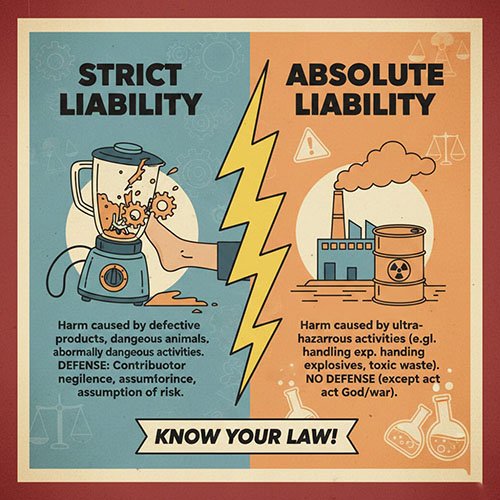
Strict Liability is a rule of tort law where a person is held liable for damage without proof of negligence or intention, but with recognized exceptions.
|
Absolute Liability is modified and strengthened version of strict liability, developed by the Indian Supreme Court.
|
|
Essentials
|
→ Dangerous thing. → Brought by the defendant. → Non-natural use of land. → Escape of the Dangerous thing. → Damage caused. → Defences available.
|
→ Hazardous or Inherently dangerous activity. → Enterprise engaged in such activity → Occurrence of harm or damage. → Nexus between Activity and Harm. → No requirement of Escape. → Compensation based on capacity of enterprise. → No defenses available.
|
|
Scope of application
|
Non Natural use of land causing damage.
|
Hazardous or Inherently dangerous Industry.
|
|
Nature of Liability
|
Limited.
|
Absolute and unlimited.
|
|
Defences
|
→ Act of God → Act of Third party → Plaintiff's own fault → Consent of plaintiff → Statutory authority |
No defenses.
|
|
Public Policy
|
Private law and remedy
|
Public interest and social justice
|
|
Compensation principle
|
Damage based compensation.
|
Compensation based on magnitude and capacity of enterprise.
|
|
Aim
|
Developed to balance- →Individual freedom of land use. →Protection of neighboring property and persons.
|
It reflects →Social justice →Environmental protection →Right to life under Art-21
|
|
Policy justification
|
→Developed for small scale risk →Allowance escape through defenses →Inadequate mass industrial harm.
|
→Industries have deep pockets. →Victims are often helpless. →Risk is created for profit. → Preventive and deterrent effect.
|
|
Important cases
|
→Ryland v/s Fletcher (1868) - Foundation case. →Read v/s Lyons (1947) - No escape - No liability.
|
→M.C. Mehta v/s Union of India (1987 Oleum Gas Leak) →Charanlal Sahu v/s Union of India (1990 - Bhopal Gas case) →Indian Council For enviro - Legal action v/s Union of India (1996 - polluter pays principle) →Vellore Citizens Welfare Forum v/s Union of India (1996) - Sustainable development.
|

we believe in a holistic approach to legal education building not just lawyers, but socially conscious leaders of tomorrow.
