DIFFERENCE BETWEEN INTERPRETATION AND CONSTRUCTION
Dr. Tanmoy Mukherji
Advocate
DIFFERENCE BETWEEN INTERPRETATION AND CONSTRUCTION –
Tanmoy Mukherji
Advocate
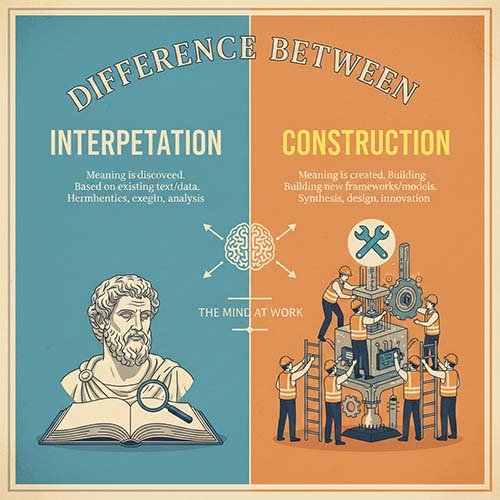
|
Basis |
INTERPRETATION |
CONSTRUCTION |
|
1. Meaning
|
Interpretation means finding the true meaning of the words used in a statute. It focuses on the literal and grammatical meaning of the text. It is used when the language is clear.
|
Construction means drawing inferences beyond the literal meaning to give effect to the intention of the legislature, especially when the language is ambiguous, vague, or silent. It is used when interpretation alone is not sufficient.
|
|
2. Purpose
|
-To understand what the law says. -To give ordinary meaning to the statute.
|
-To understand what the law intends to say, especially in complex or doubtful situations. -Helps to fill gaps, remove inconsistencies, and avoid absurd results.
|
|
3. Basis
|
Based purely on the textual meaning.
|
Based on: -Context -Purpose -Legislative intent -Consequences -Mischief rule -Equity and justice
|
|
4. Judicial Power
|
Judges cannot add, modify, or subtract words.
|
Judges may: -Add words -Supply omissions -Harmonize conflicting provisions -Extend meaning to cover legislative intent (But within reasonable limits).
|
|
5. When Used?
|
Used when: -Words are clear. -Language is unambiguous. -Meaning is straightforward.
|
Used when: -Words are ambiguous. -Two interpretations are possible. -Literal meaning leads to absurdity. -Law is silent (casus omissus).
|
|
6. Techniques Used
|
-Literal Rule. -Golden Rule (only minor modification).
|
-Harmonious construction -Beneficial construction -Purposive construction -Mischief Rule (Heydon’s Case)
|
|
7. Nature
|
Mechanical — applies strict grammatical meaning.
|
Creative and logical — court reasons to give meaning that fits the purpose of the law.
|
|
8. Related to |
Literal Rule or plain meaning rule. |
-Mischief Rule -Purposive interpretation -Golden Rule.
|
|
9. Flexibility |
More rigid, restricted to exact words. |
More flexible, seeks just and reasonable meaning. |
|
10. Aim |
Certainty and Consistency. |
To remove ambiguity, avoid absurdity and ensure justice. |
|
11. Example
|
If statute says “No vehicle allowed in the park,” A literal interpretation = all vehicles, even bicycles.
|
Court may consider purpose (public safety) and hold that → bicycles may be permitted if they pose no danger.
|

we believe in a holistic approach to legal education building not just lawyers, but socially conscious leaders of tomorrow.
